Your phone lights up on a bad afternoon. Your friend was meant to catch a train, the train left without them, and the only reply they send you is three letters: “sol”.
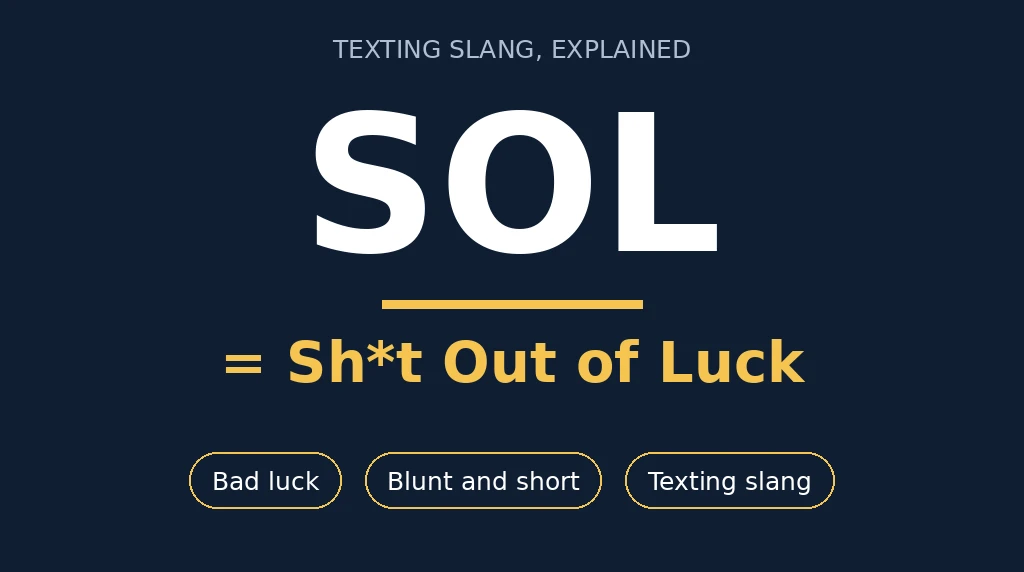
Here is the quick answer. SOL means “Sh*t Out of Luck”, a blunt way of saying someone is stuck in a bad spot with no easy way out. This guide covers the sol meaning in text, the cleaner “strictly out of luck” reading, the second meaning “Sooner or Later”, when the tone turns rude, and the best ways to reply. By the end, you will know when to laugh along, when to offer help, and when to keep the word out of your own messages.
What Does SOL Mean in Text?
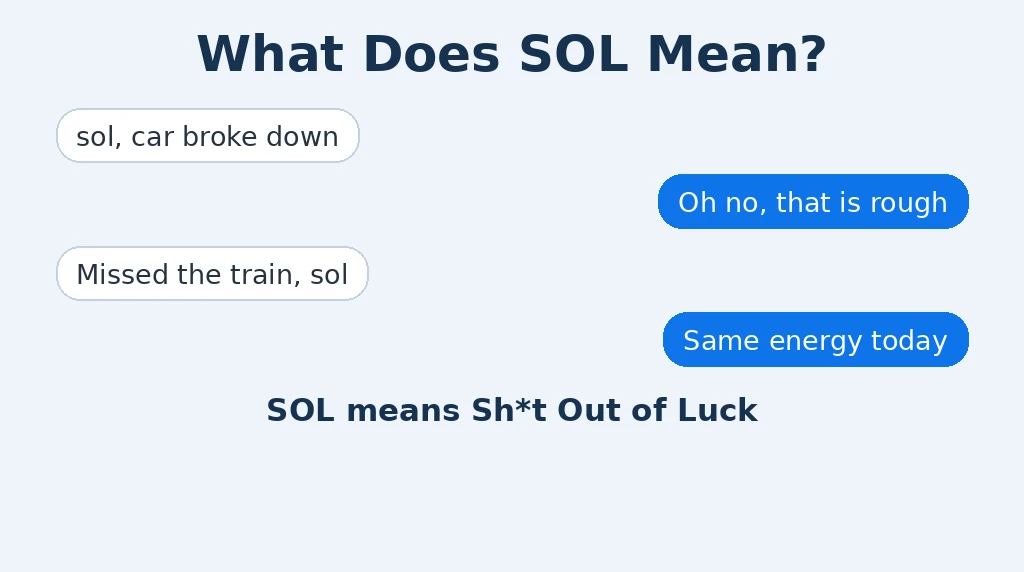
In texting, SOL means “Sh*t Out of Luck”. It is a blunt, slightly crude way of saying someone is stuck in a bad situation with no easy way out. The plan fell apart, the luck ran out, and there is no quick fix in sight. A friend who missed a flight might type “sol, missed my flight”.
The feeling behind it is frustration mixed with resignation. The person is not usually angry at anyone in particular. They are annoyed at the situation, and they have accepted, at least for now, that it went wrong. That is why SOL often comes with a laugh or a groan. It says “this is bad” and “I have to live with it” at the same time.
The tone still needs care, because one of the words inside the expansion is a swear word. Between close friends it reads as a joke or a groan. To a stranger, a coworker, or someone who prefers cleaner language, it can read as rough. Lowercase “sol” reads softer and more tired than uppercase “SOL”, which sounds louder and more dramatic. The meaning stays the same either way.
Full Form of SOL
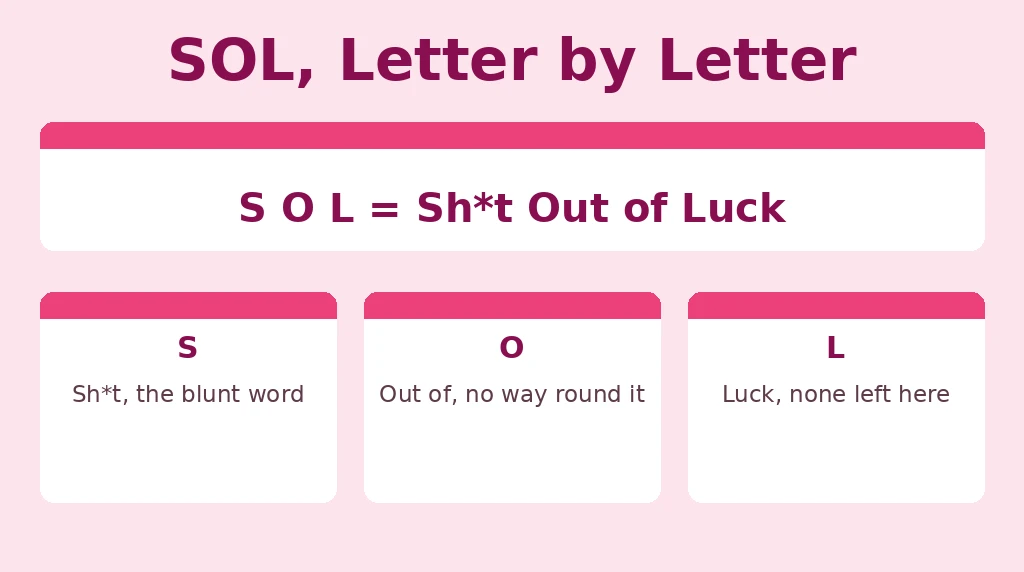
SOL stands for “Sh*t Out of Luck”. Each letter comes from one word of that phrase, and the whole thing is read letter by letter, ess-oh-el. Nobody pronounces it as a single word, and trying to do so is the fastest way to confuse the person you are talking to.
- S: from “Sh*t”, the blunt word that gives the phrase its edge
- O: from “Out”, as in out of options
- L: from “Luck”, the thing that ran out
There is also a clean version worth knowing. Dictionary.com lists “strictly out (of) luck” as an alternate reading of the same letters, and it keeps the meaning while dropping the swear word. If you are talking to someone who prefers cleaner language, the clean version does the same job without the edge.
SOL vs FML vs SMH: What Is the Difference?
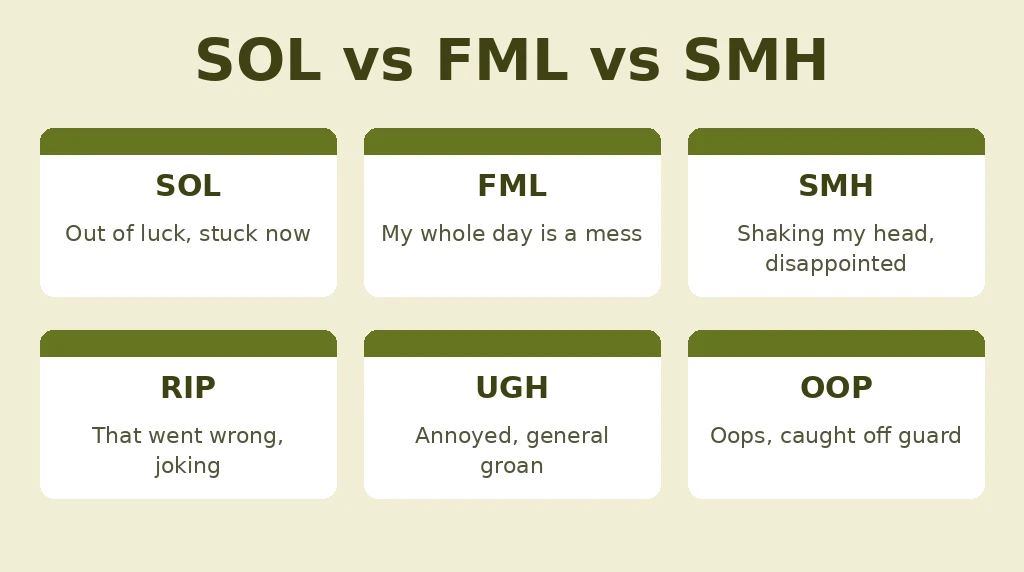
SOL looks like other short slang words, and the family members are easy to mix up at a glance. Here they are side by side.
| Abbreviation | Full Form | What It Really Says | Tone |
|---|---|---|---|
| SOL | Sh*t Out of Luck | I am stuck, no good options left | Blunt, resigned, sometimes funny |
| FML | F**k My Life | My whole day is a mess | Frustrated, dramatic, venting |
| SMH | Shaking My Head | I cannot believe that happened | Disappointed, judging |
| RIP | Rest In Peace | That went wrong, what a shame | Playful, joking about small fails |
The classic mix up is SOL versus FML, because both carry frustration and both sound dramatic. The gap is the size of the problem. SOL is narrow: one moment went wrong and there is no good option left. FML is wider: the whole day feels like a mess. If one bad thing happened, SOL fits. If everything went wrong, FML fits better.
SMH is the other common confusion, and it points in a different direction entirely. SMH means shaking my head, and it is about disappointment in someone or something. If a friend tells you their phone died, you might send smh because you cannot believe their luck. But the friend is the one who is SOL, because they are the one stuck without a phone. One word judges the situation, the other describes being stuck in it.
Where SOL Is Commonly Used
Texting and WhatsApp
In one to one chats, SOL shows up right after bad news lands. A typical line looks like this: “sol, missed my flight, next one is tomorrow.” The chat pauses while the person works out what to do next. The detail after it tells the other person how bad things really are.
Instagram and Snapchat
On Instagram and Snapchat, SOL shows up in captions and story text when a plan falls apart in public. A story captioned “sol, concert sold out in two minutes” tells every friend what happened. The replies are mostly sympathy and jokes.
TikTok Comments
On TikTok, SOL appears under clips about bad luck, failed plans, and small disasters. A viewer writes “sol, that is literally me every Monday” under a video of someone missing a bus.
Group Chats
Group chats use SOL when one person announces bad luck to everyone at once. Someone drops “sol, car broke down, I am not making dinner” and the group knows the plan has changed. Friends reply with sympathy or a joke, and the chat moves on.
Gaming Chats
Gaming chats use SOL when a match goes wrong in a way nobody could fix. A player who loses a ranked match to a disconnect might type “sol, wifi died at the worst time”. Most gamers accept it at once.
Discord and Forums
On Discord and forums, SOL shows up in status lines and short replies when someone is venting about a bad day. A user who writes “sol, failed the test by one mark” in a study server gets sympathy fast. The thread usually fills with similar stories.
Origin and History of SOL
The full phrase behind SOL goes back to American slang from at least the early 20th century, and it described someone whose luck had run out completely. It was the blunt phrase people said when a plan fell apart and nothing was left to try.
The short form came later. As texting spread in the late 1990s and early 2000s, people shortened common phrases so they could type fast on small keypads, and SOL was a natural fit. Three letters did the job of a whole sentence, so it caught on quickly.
Dictionary.com now lists SOL as slang and calls it a euphemistic initialism used to avoid explicit vulgarity, which is a careful way of saying the letters let people use a rude phrase without spelling the rude word out. That is the whole point of the abbreviation.
Other Meanings and Variations of SOL
In everyday talk, SOL almost always means “Sh*t Out of Luck”, but the same letters carry a few other readings, and some have nothing to do with texting at all.
- “Sooner or Later” as a second texting meaning: this reading is neutral and much less common, and very different in tone. It talks about timing, not bad luck. “Sol, we will meet up” means sooner or later, not out of luck.
- “Strictly out of luck” as the clean alternate: same letters, same idea, no swear word. Use this one when the chat calls for cleaner language.
- Sol as the sun: a poetic word for the sun, and the name of the Roman god who personified it. This reading shows up in books and poems, never in a text about bad luck.
- The Solana crypto token is called SOL: in crypto chats, SOL usually means the token. The topic of the chat decides.
- Standards of Learning: the school tests used in Virginia, often shortened to SOL.
- A music note: in singing, sol is the fifth tone of a scale.
- A Peruvian currency unit: the sol is the money used in Peru, so “10 soles” has nothing to do with texting.
- Lowercase sol vs uppercase SOL: the small letters feel softer and more tired, while the capitals feel firmer and more dramatic. The meaning stays the same either way.
How to Use SOL Correctly
- Use it only with people who are comfortable with blunt casual language. SOL carries a swear word inside it, so it lands best with close friends. With anyone else, the clean version is safer.
- Pair it with a brief explanation. A bare SOL leaves the other person guessing, so a few extra words like “sol, missed my flight” tell them what went wrong.
- Keep it for real bad luck, not small annoyances. If the coffee shop ran out of your usual order, that is a shrug, not an SOL. Save the word for moments when the plan truly fell apart.
- Use the clean version when you are unsure. “Strictly out of luck” says the same thing without the swear word.
- Read the mood before you send it. If the other person is upset, a kinder reply beats a joke. SOL fits a bad day, not a bad moment in someone’s life.
Example Conversations Using SOL
Missed flight
Person A: “Did you catch the 9am flight?”
Person B: “sol, missed it by five minutes”
Sold out tickets
Person A: “Did you get the concert tickets?”
Person B: “sol, sold out in two minutes”
Dead laptop
Person A: “Did you save the essay?”
Person B: “sol, laptop died before I saved it”
Rainy picnic
Person A: “Is the picnic still on?”
Person B: “sol, it is pouring, we are staying home”
Gaming loss
Person A: “What happened in the ranked match?”
Person B: “sol, wifi died at the worst time”
Car trouble
Person A: “sol, my car broke down on the way”
Person B: “oop, do you need a lift?”
The unsure one
Person A: “sol?”
Person B: “yeah, missed the bus, now I am walking”
The playful one
Person A: “sol, locked my keys in the car again”
Person B: “again? your car hates you”
When Not to Use SOL
- In a work email or message to a boss: SOL reads as crude and unprofessional, so write a plain sentence instead.
- In formal writing of any kind: essays, applications, and official messages have no room for slang with a swear word inside it.
- With people who prefer cleaner language: if someone has asked you to keep it clean, use the clean version instead.
- In serious emotional conversations: if a friend is upset or sharing bad news, SOL makes light of it, so a kinder reply is needed.
- With a teacher or an elder: using SOL with someone you should respect will sound dismissive.
- When the news is truly serious: a missed train is one thing, a real loss is another, and SOL is far too light for the second one.
How to Respond When Someone Sends You SOL
An SOL lands in your chat and the ball is suddenly in your court. The person is venting, so the best reply is usually short, warm, and honest.
Supportive replies work when someone is upset:
- “That is rough, I am sorry that happened.”
- “Ugh, that is the worst luck, are you okay?”
- “Let me know if I can help with anything.”
Lighthearted replies fit close friends, when you know the person is joking:
- “Your luck needs a day off, honestly.”
- “Classic Monday energy, even on a Thursday.”
- “Well, the story will be funny next week.”
Practical replies suit an SOL that comes with a real problem:
- “Is there another train today, or do you need a lift?”
- “Can I send you the notes, or help you redo it?”
- “Let us make a new plan, no rush.”
If the joke lands and everyone is laughing, a quick lmfao keeps the mood light. Just make sure the person is actually laughing first. One thing to avoid: do not answer an SOL with a lecture about planning better, and do not ask “why, what happened” five times in a row. Sympathy or a practical offer beats a question every time.
Common Mistakes People Make With SOL
- Using it for tiny annoyances. A late bus is annoying, a missed flight is SOL. If you use the word for every small thing, it starts sounding dramatic.
- Using it at work or in formal chats. SOL is casual slang with a swear word inside it, and in formal chats it reads as crude.
- Confusing it with “Sooner or Later”. The second meaning is real but much less common, so read the chat first. “Sol, we will meet up” is about timing, while “sol, missed the bus” is about bad luck.
- Sending it to someone who is upset. If a friend is sharing something serious, SOL makes light of their feelings, so a kinder reply is the better choice.
- Overusing it until it loses meaning. If every message is SOL, nobody can tell when your luck really ran out. Save it for the moments that deserve it.
Frequently Asked Questions
What does SOL mean in text?
SOL means “Sh*t Out of Luck.” It is a blunt, slightly crude way of saying someone is stuck in a bad situation with no easy way out, usually after a plan fell apart or their luck ran out.
Does SOL always have a crude meaning?
The main meaning carries a swear word inside it, so it always sounds blunt, even when the person means it as a joke. The clean alternate “strictly out of luck” keeps the same idea without the crude word.
What does strictly out of luck mean?
“Strictly out of luck” means the same thing as SOL: no good options are left and the situation cannot be fixed easily. Dictionary.com lists it as an alternate reading of the same letters, and it is the safer choice in polite company.
Is SOL appropriate at work?
No, it is best not to use it at work. The word inside the expansion is a swear word, so it reads as crude and unprofessional in a work email or a message to a boss. Write a plain sentence instead, such as “I missed the train, so I will be late.”
How is SOL different from FML?
SOL is narrow: one moment went wrong and there is no good option left, like a missed flight. FML is wider: the whole day feels like a mess and the person is venting about everything at once. SOL is about one unlucky moment, FML is about a whole bad day.
How do I reply when someone sends me SOL?
Keep it short and warm. A supportive reply like “That is rough, are you okay?” works in most cases, and a practical offer like “Do you need a lift?” helps when the problem is real. Do not lecture the person, and do not keep asking what happened.
Final Thoughts
SOL is a small set of letters with a clear job. In almost every chat it means “Sh*t Out of Luck”, a blunt way of saying the plan fell apart and there is no easy way out. The clean “strictly out of luck” reading does the same job without the swear word, and “Sooner or Later” is real but much less common. The letters never change, but the chat around them changes everything about how they feel.
If you want a second opinion from a dictionary source, Dictionary.com lists an entry for SOL with both the slang sense and the clean alternate. Either way, you now have the sol meaning in text down, plus a calm reply ready for the next time it shows up in your messages.
