You are scrolling through a group chat when a message pops up out of nowhere. It is just three letters, no explanation, no emoji, just “oop”. Someone sent a text to the wrong chat, or noticed an awkward silence, and those three letters are the whole reaction.
Here is the quick answer. OOP is a small surprised sound written down, like “oops” said softly when something goes slightly wrong. This guide covers the oop meaning in text, the “out of pocket” sense, OOP vs oops and whoops, where it shows up, and the best ways to reply. By the end, you will read OOP the way you hear a soft gasp in real life, fast and without a second thought.
What Does OOP Mean in Text?
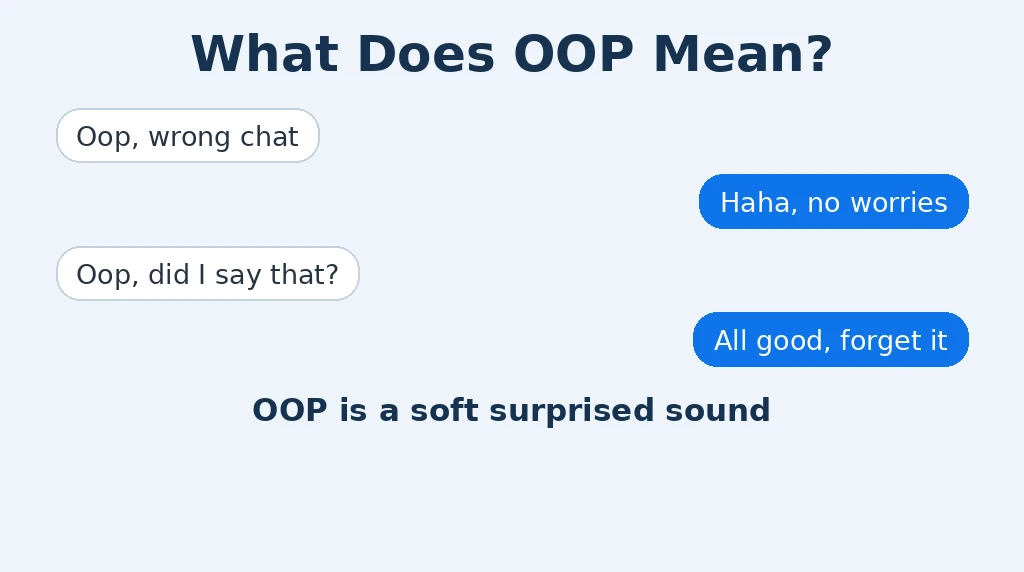
In texting, OOP is a reaction, not a word with a dictionary definition. It is the sound people make when something goes a little bit wrong, written down as three letters. A friend who sends a message to the wrong chat types “oop” the moment they notice. A person who walks into an awkward silence types “oop” to mark the moment. The letters carry the feeling of a soft gasp, surprise mixed with a little embarrassment.
The tone is mild and harmless. OOP sounds surprised or a little sheepish, never angry and never rude. It is one of the softest reactions in texting, closer to a nervous laugh than to a complaint. A person who types “oop” is usually saying, “I noticed that, and I feel a bit silly about it,” and the chat moves on without any hard feelings.
Full Form of OOP
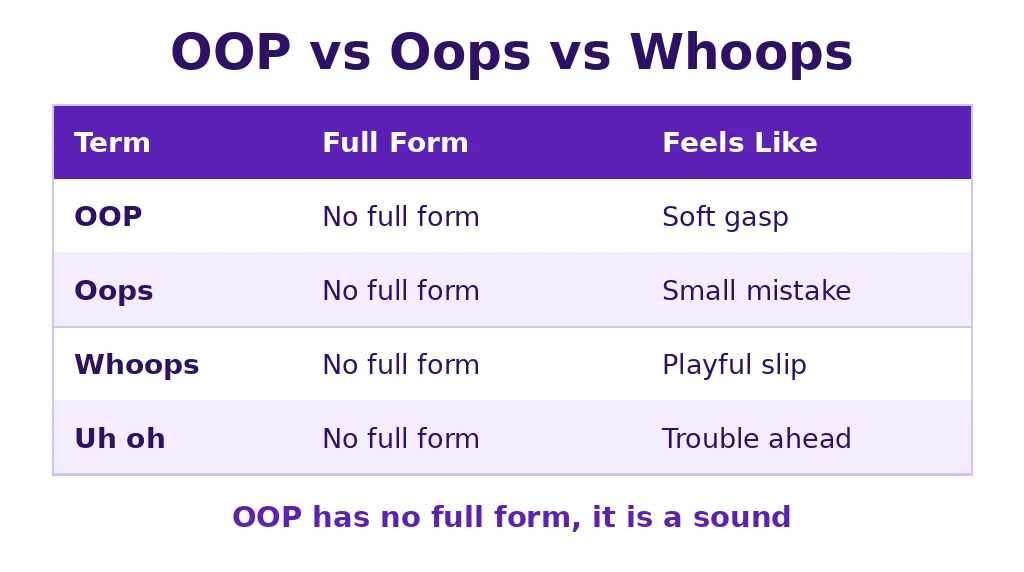
Here is the honest answer, and it matters more than it sounds: OOP has no full form. It is not an acronym, and its letters do not stand for three separate words. OOP is a spoken sound written down, the way people write “hmm” or “uh oh” when they want the reader to hear a feeling instead of reading a word.
The sound is close to “oops”, and that is the easiest way to understand it. Say “oops” out loud, then cut it short before the final “s”, and you get “oop”. The missing letter is the whole point.
This is why you will not find OOP expanded into three words in any dictionary. Dictionaries list it as an interjection, a word that expresses a feeling, the same way they list “wow” or “ouch”. If someone tells you OOP stands for a secret phrase, they are guessing. The letters are a sound, not a code.
OOP vs Oops vs Whoops: What Is the Difference?
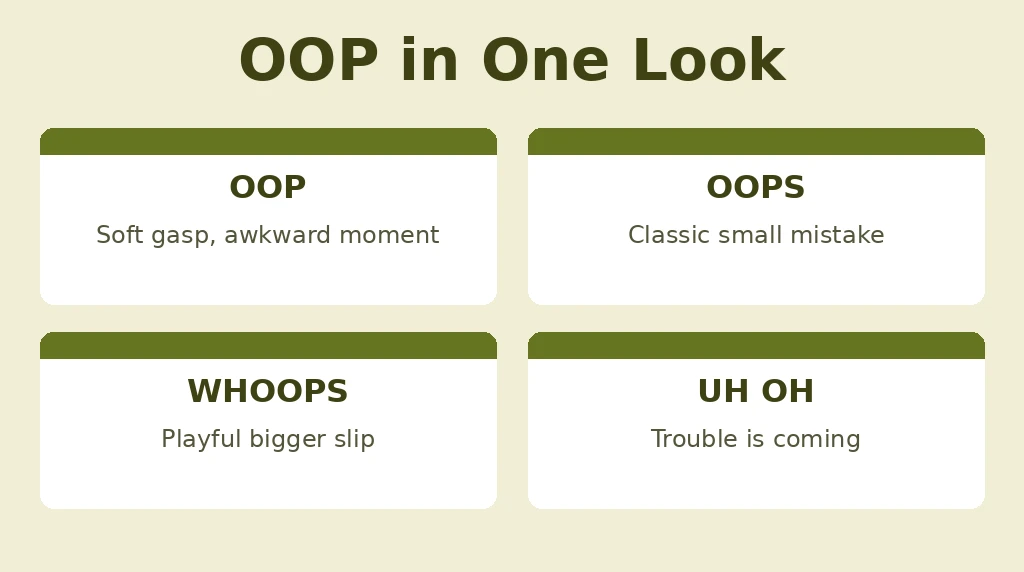
OOP belongs to a small family of short surprise words, and the family members look alike at a glance. They all react to a small slip, but they differ in how big the slip feels and how the person saying them feels about it.
| Word | Full Form | What It Really Says | Tone |
|---|---|---|---|
| OOP | None, it is a sound | A soft gasp at an awkward moment | Mild, sheepish |
| Oops | None, it is a sound | A small mistake just happened | Light, everyday |
| Whoops | None, it is a sound | A bigger slip, said with a laugh | Playful, open |
| Uh oh | None, it is a sound | Trouble is coming, watch out | Worried, alert |
The classic mix up is OOP versus oops, because the two sound almost the same. The gap is simple, though. “Oops” is the classic word for a small physical mistake, like dropping a glass or tripping on a step. OOP is softer and more social, typed when the slip is awkward, like sending a message to the wrong chat or noticing a silence you caused.
Whoops is closer to OOP in feeling, but it is louder and more playful. A person who writes “whoops” is usually laughing at their own mistake, while a person who writes “oop” is usually a little embarrassed by it.
Where OOP Is Commonly Used
Texting and WhatsApp
In one to one chats, OOP shows up the moment a small slip happens. A typical line looks like this: “Oop, wrong chat, ignore that.” Short, honest, and the chat keeps moving without any fuss.
Instagram and Snapchat
On Instagram and Snapchat, OOP shows up in replies to stories and photos. A person comments “oop” under a photo of a friend caught mid fall, and the picture beside it usually makes the meaning obvious. The tone is playful, never mean.
TikTok Comments
On TikTok, OOP appears under awkward clips and fail videos. A viewer writes “oop, that went wrong fast” and the clip itself, a small disaster caught on camera, does the explaining. The word has become a standard comment under this kind of video.
Group Chats
Group chats are the natural home of OOP. Someone sends a message meant for another chat, types “oop” a second later, and the whole group laughs. One person writes “oop, pretend you did not see that” and the answers roll in before anyone has time to write more.
Gaming Chats
Gaming chats use OOP when a player makes a small mistake mid game. A line like “oop, walked straight into that” packs a whole failed move into a few words, and the team knows exactly what happened without a long explanation.
Twitter and Threads
On Twitter and Threads, OOP shows up as a reaction to awkward public moments. A person quotes a strange post with a single “oop” and everyone reading knows the feeling. The word works as a whole reply all by itself, no extra words needed.
Origin and History of OOP
The sound behind OOP is old. People have said “oops” for a very long time, and “oop” is simply the shorter form of the same gasp. The “s” drops off when the speaker catches themselves fast, the way a gasp cuts off halfway in real life. Dictionaries list “oop” as an interjection, a word that expresses surprise, and they note “oops” as its close synonym.
Texting gave the old sound a new life. As people started chatting fast on phones, they typed the sounds they made in real life, and “oop” fit perfectly. It was short, it carried a clear feeling, and it worked as a whole message all by itself. A single “oop” could replace a whole sentence of apology, and that made it popular.
The “out of pocket” sense grew up on a separate path, in slang about behaviour. There, OOP is a true acronym, short for “out of pocket”, and it describes someone acting wild or out of line.
Other Meanings and Variations of OOP
In everyday talk, OOP almost always means the surprised sound, but the same letters carry a few other readings worth knowing, and one of them is much stronger.
- “Out of pocket” as a behaviour sense: in slang, OOP can mean “out of pocket”, which describes someone behaving wild, rude, or out of line. A comment like “that joke was out of pocket” means the joke went too far. This sense is separate from the surprised sound, and the context tells you which one fits.
- “Oop” stretched longer: people stretch the sound to show a bigger feeling, as in “ooop, that was awkward”. The longer the stretch, the bigger the gasp, and the meaning stays the same, just louder.
- OOP with an exclamation mark: adding a mark changes the energy, as in “oop!” The mark makes the gasp sound sharper and more sudden, while a plain “oop” reads calmer and more sheepish.
- OOP as a whole reply: a single “oop” can be an entire message. It needs no extra words, because the feeling is the whole message, and the reader fills in the rest from the chat around it.
How to Use OOP Correctly
- Use it for small slips, not big ones. OOP belongs in awkward little moments, a wrong chat, a typo, a caught mistake. A serious problem needs real words, not a gasp.
- Let it stand alone when it fits. A single “oop” can be the whole reply. Adding a long explanation after it takes away the charm, so keep it short when the moment is small.
- Match the feeling to the moment. OOP sounds sheepish, so use it when you feel sheepish. Using it after something genuinely funny can fall flat, because the reader expects a laugh instead.
- Save “out of pocket” for the right chat. The behaviour sense is slang about someone acting wild. Use it with friends who know the sense, never with strangers or at work.
- Do not force it outside its natural home. OOP works best when the chat already makes the feeling obvious. Dropping it into an unrelated sentence just creates confusion.
Example Conversations Using OOP
A wrong chat message
Person A: “Oop, wrong chat, ignore that”
Person B: “Haha, no worries, happens to everyone”
An awkward silence
Person A: “Oop, did I say something wrong?”
Person B: “No, you are fine, we were just quiet for a sec”
A small fail
Person A: “Oop, just dropped my phone again”
Person B: “That phone has survived so much, respect”
A TikTok comment
Person A: “Oop, that went wrong so fast”
Person B: “I watched it three times, still funny”
A gaming slip
Person A: “Oop, walked straight into the trap”
Person B: “We saw it, classic, next round”
A greeting gone wrong
Person A: “sup, oop, wrong person, sorry”
Person B: “No stress, wrong chats happen”
The out of pocket sense
Person A: “That comment he made was out of pocket”
Person B: “Yeah, way too far, someone had to say it”
When Not to Use OOP
- In a work email: using OOP instead of a plain apology can look unprofessional, even for a small slip.
- In formal writing: reports, applications, and official documents should always use full words, not reaction sounds.
- After a serious mistake: a real problem needs a real apology. A soft “oop” can sound like you do not care.
- When someone is upset: if a friend is hurt or angry, a gasp is not a reply. Answer them properly instead.
- As the “out of pocket” sense at work: calling a colleague out of pocket in a work chat can start a fight, so keep that sense for friends.
How to Respond When Someone Sends You OOP
An OOP lands in your chat and the ball is suddenly in your court. Check the moment first, then pick the lane that matches. A soft “oop” usually needs nothing more than a kind word and a quick move on.
Patient replies work when someone made a small slip and feels silly about it:
- “No worries, happens to everyone.”
- “All good, forget about it.”
- “Fair enough, no harm done.”
Helpful replies suit an OOP that needs a fix, like a message sent to the wrong chat:
- “Got it, I will just ignore that one.”
- “No stress, send it to the right chat when you can.”
Playful replies fit close friends and light topics:
- “Oop indeed, caught in the act”
- “Haha, classic, that was a good one”
One thing to avoid: do not laugh at someone who typed “oop” after a moment that clearly embarrassed them. If they typed the wrong thing, a quick nvm from them will tell you the chat has moved on, and a kind reply from you will help it move on faster. If you are confused by a bare “oop”, a simple huh asks what happened without sounding sharp.
Common Mistakes People Make With OOP
- Reading it as an acronym every time. The surprised “oop” has no full form. Only the “out of pocket” sense expands into words, so check the context before you expand it.
- Confusing OOP with oops. The two are close, but OOP is softer and more social, while “oops” fits a plain physical mistake like dropping something.
- Using it after a serious mistake. A soft gasp is not an apology. When something real went wrong, use real words.
- Using the “out of pocket” sense at work. That sense is slang about wild behaviour, and it will land badly in a professional chat.
- Assuming everyone knows it. Some people have never seen OOP in a chat. If they look confused, spell out what happened instead of laughing at them, or a simple smh from them will tell you the chat has gone wrong.
Frequently Asked Questions
What does OOP mean in text?
OOP is a small surprised sound written down, like “oops” said softly. People type it when something goes slightly wrong, when they notice an awkward moment, or when they walk into a chat they should not have joined.
Is OOP rude?
No. OOP is a mild, harmless reaction with no edge to it. It sounds surprised or a little embarrassed, never angry. It is one of the softest ways to react to a small mistake in a chat.
What is the difference between OOP and oops?
They are close cousins. “Oops” is the classic word for a small mistake, like dropping a glass. OOP is shorter and softer, often typed when the mistake is social, like sending a message to the wrong chat or noticing an awkward silence.
What does OOP mean by out of pocket?
“Out of pocket” is a separate sense of OOP. It means someone is behaving wild, rude, or out of line, as in “that comment was out of pocket.” The context tells you which sense fits, because a surprised “oop!” and a wild comment feel very different.
Can I use OOP in a work chat?
A soft “oop” is fine in a casual work chat when you make a small slip, like sending a message to the wrong channel. Skip the “out of pocket” sense at work, and skip OOP entirely in formal emails.
How do I reply when someone sends me OOP?
Keep it light. A soft “oop” usually needs nothing more than a laugh, a “haha, no worries,” or a quick fix of whatever went wrong. If they typed it after an awkward moment, a kind reply beats a joke about it.
Final Thoughts
OOP is three small letters with a very soft job. In most chats it is a surprised sound written down, a little gasp for a wrong message or an awkward moment, and it has no full form at all. In other chats it means “out of pocket”, someone behaving wild or out of line, and only the context tells you which sense you are reading. The letters never change, but the moment around them changes everything about what they mean.
If you want a second opinion from a dictionary source, Dictionary.com lists an entry for OOP. Either way, you now have the oop meaning in text down, plus a decent reply ready for the next time it shows up in your messages.
