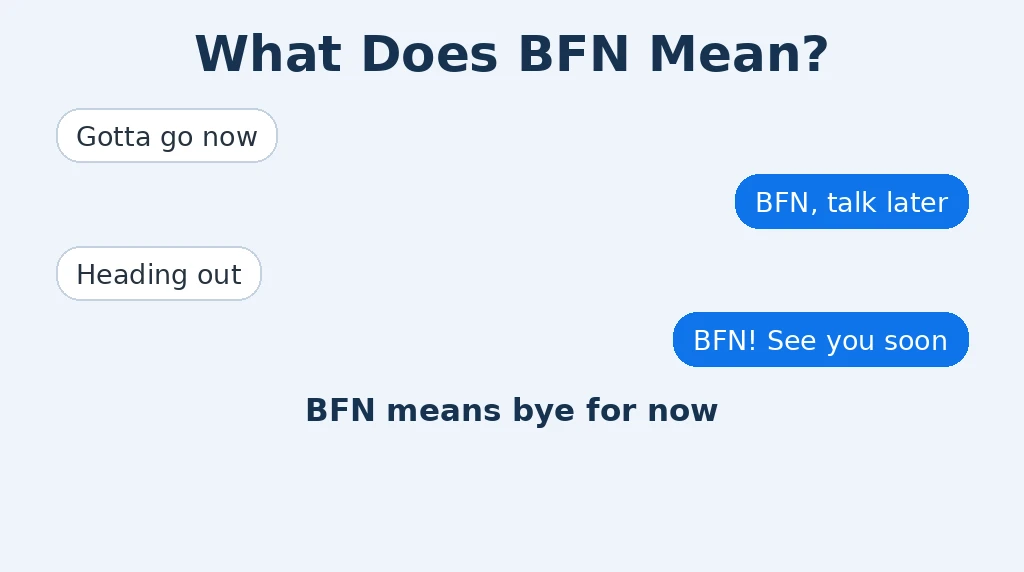
Your phone buzzes one last time and the chat ends with three letters: “BFN!” You stare at them for a second. Is that a friendly goodbye, a brush off, or a goodbye that means you will not hear from this person for a while? It looks like a code, and it definitely looks like something you should already know.
Quick answer first. BFN means “Bye for Now” in texting and on social media, a casual way to end a conversation for the moment while expecting to talk again later. This guide covers the bfn meaning in text, when it sounds warm and when it can feel cold, BFN vs TTYL and BRB, where it shows up, and the best ways to reply when it lands in your chat.
What Does BFN Mean in Text?
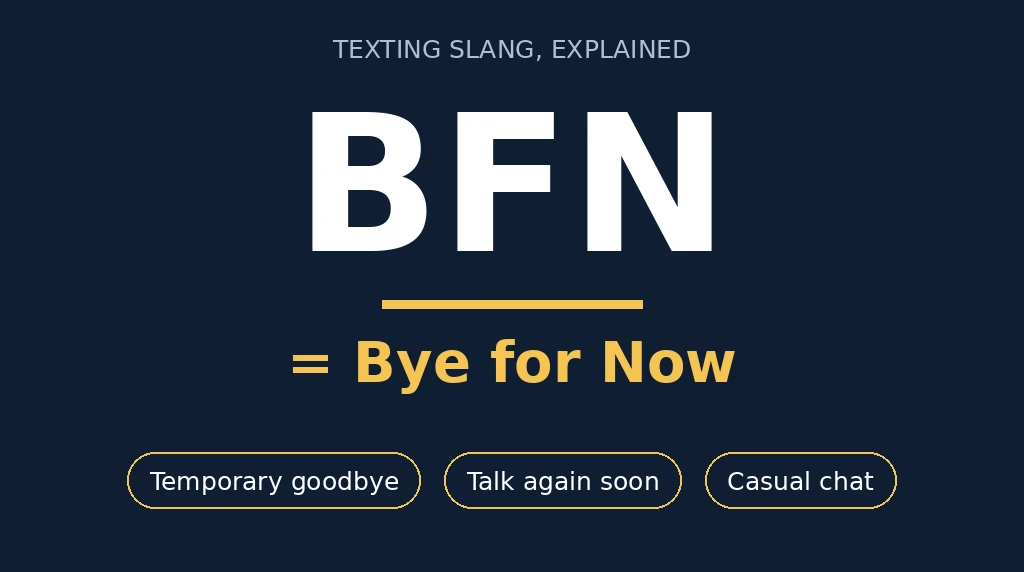
BFN is short for “Bye for Now.” People type it when they are leaving a conversation but do not want to end contact for good. It says, in three letters, “I have to go, but we will talk again.” A typical line looks like this: “I have to go now. BFN!” The sender is leaving the chat, not leaving your life.
The tone is friendly and neutral most of the time, nothing more. BFN carries no attitude on its own, and it never sounds formal, which is why it fits fast chats between friends and looks out of place in a serious message. The word “now” does the real work here. A plain “bye” can mean anything, but “bye for now” promises another conversation, and that promise is what keeps the goodbye light.
Punctuation changes the feeling more than the letters do. “BFN!” with an exclamation mark sounds cheerful and warm. “BFN.” with a full stop can feel a little flat, and after a serious or emotional chat it can even feel cold. Lowercase “bfn” is the everyday typed form, soft and casual. Read the punctuation and the message before it.
Full Form of BFN
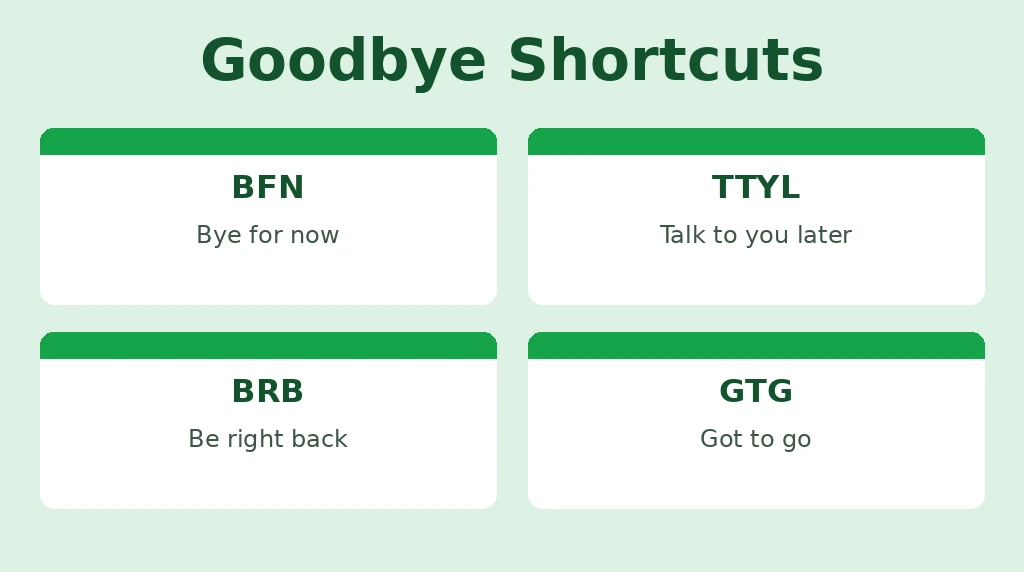
BFN is a true initialism, because it is built from the first letters of a plain English phrase:
- B: Bye
- F: For
- N: Now
Put together, you get “Bye for Now,” a temporary goodbye from the early days of instant messaging. It saves time while still saying something a plain “bye” does not, that the goodbye is only for the moment.
Say it out loud and the pattern is simple. People say the letters one at a time, bee eff en, because BFN is an initialism in speech, not a spoken word. In a real conversation people just say “bye for now” in full, and the short form belongs in typing, where every saved keystroke counts.
BFN vs TTYL vs BRB: What Is the Difference?
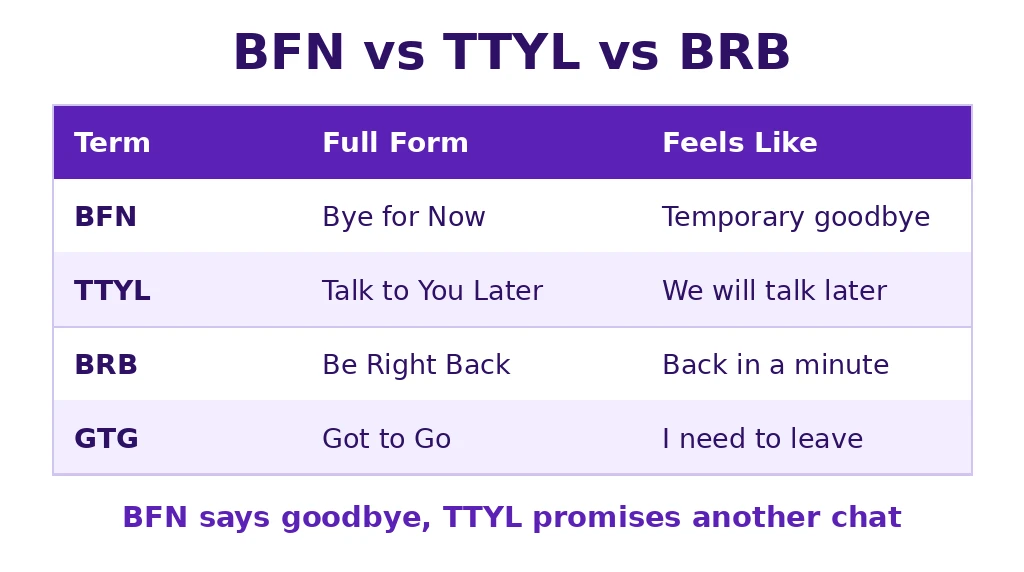
BFN belongs to a small family of goodbye shorthand, and the family members look alike at a glance. Here they are side by side.
| Abbreviation | Full Form | What It Really Says | Tone |
|---|---|---|---|
| BFN | Bye for Now | Goodbye for the moment, we will talk again | Friendly, casual |
| TTYL | Talk to You Later | We will chat again later | Friendly, casual |
| BRB | Be Right Back | I am stepping away for a minute | Casual, quick |
| GTG | Got to Go | I need to leave right now | Casual, hurried |
The classic mix up is BFN versus TTYL, because both close a chat and both promise another one. The gap is small but real. BFN focuses on the goodbye itself, the act of leaving, while TTYL focuses on the next conversation. “BFN, talk later!” covers both at once, which is why so many people pair them together without thinking about it.
BRB is different again, because it pauses a chat instead of closing it. “BRB, getting some water” means the person is coming back to the same conversation in a minute, while “BFN, I have to leave for class” means the chat is over for now. GTG is the most hurried of the four, because it explains why the person is leaving, not just that they are leaving.
Where BFN Is Commonly Used
Texting and WhatsApp
One to one chats are where BFN does most of its work, usually when someone has to leave in the middle of a conversation. It closes a plan making chat cleanly, as in “BFN, see you tdy at six.” Short, plain, and the other person knows the chat is paused, not finished.
Instagram and Snapchat
On Instagram and Snapchat, BFN shows up in DMs and quick chats, often when someone is heading out. A message like “I gotta go. BFN!” is a normal way to leave a conversation on either app. It is less common in captions, because captions are not conversations, and a goodbye needs someone to say it to.
TikTok Comments
Scroll a busy TikTok comment section and BFN pops up now and then, usually under clips about daily routines and trends. Viewers type things like “gotta go, BFN!” after watching, a quick way to leave the thread.
Group Chats
Group chats run on quick reactions, so BFN fits them well when one person has to step out. One person types “I have to study now. BFN!” and the rest of the group keeps talking without waiting for a reply. The whole group knows the goodbye is temporary, and nobody takes it personally.
Gaming Chats
In game chat there is no time for full sentences, so BFN does quick work between rounds. Players type things like “BFN, dinner time” while the lobby is still filling, and nobody stops playing to decode it. Players also drop a quick nt after a close round, a different kind of short message that praises the effort, and then BFN when they log off for the night.
Discord and Forums
Discord servers and forums use BFN the same way, just in longer threads. Someone posts a same day event or a daily update, and “BFN, talk tomorrow” is a normal reply that closes the exchange politely. In older forums and early chat rooms, BFN was far more common than it is today, which is why longtime internet users reach for it most.
Origin and History of BFN
BFN grew out of early internet chat, when instant messaging and chat rooms made short goodbyes valuable. In the late 1990s and early 2000s, people spent hours in chat rooms and on messengers like AIM and MSN, and they needed fast ways to enter and leave conversations. “Bye for now” shrank to BFN the same way “talk to you later” shrank to TTYL, and the pattern stuck because it was easy to read once you had seen it twice.
As texting took over from chat rooms, BFN carried over into SMS and then into WhatsApp, Instagram and Snapchat. It never became as common as TTYL or BRB, but it never died out either. It survived in forums, in gaming chats and in the messages of people who learned to type online in the early 2000s.
Today, BFN reads as a slightly old fashioned piece of internet slang, and that is part of its charm. When someone types it, they are usually someone who has been chatting online for a long time.
Other Meanings and Variations of BFN
In everyday talk, BFN almost always means “Bye for Now,” but the same letters carry a few other readings and a handful of close cousins worth knowing.
- Back for Now: a rare misreading from people who guess the letters instead of knowing the phrase. The standard meaning is “Bye for Now.”
- BFN as a tag: on social media, #bfn gathers farewell posts and goodbye messages under one label, so the tag works as a topic label rather than a message aimed at one person.
- Lowercase bfn vs uppercase BFN: the small letters feel softer and more casual in a sentence, while the capitals stand out in a caption. The meaning stays the same either way.
- TTYL: the closest cousin, meaning “Talk to You Later.” It promises another chat, just like BFN, but it points at the talking rather than the leaving.
- BRB and GTG: the hurried cousins. BRB means “Be Right Back” and GTG means “Got to Go.” Both explain a short absence, while BFN closes the chat for now.
- CYA: another casual goodbye, short for “See Ya.” It is warmer and more playful than BFN, and it fits the same moments.
How to Use BFN Correctly
- Use it at the end of a chat, not the middle. BFN works best as a closing line, after the real point is made. Dropping it halfway through a conversation leaves the other person wondering if you are gone.
- Add a few words when it matters. “BFN, talk later!” is far warmer than a bare “BFN” on its own. It takes only a few extra seconds to type, and it tells the other person when you will be back.
- Keep it in casual chats. BFN fits friends, family and relaxed group chats. It looks out of place in a message to a teacher, a boss or anyone you are meeting for the first time.
- Pair it with a time when you can. “BFN, see you tomorrow” settles the question of when you will talk again. A bare BFN leaves that open, and the other person has to guess.
- Skip it when the chat is serious. If someone just shared bad news or asked for real support, a quick BFN can feel like you are walking away. Answer them properly first, then close the chat gently.
Example Conversations Using BFN
Leaving for work
Person A: “Are you staying online?”
Person B: “No, I have work tomorrow. BFN!”
Ending a plan making chat
Person A: “I will send you the pictures later.”
Person B: “Okay, BFN!”
Heading out for dinner
Person A: “I have to go eat dinner.”
Person B: “No problem. BFN!”
Talking again tomorrow
Person A: “Talk to you tomorrow?”
Person B: “Definitely. BFN!”
A dying phone battery
Person A: “My battery is almost dead.”
Person B: “BFN, charge it and text me”
Study time
Person A: “I need to study.”
Person B: “Same here. BFN!”
Checking in later
Person A: “I will call you tonight.”
Person B: “Sounds good. BFN!”
The sleepy one
Person A: “BFN, talk tomorrow, I am falling asleep”
Person B: “ik, sleep well”
When Not to Use BFN
- In a work email: spelling out “I will speak with you later” takes barely any extra effort and keeps your message clear.
- In formal writing: academic papers, cover letters and official documents should always use full sentences, not chat shorthand.
- As a bare reply to a serious message: when someone shares bad news, a quick BFN can feel like you are brushing them off.
- When you are not actually leaving: typing BFN and then keeping on chatting confuses the other person, who thought the conversation was over.
- With people who do not know texting shorthand: older relatives and people outside chat culture may read BFN as a typo and answer the wrong question.
- In a first message to someone new: a goodbye before any real conversation can read as odd, so save it for chats that already exist.
How to Respond When Someone Sends You BFN
A BFN lands in your chat and the ball is suddenly in your court. The sender is leaving for now, so answer with a goodbye of your own, and pick the lane that matches the mood.
Patient replies work when the goodbye is fair and calm:
- “No worries, talk to you later.”
- “Okay, take your time, I will be here.”
- “All good, catch you tomorrow.”
Helpful replies suit a BFN that follows a plan:
- “Sounds good, I will send the pictures tonight.”
- “Okay, I will text you when I am free.”
Playful replies fit close friends and light topics:
- “BFN! Do not forget about me”
- “See you later, alligator”
- “Okay, bye for now, legend”
One thing to avoid: do not answer a BFN with a fresh question that needs a long reply, because the sender just told you they are leaving. If the question matters, save it for the next chat.
Common Mistakes People Make With BFN
- Thinking BFN means “Back for Now.” The standard texting meaning is “Bye for Now.” Reading it the other way round flips the whole message.
- Treating it as a permanent goodbye. BFN usually suggests a temporary goodbye, not a permanent ending, so do not panic when a friend types it.
- Assuming BFN is flirty or romantic. The abbreviation itself is not romantic at all. Any warmth comes from the rest of the message, like a heart emoji or a sweet line beside it.
- Using it in every professional situation. BFN is informal, and in formal communication spelling out your message is usually clearer and kinder.
- Sending a bare BFN after a serious message. Three letters alone can sound cold when someone just shared something heavy. Add one kind sentence first, then close the chat.
Frequently Asked Questions
What does BFN mean in text?
BFN means “Bye for Now” in texting and on social media. It is a casual way to end a conversation for the moment, with the sense that you will talk again later.
Is BFN rude?
Usually not. BFN is a friendly, neutral way to close a chat. It can feel a little cold if it arrives as a bare “BFN.” after a serious or emotional message, so add a kind word when the moment matters.
What is the difference between BFN and TTYL?
BFN means “Bye for Now” and focuses on the goodbye itself, while TTYL means “Talk to You Later” and focuses on the promise of another chat. They fit the same moments, but BFN closes the conversation and TTYL points at the next one.
Is BFN still used in texting?
Yes. BFN still appears in casual texts, online chats, forums and social media messages, although some people now prefer shorter closings like TTYL or BRB.
Does BFN mean goodbye forever?
No. The word “now” is the whole point. BFN says goodbye for the moment, not for good, and the sender usually expects to talk to you again soon.
How do I reply when someone sends me BFN?
Answer with another casual goodbye, like “See you later,” “Talk soon” or a simple “Bye.” If you expect to talk again soon, add when, as in “Talk tomorrow.” A bare BFN back works too, when the chat is already winding down.
Final Thoughts
BFN is one of the oldest shortcuts in internet chat, and that is exactly why it still works. It takes a polite little phrase, trims it down to three letters, and keeps the meaning clear for anyone who has seen it once. Used plainly, with a few extra words when the moment matters, it never really causes trouble.
If you want a second opinion from a dictionary source, Dictionary.com lists an entry for BFN. Either way, you now have the bfn meaning in text down, plus a decent reply ready for the next time it shows up in your messages.
