
Your phone buzzes while you are halfway out the door. A friend has texted, “free TDY?” You stare at the three letters for a second. It looks like a typo, it looks like a code, and it definitely looks like something you should already know.
Here is the quick answer. TDY means “today” in casual texting and on social media, so “free TDY?” means “are you free today?” Once you see it as a shortened spelling of a word you already use every day, it stops looking strange. This guide covers the tdy meaning in text, the one formal meaning that can trip you up, TDY vs TMRW and RN, where it shows up, and the best ways to reply when it lands in your chat.
What Does TDY Mean in Text?
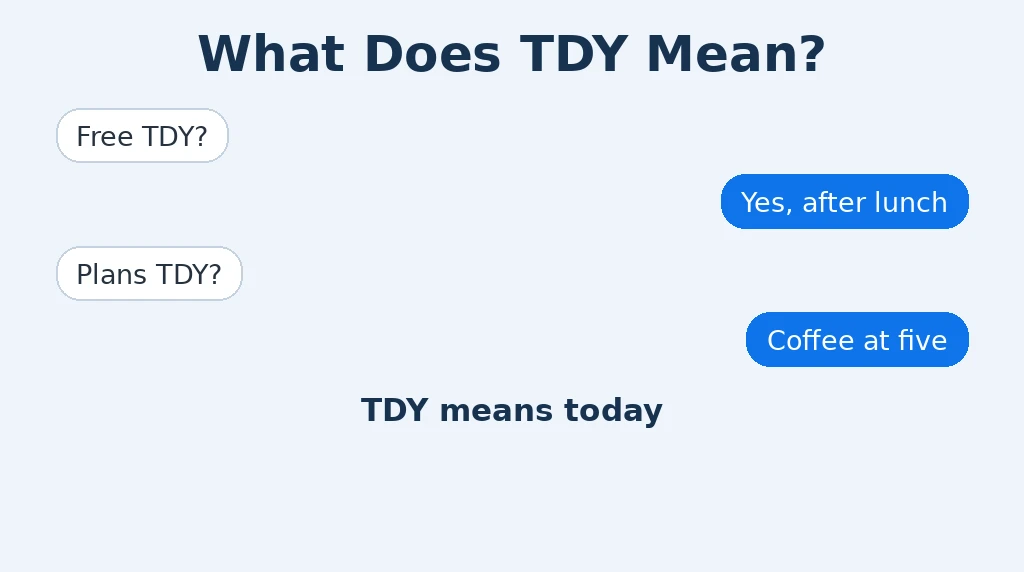
TDY is a shortened spelling of “today.” Take the word today, drop the vowels o and a, and you are left with t, d and y. People type it the same way they would type the full word, just with fewer keystrokes, so “what are we doing TDY?” means exactly the same as “what are we doing today?”
The tone is light and casual, nothing more. TDY carries no attitude on its own, and it never sounds formal, which is why it fits fast chats between friends and looks out of place in a serious message. A bare “TDY?” can sound rushed if the rest of the message is missing, so most people pair it with a few extra words, like “free TDY after six?” That small addition keeps the question friendly instead of blunt.
Lowercase “tdy” is the everyday typed form, and it blends into a casual sentence without drawing attention. Uppercase “TDY” is the form you see in captions and headlines, and it can look like a formal abbreviation, which is where the mix up with the military meaning starts. If the chat is about plans, lunch or a meetup, “today” is the right reading almost every time.
Full Form of TDY
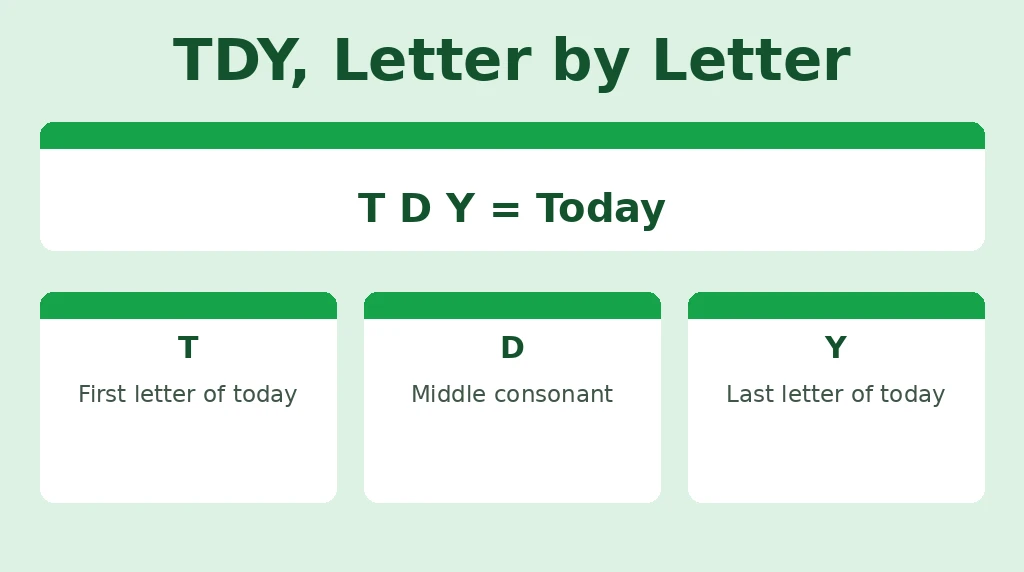
TDY is not a true acronym in its casual sense, because it does not stand for three separate words. It is a shortened spelling of one word, built by keeping the consonants and dropping the vowels:
- T: the first letter of today
- D: the consonant in the middle of today
- Y: the last letter of today
Say it out loud and the pattern is simple. People say the letters one at a time, tee dee why, because TDY is an initialism in speech even though it started as a spelling shortcut. Nobody pronounces it as a single word, and trying to do so is the fastest way to confuse the person you are talking to.
The only other full form worth knowing is “Temporary Duty,” the formal military meaning. That reading belongs to orders, travel papers and work talk, and this guide covers it separately in the variations section, because mixing the two up is the one real mistake people make with these letters.
TDY vs TMRW vs RN: What Is the Difference?
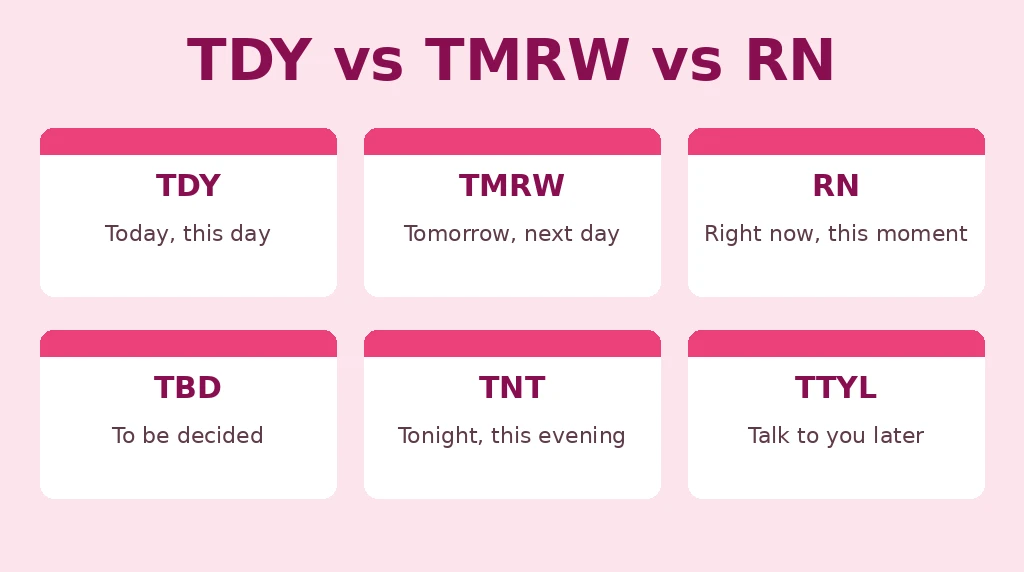
TDY belongs to a small family of time shorthand, and the family members look alike at a glance. Here they are side by side.
| Abbreviation | Full Form | What It Really Says | Tone |
|---|---|---|---|
| TDY | Today | This day, right now in the calendar | Casual, quick |
| TMRW | Tomorrow | The next day, not this one | Casual, quick |
| RN | Right Now | This exact moment | Casual, urgent |
The classic mix up is TDY versus TMRW, because both are shortened spellings of ordinary time words and both show up in plan making chats. The gap is simple, though. TDY points at this day, the one you are living in, while TMRW points at the next day. “Free TDY?” and “free TMRW?” are two different questions, and answering the wrong one can leave a friend waiting at the wrong time.
RN is different again, because it shrinks the window from a whole day to a single moment. “Busy TDY” means your day is full, while “busy RN” means you cannot talk at this exact second. And if the plan itself is still undecided, people reach for tbd, which means “to be determined” and says nothing about any day at all.
Where TDY Is Commonly Used
Texting and WhatsApp
One to one chats are where tdy does most of its work, usually when two people are sorting out same day plans. It answers “when?” fast, without making the sender type a full sentence. A typical line looks like this: “gym TDY or nah?” Short, plain, and the chat keeps moving.
Instagram and Snapchat
On Instagram and Snapchat, tdy shows up in captions, stories and quick DMs about the day in progress. A story captioned “TDY mood” is talking about how the person feels right now, not yesterday and not next week. The photo or the clip beside it usually makes the meaning obvious.
TikTok Comments
Scroll a busy TikTok comment section and tdy pops up under clips about daily routines, outfits and trends. Viewers type things like “saw this five times TDY” right after watching, a quick way to say the trend is everywhere at this moment.
Group Chats
Group chats run on quick reactions, so tdy fits them well. One person asks “anyone free TDY?” and the answers roll in before anyone has time to write more. The whole group then knows the question is about this day, not some vague future plan.
Gaming Chats
In game chat there is no time for full sentences, so tdy does quick work between rounds. Players type things like “anyone up for a match TDY?” while the lobby is still filling, and nobody stops playing to decode it.
Discord and Forums
Discord servers and forums use tdy the same way, just in longer threads. Someone posts a same day event or a daily update, and “who is in TDY?” is a normal reply that keeps the discussion going.
Origin and History of TDY
The casual meaning grew out of early mobile texting, when physical keypads made every letter cost effort and character limits made every letter cost space. People started dropping vowels from common words to save time, and words people type every day were the first to shrink. “Today” became “TDY,” “tomorrow” became “TMRW,” and the pattern stuck because it was easy to read once you had seen it twice.
As smartphones took over and Instagram, Snapchat and TikTok grew, these shortened spellings carried over into captions, comments and quick messages. The trend held on because it fits the fast, casual tone social media encourages, and because “today” is a word people need in almost every plan making chat.
The formal meaning took a separate path entirely. “Temporary Duty” has been standard military and government language for decades, describing a short work assignment away from a person’s normal post. It predates texting by a long way, and it has nothing to do with internet slang. Two histories, one set of letters, and the setting tells you which one you are reading.
Other Meanings and Variations of TDY
In everyday talk, TDY almost always means “today,” but the same letters carry one formal reading and a few edge cases worth knowing.
- Temporary Duty: in military, government and some corporate travel talk, TDY means “Temporary Duty,” a short term assignment away from a person’s usual post. If the message mentions orders, travel papers or a duty station, this is the reading that fits.
- A username or handle fragment: in rare cases TDY is just part of someone’s username or brand name rather than an abbreviation at all, so context always matters.
- Lowercase tdy vs uppercase TDY: the small letters feel softer and more casual in a sentence, while the capitals stand out in a caption. The meaning stays the same either way.
- TDY as a tag: on social media, #tdy gathers daily updates, outfit posts and same day plans under one label, so the tag works as a topic label rather than a message aimed at one person.
On social media, the tag use behaves differently from the chat use. In a DM, tdy points at this day for one person. In a hashtag, it labels a post for everyone scrolling past.
How to Use TDY Correctly
- Use it for same day plans, not vague ones. TDY works best when the plan is happening on this day. “Coffee TDY at five?” is clear, while “let us meet TDY or TMRW” just moves the confusion somewhere else.
- Pair it with a time when it matters. A bare “TDY?” can sound rushed, so add the detail that settles it. “Free TDY after six?” tells the other person exactly what you are asking.
- Keep it in casual chats. TDY fits friends, family and relaxed group chats. It looks out of place in a message to a teacher, a boss or anyone you are meeting for the first time.
- Skip it when the reader might not know it. Older relatives and people outside texting culture can read TDY as a typo. With them, spelling out “today” costs two extra seconds and saves a confused reply.
- Check the setting before you type it. In a work or military chat, TDY can be read as “Temporary Duty,” so spell out “today” there and save the shorthand for your friends.
Example Conversations Using TDY
Making plans with a friend
Person A: “Anyone free TDY? Thinking coffee later.”
Person B: “I am down, what time?”
A WhatsApp check in
Person A: “Gym TDY or nah?”
Person B: “Yes, 6 PM works for me.”
An Instagram caption
Person A: “New haircut, new mood, TDY is a good day”
Person B: “Love it, suits you so well”
A group chat
Person A: “Who is in for the match TDY?”
Person B: “idk, I might be stuck at work”
A Snapchat streak
Person A: “Nothing much happening TDY, just chilling.”
Person B: “Same here, lazy day for me too”
A TikTok comment
Person A: “This trend is everywhere TDY”
Person B: “Literally saw it five times already”
A Discord gaming chat
Person A: “Anyone up for a match TDY?”
Person B: “I am in, give me ten minutes.”
The confusing one
Person A: “My sergeant said TDY starts Monday”
Person B: “Wait, do you mean today or a duty trip?”
When Not to Use TDY
- In a work email: spelling out “today” takes barely any extra effort and keeps your message clear.
- In formal writing: academic papers, cover letters and official documents should always use the full word.
- In military or government chats: TDY already means “Temporary Duty” there, so the casual use risks a real misunderstanding.
- With people who do not know texting shorthand: they may read it as a typo and answer the wrong question.
- In serious conversations: when someone shares bad news or asks for real support, shorthand can feel like you are brushing them off.
- When the day itself is the point: if the date matters, write the full date instead of a shortcut.
How to Respond When Someone Sends You TDY
A tdy lands in your chat and the ball is suddenly in your court. The sender is almost always asking about this day, so answer the question they actually asked, and pick the lane that matches the mood.
Patient replies work when the question is fair and calm:
- “Yes, I am free after six, what did you have in mind?”
- “Not TDY, but tomorrow works for me.”
- “Fair enough, let me check and I will get back to you.”
Helpful replies suit a tdy that asks for detail:
- “I am free TDY, want to meet at five?”
- “I cannot do TDY, but I can send it over tonight.”
Playful replies fit close friends and light topics:
- “TDY? My calendar says yes, my energy says maybe”
- “Only if coffee is involved”
- “Sure, TDY is the new someday”
One thing to avoid: do not answer a plan question with a bare “yeah” and no time, because the sender still has to guess when you mean. If you typed the wrong day, send a quick nvm and restate the plan before anyone starts moving.
Common Mistakes People Make With TDY
- Assuming TDY always means “today.” In a military or work chat it can mean “Temporary Duty,” and the wrong guess can cause a real mix up.
- Mixing up TDY and TMRW. One points at this day and the other at the next day, so double check which day you mean before you send the message.
- Using it with people who do not know it. Some readers see TDY as a typo, and they may ignore the message or answer a different question.
- Dropping it into formal writing. A work email or an application with TDY in it can look careless when the full word costs nothing to type.
- Sending a bare TDY with no context. Three letters alone tell the other person the day matters, but not what you want to do with it. Add one short line about the plan.
Frequently Asked Questions
What does TDY mean in text?
TDY means “today” in casual texting and on social media. It is a shortened spelling of today, made by dropping the vowels, and people use it exactly the same way they use the full word.
Is TDY the same as TMRW?
No. TDY means today, this day, while TMRW means tomorrow, the next day. They are often used in the same plan making chats, which is why they get mixed up.
What does TDY mean in the military?
In military and government talk, TDY stands for “Temporary Duty,” a short term work assignment away from a person’s normal post. That meaning is older than the texting use and has nothing to do with it.
Is TDY rude?
No, TDY is neutral and polite. It is simply a faster way to type “today,” and it carries no attitude on its own. It can only sound blunt when it arrives with no context at all.
Can I use TDY in a work email?
It is best to avoid it. Spell out “today” in work emails and formal messages, and save TDY for casual chats with friends. In military or government work chats, avoid it entirely, because it already means something else there.
How do I reply when someone sends me TDY?
Answer the question they actually asked. If they are asking about plans, say whether you are free and suggest a time. If you are not sure which meaning they intend, ask for a quick clarification.
Final Thoughts
TDY is one of the smallest shortcuts in texting, and that is exactly why it works. It takes a word you type every day, trims it down to three letters, and keeps the meaning clear for anyone who has seen it once. Used plainly, with a time attached when the plan matters, it never really causes trouble.
If you want a second opinion from a dictionary source, Dictionary.com lists an entry for TDY. Either way, you now have the tdy meaning in text down, plus a decent reply ready for the next time it shows up in your messages.

2 thoughts on “TDY Meaning in Text: What It Means, How to Use It and How to Reply”