Your friend texts you: “can’t come bc I’m sick.” You read it twice. The reason is clear, but the shortcut is doing a lot of work for two small letters, and if you are new to texting slang, you might wonder what exactly “bc” is standing in for.
Here is the quick answer. BC means “because” in everyday texting, so “can’t come bc I’m sick” means “can’t come because I’m sick.” Once you see it as a sound shortcut for a word you already say a dozen times a day, it stops looking strange. This guide covers the bc meaning in text, the other senses you might meet, BC vs cuz and since, where it shows up, and the best replies when it lands in your chat.
What Does BC Mean in Text?
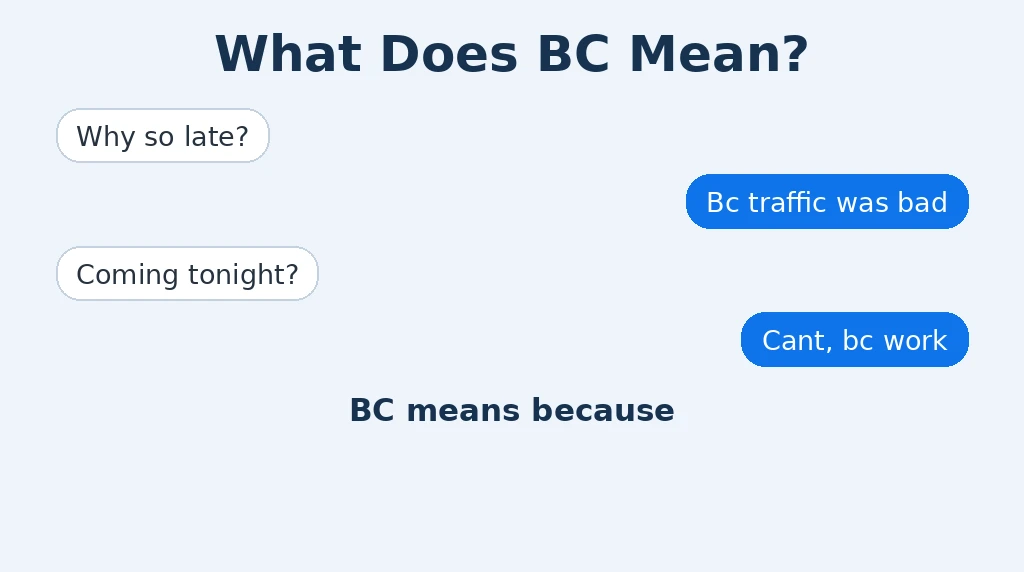
BC is a shortened form of “because.” It gives a reason fast, without making the sender type a seven letter word every time, so “I’m staying in bc it’s raining” means exactly the same as “I’m staying in because it’s raining.” Since “because” is one of the most typed words in casual conversation, cutting it down saves real time across hundreds of messages.
The tone is relaxed and matter of fact, nothing more. BC carries no attitude on its own, and it never sounds formal, which is why it fits fast chats between friends and looks out of place in a serious message. A bare “bc” on its own can sound blunt, so most people attach the reason straight after it, like “bc traffic was awful.” That small addition keeps the message friendly instead of clipped.
Lowercase “bc” is the everyday typed form, and it blends into a casual sentence without drawing attention. Uppercase “BC” is the form you see in headlines and history books, where it usually means something else entirely. If the message is giving a reason for something, “because” is the right reading, and the sentence after it almost always proves it. A bare “bc” with no reason attached can leave you guessing, much like a bare huh leaves you guessing what the other person missed.
Full Form of BC
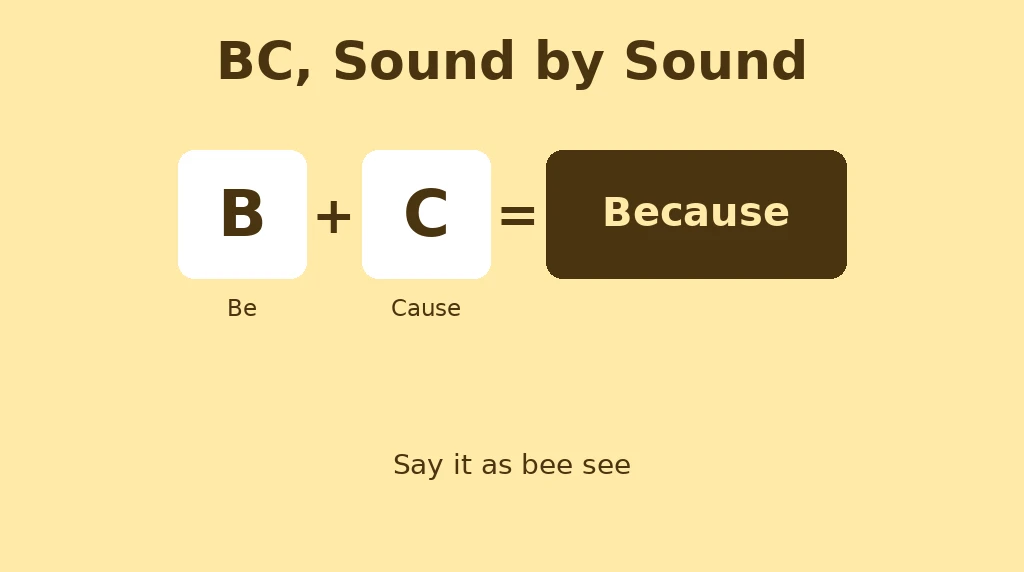
The full form is simple, because BC is built from the sounds of a single word rather than the first letters of a phrase:
- B: Be
- C: Cause
Put together, you get “be cause,” which sounds out the word “because.” Say the letters out loud and the pattern is clear. People say B C one letter at a time, bee see, because the abbreviation is an initialism, not a spoken word. In real conversation people still say the full word “because,” and the two letter form lives mostly in typing. It is a phonetic shortcut, not a set of initials, which is why it feels so natural to use.
The only other full form most people meet is “Before Christ,” the history label for years before the traditional birth of Jesus. That reading belongs to textbooks and timelines, and this guide covers it separately in the variations section, because mixing the two up is the one real mistake people make with these letters.
BC vs Cuz vs Since: What Is the Difference?
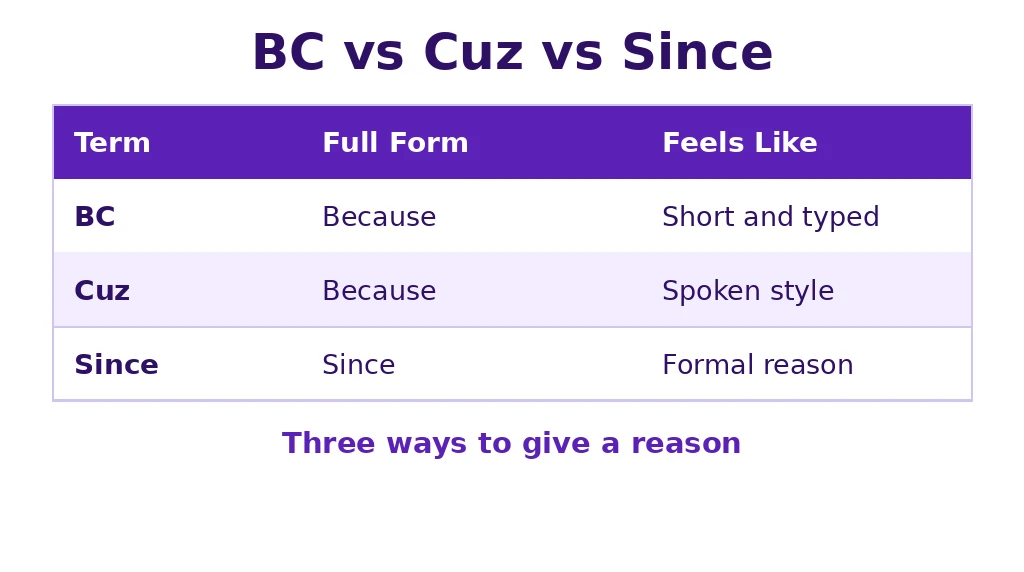
BC belongs to a small family of reason words, and the family members sound alike at a glance. Here they are side by side.
| Abbreviation | Full Form | What It Really Says | Tone |
|---|---|---|---|
| BC | Because | Here is the reason, quickly | Casual, typed |
| Cuz | Because | Here is the reason, spoken style | Casual, spoken |
| Since | Since | Here is the reason, more formal | Neutral, written |
The classic mix up is BC versus cuz, because both mean “because” and both show up in the same chats. The gap is small but real. BC is the typed shortcut, built from the sounds of the word, while cuz copies how “because” sounds when people say it fast. Most people use them interchangeably, and nobody will misunderstand you if you pick the other one.
Since is different in a useful way. It can replace “because” in a sentence, but it carries a slightly more formal tone and it shows up more in written explanations than in quick texting shorthand. Think of it as three speeds: BC is the fastest typed form, cuz is the spoken form, and since is the polished form.
Where BC Is Commonly Used
Texting and WhatsApp
One to one chats are where bc does most of its work, usually when someone is giving a quick reason for a change of plan. It answers “why?” fast, without making the sender type a full sentence. A typical line looks like this: “can’t come bc I’m still at work.” Short, plain, and the chat keeps moving.
Instagram and Snapchat
On Instagram and Snapchat, bc shows up in captions, comments and quick DMs. A caption like “late post bc I forgot to upload this” is giving a reason in passing, not starting a debate. The photo or the clip beside it usually makes the meaning obvious.
TikTok Comments
Scroll a busy TikTok comment section and bc pops up under clips where viewers are explaining a reaction. People type things like “bc it’s literally the same beat as that other song” right after watching, a quick way to give the reason behind an opinion.
Group Chats
Group chats run on quick explanations, so bc fits them well. One person asks where someone was, and “sorry, bc I had a dentist appointment” lands before anyone has time to write more. The whole group then knows the reason without a long story.
Gaming Chats
In game chat there is no time for full sentences, so bc does quick work between rounds. Players type things like “I died bc lag” while the match is still moving, and nobody stops playing to decode it.
Discord and Forums
Discord servers and forums use bc the same way, just in longer threads. Someone explains an opinion or a decision, and “I picked it bc the story is better” is a normal reply that keeps the discussion going.
Origin and History of BC
BC grew out of the SMS era of the late 1990s and early 2000s, when character limits and clunky flip phone keypads pushed people to shorten everything they could. Words people type constantly were the first to shrink, and “because” was near the top of that list, since almost every explanation in a chat starts with it. Cutting seven letters down to two saved real time on every message.
As texting grew into smartphone messaging apps, social media captions and online chat platforms, BC carried over without needing to change. It already worked perfectly as a fast way to type a common word, so it survived the move from keypads to touchscreens untouched. Over time it became so normal that it barely registers as slang anymore, and people of all ages use it in casual writing.
The history sense took a separate path entirely. “Before Christ” has labelled years in the Western calendar for centuries, long before anyone typed a text message, and the modern alternative BCE, “Before Common Era,” uses the same year numbering without the religious reference. Two histories, one set of letters, and the setting tells you which one you are reading.
Other Meanings and Variations of BC
In everyday talk, BC almost always means “because,” but the same letters carry other readings, and one of them needs a clear warning.
- Before Christ: in history and academic writing, BC means “Before Christ,” labelling years before the traditional birth of Jesus, as in “500 BC.” The modern alternative is BCE, “Before Common Era.”
- British Columbia: in Canada, BC can mean “British Columbia,” the province on the west coast. If the chat is about places, travel or Canadian news, this is the reading that fits.
- Birth Control: in health related chats, BC can be shorthand for “birth control.” The topic of the conversation makes this reading clear, and it never fits in a general chat.
- Offensive slang sense, use with care: in some South Asian online chats, BC is also used as a vulgar swear word abbreviation. It is offensive, and it can cause real offence in the wrong setting, so treat it as a warning sign, not a meaning to use. If a message gives no reason and the tone feels angry, that is the sense at play, and the safest reply is no reply at all.
- BC as a tag: on social media, #bc gathers history posts, travel photos from British Columbia and casual captions under one label, so the tag works as a topic label rather than a message aimed at one person.
On social media, the tag use behaves differently from the chat use. In a DM, bc gives a reason for one person. In a hashtag, it labels a post for everyone scrolling past.
How to Use BC Correctly
- Use it to give a reason, not to open a chat. BC works best right after someone asks why. Starting a chat with it out of nowhere leaves the other person guessing what you mean.
- Keep the reason short and clear. “Can’t come bc I’m sick” is far clearer than a bare “bc” on its own, and it takes only a few extra seconds to type.
- Keep it lowercase in casual chats. Lowercase “bc” blends into a sentence, while uppercase “BC” can look like the history label or a place name.
- Match it to the setting. BC fits friends, family and relaxed group chats. It looks out of place in a message to a teacher, a boss or anyone you are meeting for the first time.
- Do not stack it with other shortcuts. One “bc” in a sentence reads fine, but a message full of abbreviations gets hard to read fast. Spell out the rest of the sentence and let bc do one job.
Example Conversations Using BC
A cancelled plan
Person A: “You coming tonight?”
Person B: “Can’t, bc I’m still at work”
An Instagram comment
Person A: “Why did you delete the last post?”
Person B: “Took it down bc the lighting was bad”
A Snapchat caption
Person A: “Late night drive bc I couldn’t sleep”
Person B: “Same, my brain will not switch off”
A TikTok comment
Person A: “Why does this sound so familiar?”
Person B: “Bc it’s literally the same beat as that other song”
A gaming chat
Person A: “Why did you disconnect?”
Person B: “Bc my wifi died mid game”
A group chat
Person A: “Where were you today? Missed you at lunch”
Person B: “Sorry, bc I had a dentist appointment”
The confused friend
Person A: “He just texted ‘bc’ with no reason at all”
Person B: “idk, ask him what he meant”
Running late
Person A: “Running late bc traffic”
Person B: “nvm, take your time, we will start without you”
When Not to Use BC
- In a work email: spelling out “because” is expected, even in casual internal emails.
- In formal writing: academic papers, cover letters and official documents should always use the full word.
- With people you do not know well: a landlord, a doctor’s office or customer service deserves the full word, not a shortcut.
- When the reason matters a lot: if the explanation is important or sensitive, spelling it out fully avoids any chance of the message feeling rushed.
- As an insult or an angry outburst: the offensive sense of BC has no place in any chat, and using it can cause real offence.
- When the reader might read the history sense: in a history or school chat, a bare BC can be read as “Before Christ,” so spell out “because” there.
How to Respond When Someone Sends You BC
A bc lands in your chat and the ball is suddenly in your court. The sender is giving you a reason, so acknowledge it and move the conversation forward, picking the lane that matches the mood.
Patient replies work when the reason is fair and calm:
- “Ohh okay, that makes sense.”
- “No worries, take your time.”
- “Fair enough, let me know when you are free.”
Helpful replies suit a bc that asks for a follow up:
- “Got it, I will send the notes over so you can catch up.”
- “No problem, next time then.”
Playful replies fit close friends and light topics:
- “Classic, bc life always has other plans”
- “Relatable, my day went the same way”
- “Okay, but the traffic excuse only works once”
One thing to avoid: do not argue with the reason before you have even heard the full story. A quick “okay, got it” keeps the chat friendly, and you can ask for details later if you need them.
Common Mistakes People Make With BC
- Reading every BC as “because.” In a history chat it means “Before Christ,” and in a Canada chat it means “British Columbia.” Read the sentence first.
- Using it in formal writing. BC slips into work emails because it feels automatic, but the full word “because” costs nothing to type and reads far better.
- Sending a bare bc with no reason. Two letters alone tell the other person a reason exists, but not what it is. Add the reason in the same message.
- Overusing it in long sentences. Stacking BC with other abbreviations in every sentence can make a message harder to read, not faster.
- Treating BC and cuz as formal words. Both are casual shorthand, and neither belongs in a formal message, even though both mean exactly the same thing.
Frequently Asked Questions
What does BC mean in a text message?
In most everyday texting, BC means “because,” used to give a quick reason for something. “I left early bc I was tired” means “I left early because I was tired.”
Is BC the same as cuz?
They are very similar and often used interchangeably. BC is a short typed form of “because,” while cuz copies how the word sounds when people say it fast.
Can BC mean something else?
Yes. In history it means “Before Christ,” in Canada it can mean “British Columbia,” and in health chats it can mean “birth control.” In casual texting, though, “because” is by far the most common reading.
Is it okay to use BC in a work email?
It is best to avoid it. Professional and formal communication should always spell out “because” in full.
Does BC mean the same thing on every platform?
Yes, the core meaning stays the same whether it is in a text message, an Instagram comment, a gaming chat or a TikTok reply. The reason giving job of BC does not change from app to app.
How do I reply when someone sends me BC?
Acknowledge the reason they gave, then move on. “Ohh okay, that makes sense” works for most chats, and “no worries, next time then” fits when they are cancelling plans.
Final Thoughts
BC is one of the most useful shortcuts in texting, and that is exactly why it works. It takes a word you type in almost every conversation, trims it down to two letters, and keeps the meaning clear for anyone who has seen it once. Used plainly, with the reason attached, it never really causes trouble.
If you want a second opinion from a dictionary source, Dictionary.com lists an entry for BC. Either way, you now have the bc meaning in text down, plus a decent reply ready for the next time it shows up in your messages.
