Your friend texts you after a wild play: “that mf is unreal.” You stare at the two letters and wonder if that is a compliment or an insult. You are not the only one who has paused on it.
Here is the short answer first. MF is short for “motherfucker,” a vulgar slang word that people online use as an intensifier, a tease, or an insult, depending on the tone and the room. Among close friends it is often playful, even affectionate, while in a work chat or a family group it lands as plain rude. This guide covers the mf meaning in text, the tone traps, MF vs WTF vs LOL, where it shows up, and the best replies when it lands in your chat.
What Does MF Mean in Text?
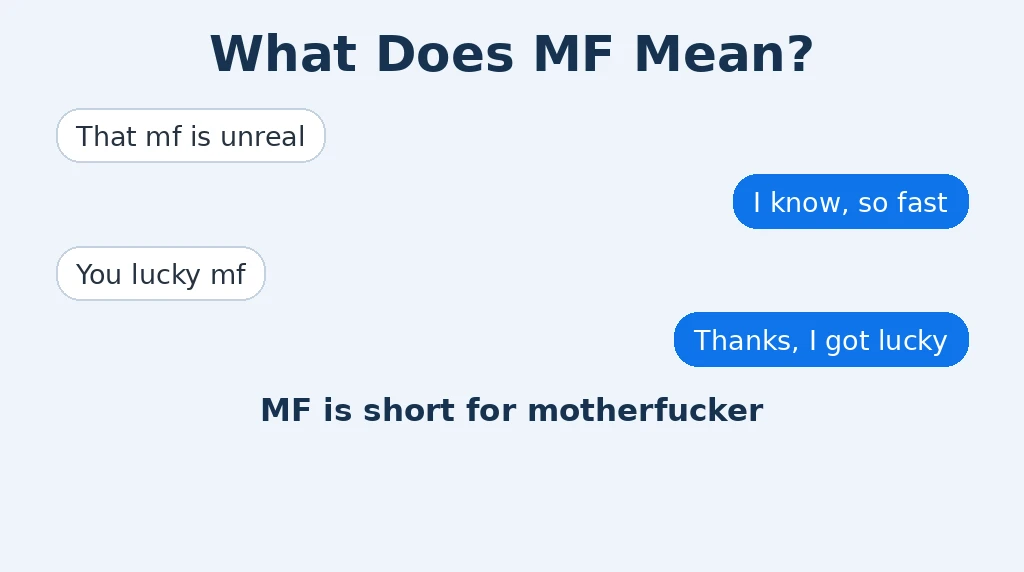
MF is the shortened form of “motherfucker.” It is a swear word, and Wiktionary lists it plainly as a vulgar slang initialism of that word. Online, people use it to describe a person or a thing with extra force. “That mf is fast” does not really say anything bad about the person, it just adds punch to “he is fast.”
The tone almost always depends on context, and this is the part people get wrong. Said with excitement, it is hype. Said with anger, it is an insult. Said between close friends, it is often just a joke. Meanzafy notes that most online use is playful, exaggerated, or affectionate rather than negative.
It sits close to a plain huh in one way: both can leave you guessing when they arrive with no context. A huh says “I did not follow that,” while a bare MF expects you to know the sender’s mood already. Lowercase “mf” reads softer and more relaxed, the everyday typed form between friends. Uppercase “MF” with an exclamation mark reads louder and angrier, so caps and punctuation change the feeling fast.
One honest warning helps here. Never assume MF is playful just because you have seen it used as a joke. If the sender is angry, or if you do not know them well, it is an insult, and treating it as a joke will only make things worse. When in doubt, read the message before it. That line almost always settles the mood.
Full Form of MF
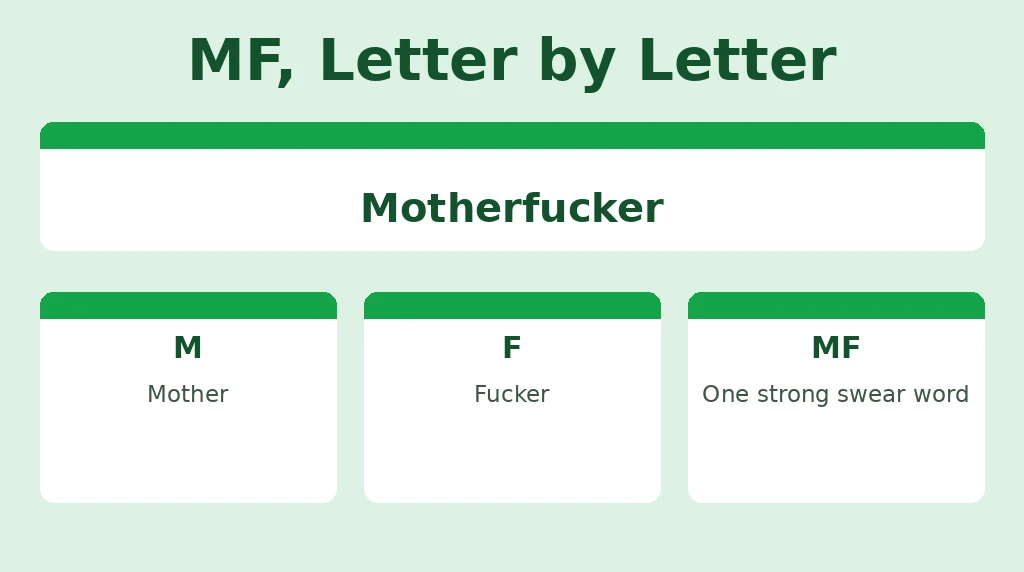
The full form is simple, because MF is built from the first letters of one compound swear word:
- M: Mother
- F: Fucker
Put together, you get “motherfucker.” That is the reading almost everyone means, and it is the one Wiktionary gives as the entry for MF. Meanzafy calls it the slang shortening of a well-known curse word combo, used super casually online, and that matches how it actually appears in chats.
Say the letters out loud and the pattern is clear. People say M F one letter at a time, em eff, because the abbreviation is an initialism, not a spoken word. In real conversation people usually say the full word, or they skip it entirely and use a cleaner word instead. The short form works in typing, where it looks softer than the full word even though everyone knows exactly what it means.
There is also an adjective form worth knowing. “Motherfucking” works before a noun for emphasis, as in “that motherfucking traffic jam.” Wiktionary lists it as a variant of the same word.
MF vs WTF vs LOL: What Is the Difference?

Three short forms that all live in fast chats, so here they are side by side.
| Abbreviation | Full Form | What It Really Says | Tone |
|---|---|---|---|
| MF | Motherfucker | Names a person or thing with force | Playful or angry, depends on tone |
| WTF | What the Fuck | Reacts to shocking or confusing news | Shocked, confused |
| LOL | Laughing Out Loud | Says something is funny | Light, amused |
The classic mix up is MF versus WTF, because both carry the same swear word at their core. The gap is real, though. WTF reacts to a moment, as in “WTF just happened,” while MF reacts to a person or a thing, as in “that mf is unreal.” One asks a question about the news, the other points at someone with emphasis.
LOL is the odd one out in a useful way. It is clean, it is safe, and it fits almost every casual chat. Think of it as three levels: LOL laughs at something, WTF stares at something in shock, and MF adds force to a person or a thing, for praise or for anger.
Where MF Is Commonly Used
Texting and WhatsApp
One to one chats are where mf shows up most, usually between close friends who already trust each other. It teases, it hypes, and it reacts to something unexpected without a long sentence. A typical line looks like this: “You lucky mf, I cannot believe you won.” Short, warm, and the chat keeps moving.
Instagram and Snapchat
On Instagram and Snapchat, mf appears in DMs, captions, and comments about funny or impressive posts. A comment like “this mf really thought no one was watching” reacts to a video with humour, not hate.
TikTok Comments
Scroll a busy TikTok comment section and mf pops up under clips of wild moments and bold claims. Viewers type things like “this mf never misses” right after a great play, a quick way to praise someone without writing a paragraph.
Group Chats
Group chats run on quick reactions, so mf fits them well. One friend shares good news, and someone replies “shut up you lucky mf” before anyone has time to write more.
Gaming Chats
In game chat there is no time for full sentences, so mf does quick work between rounds. Players type things like “that mf just clutched the round” to hype a teammate, or “that mf camped the whole match” to rage at an opponent.
Discord and Forums
Discord servers and forums use mf the same way, just in longer threads. Someone tells a wild story, and “the mf actually said that to your face” is a normal reply that keeps the discussion going.
Origin and History of MF
The full word behind MF has been part of English slang for decades, long before texting even existed. It gained massive popularity through music, movies, and comedy, especially hip hop culture, stand up comedy, and action films from the late 20th century, where it worked as an all purpose intensifier, insult, or exclamation. It was already a familiar word before anyone shortened it.
When texting and instant messaging became mainstream in the early 2000s, people naturally started shortening longer or spicier words to save time and character space. MF became a convenient shorthand, quick to type, instantly recognisable, and slightly less loud looking than spelling the whole word out.
As social media exploded in the 2010s, MF carried over into comments, captions, and memes. Its use grew further because so many platforms run content filters that flag full profanity, and the abbreviation lets people express the same feeling without tripping those filters.
Other Meanings and Variations of MF
In everyday talk, MF almost always means the slang word above, but the same letters carry other readings, and a few of them are easy to miss if you only know the main one.
- Motherfucking: the adjective form of the same word, used before a noun for emphasis, as in “that motherfucking traffic jam.” Wiktionary lists it as a variant, and it carries the same profanity.
- Mezzo forte: in music, mf is a written instruction meaning moderately loud. Musicians see it printed in sheet music, and it has nothing to do with slang. If you see mf on a score, it means play at a medium volume.
- My friend: in a few small circles, MF is used rarely as a shorthand for “my friend,” though this is far less common than the profanity meaning and usually needs extra context to be understood correctly.
- MF as a tag: on social media, #mf gathers posts, memes, and clips under one label, so the tag works as a topic label rather than a message aimed at one person. In a caption, it often adds attitude to a post for everyone scrolling past.
- Initials and usernames: in some cases, MF might just be someone’s initials, a brand abbreviation, or a username, so context always matters before assuming the slang meaning.
How to Use MF Correctly
- Match the energy of the conversation. If your friends are already using casual language and dropping slang, MF will blend in naturally. If the chat is calm or serious, it will feel out of place, so read the room first.
- Use it for emphasis, not just as filler. The best use of MF is when you want to add punch to a sentence. “That mf really did that” hits differently than just saying “he really did that,” and the extra force is the whole point.
- Know your audience. MF works with close friends, gaming buddies, and casual online communities. It is not something you use with your boss, a teacher, or someone you just met in a professional setting.
- Watch the punctuation and caps. Typing “MF” in all caps with exclamation marks reads as more intense or angry, while lowercase “mf” tends to feel more relaxed and joking. The same letters, typed differently, send a different message.
- Consider the platform. Some platforms are stricter about language than others, so what flies in a private group chat might get flagged or hidden in a public comment section.
Example Conversations Using MF
Gaming chat, hype
Person A: “yo did you see that shot?”
Person B: “that mf has aimbot, no way”
Group text, teasing a friend
Person A: “I got the promotion!”
Person B: “shut up you lucky mf, well done”
Instagram comment, reacting to a funny video
Person A: “this mf really thought no one was watching”
Person B: “I am crying, he had no idea”
TikTok caption
Person A: “when the mf in front of you brakes for no reason”
Person B: “every single morning, I swear”
WhatsApp chat, friendly banter
Person A: “I ate the last slice of pizza”
Person B: “you are such an mf, I was saving that”
A Discord server, gaming rage
Person A: “bro that mf camped the whole match”
Person B: “no skill at all, just waiting in a corner”
A live stream chat
Person A: “LOL that mf just fell off the map”
Person B: “clip it, that was too funny”
The confused one
Person A: “he just texted me ‘mf’ with no context”
Person B: “idk, ask him what he means before you reply”
When Not to Use MF
- Work emails or workplace chats: even casual work channels expect a certain level of professionalism, and dropping MF could cost you respect or a client.
- Job interviews and applications: even over chat, profanity can look careless when a clean sentence costs nothing to type.
- Teachers and bosses: anyone grading or managing you deserves clean language, not a burst of slang that reads as rude.
- Family groups: parents, grandparents, and younger cousins share these chats, and MF can offend people who never expected it there.
- Serious conversations: when someone shares bad news or asks for real support, a swear word reply can feel like you are brushing them off.
- With strangers or new people: you do not know their limits yet, and MF can land as an insult when you meant it as a joke.
How to Respond When Someone Sends You MF
An mf lands in your chat and the ball is suddenly in your court. The sender usually means it playfully, so answer the feeling behind it, and pick the lane that matches the mood. If it was clearly a joke, a quick “nvm, I know you were joking” keeps things light and moves the chat on.
Patient replies work when the message sounds angry or the tone is unclear:
- “Hey, what happened? Talk to me.”
- “I get it, that sounds really frustrating.”
- “Take your time, I am here when you want to talk.”
Helpful replies suit an mf that asks for a reaction or a plan:
- “That is wild, tell me the full story.”
- “Okay, what do you want to do about it?”
Playful replies fit close friends and light topics:
- “Says you, you lucky mf”
- “I know, I know, I am unreal like that”
- “Okay, calm down, superstar”
One thing to avoid: do not fire back a harsher insult when the mf was a joke between friends. It turns a laugh into a fight in one message.
Common Mistakes People Make With MF
- Assuming every MF is an insult. Among close friends it is often praise or a joke. Read the tone before you take offence, or you will start a fight over a compliment.
- Using it at work or school. MF is profanity, even shortened, and a screenshot can follow you. Keep it in private chats with close friends only.
- Typing it in all caps when you mean it lightly. “MF!” reads as anger, while “mf” reads as relaxed. The caps change the message, so type it the way you mean it.
- Using it with strangers. A new person has no reason to know you mean it playfully, and they will often read it as an insult. Earn the trust first.
- Forgetting the music meaning. On sheet music, mf means mezzo forte, moderately loud, not slang. In a music chat, the letters may have nothing to do with swearing at all.
Frequently Asked Questions
What does MF mean in text?
MF is short for “motherfucker,” a vulgar slang word used online as an intensifier, a tease, or an insult. The tone and the room decide which one it is.
Is MF rude?
It can be. Among close friends it is often playful, even affectionate, but in work, school, or family chats it reads as rude and offensive, so the setting decides.
What is the difference between MF and WTF?
WTF means “what the fuck” and reacts to shocking or confusing news, while MF names a person or a thing with extra force. WTF reacts to a moment, MF reacts to someone.
What does MF mean in music?
In sheet music, mf means “mezzo forte,” or moderately loud. In rap and hip hop lyrics, it usually carries the slang sense instead.
Can I use MF in a work email?
No. It is profanity, and even the shortened two letter form can offend a colleague or a client. Write the plain sentence instead and leave the slang out.
How do I reply when someone sends me MF?
Match their tone. Laugh along if it is a joke between friends, ask what happened if it sounds angry, and say plainly that it makes you uncomfortable if it does.
Final Thoughts
Two letters, a lot of attitude, and the wrong guess can change the whole chat. MF is first and foremost a shortened swear word, and it has earned its place in everyday online talk because everyone meets moments that call for extra force, whether that is hype for a friend or anger at a stranger. Used plainly, with close friends, it rarely causes trouble.
If you want a second opinion from a dictionary source, Dictionary.com lists an entry for MF, giving the slang meaning behind the letters. Either way, you now have the mf meaning in text down, plus a decent reply ready for the next time it shows up in your messages.
