Your friend texts you about the plan you already discussed twice, and you reply with two letters: “ik.” Then you stare at the screen and wonder if that sounded rude, bored, or just plain lazy. Two letters should not carry this much worry, yet here you are, re-reading your own message.
Here is the short answer first. IK means “I know” in text messages, the quick way to say you already understand something or you agree with what someone just said, so “ik, I saw the email” means “I know, I saw the email.” This guide covers the ik meaning in text, the tone that makes it sound friendly or impatient, IK vs IDK vs IKR, where it shows up, and the best replies when it lands in your chat.
What Does IK Mean in Text?
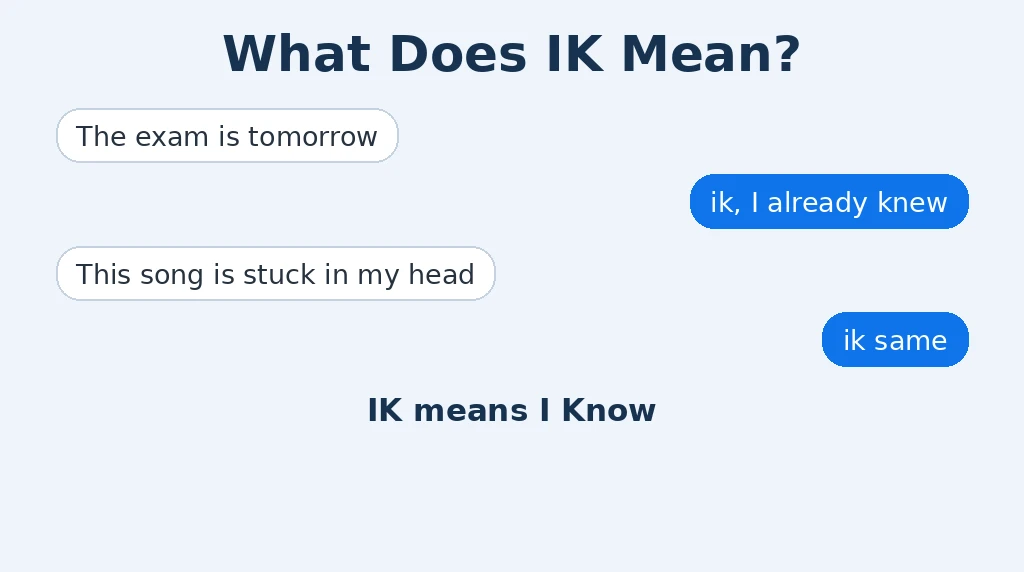
IK is the short form of “I know.” People type it when someone tells them something they already know, or when they agree with a point that was just made. It works like a nod in a real conversation. “The exam is tomorrow” gets an “ik” when you already have it in your calendar, and “this song is stuck in my head” gets an “ik” when you have been humming it all day too.
The tone behind it is where things get tricky. A friendly “ik!!” with an exclamation mark reads like shared excitement. A bare “ik” with a full stop, or no punctuation at all, can read flat, bored, or even impatient, especially if the other person was sharing something they cared about. The letters stay the same, but the feeling changes with the words around them.
Lowercase “ik” is the everyday typed form, soft and casual, while uppercase “IK” reads a little louder and more certain. Most people type lowercase in fast chats and switch to uppercase when they want to stress the point, as in “IK, I was there too.” If the message feels short, read the chat before it. The topic and the mood almost always tell you how the IK was meant.
It sits close to a plain huh in one way: both are tiny replies that leave the other person guessing if they arrive with no context. The difference is that a huh says “I did not follow that,” while an ik says “I already follow that, tell me the next part.”
Full Form of IK
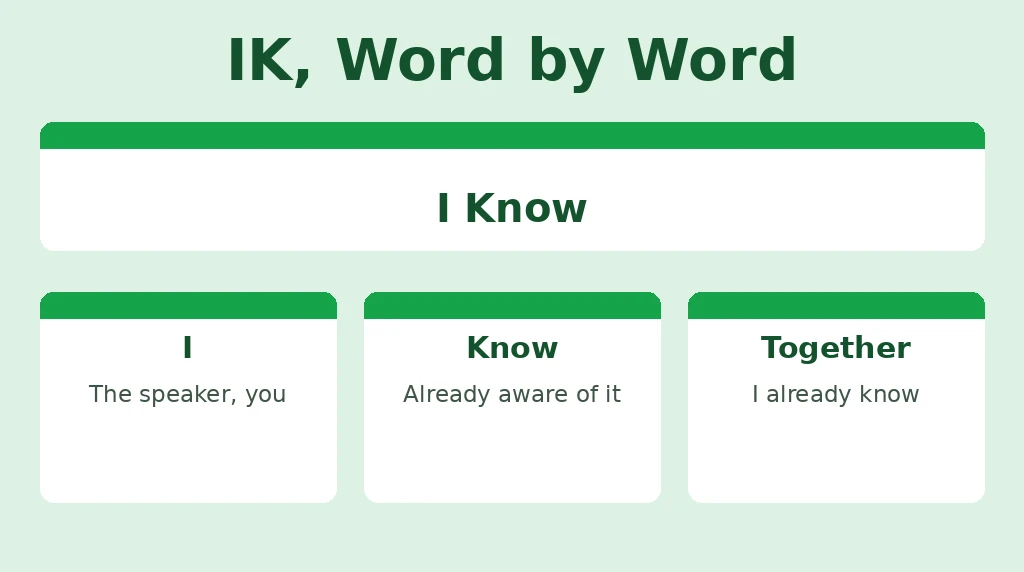
The full form is simple, because IK is built from the first letters of two plain English words:
- I: I
- K: Know
Put together, you get “I know.” That is the reading Meanzafy gives as the lead meaning, and it is the only meaning CyberDefinitions lists for IK. Wiktionary lists it the same way, as an initialism of “I know” used in internet slang and text messaging, with IDK as its antonym.
Say the letters out loud and the pattern is clear. People say I K one letter at a time, eye kay, because the abbreviation is an initialism, not a spoken word. In real conversation people say “I know,” and the two letter form works in typing and in quick voice chats alike.
IK vs IDK vs IKR: What Is the Difference?
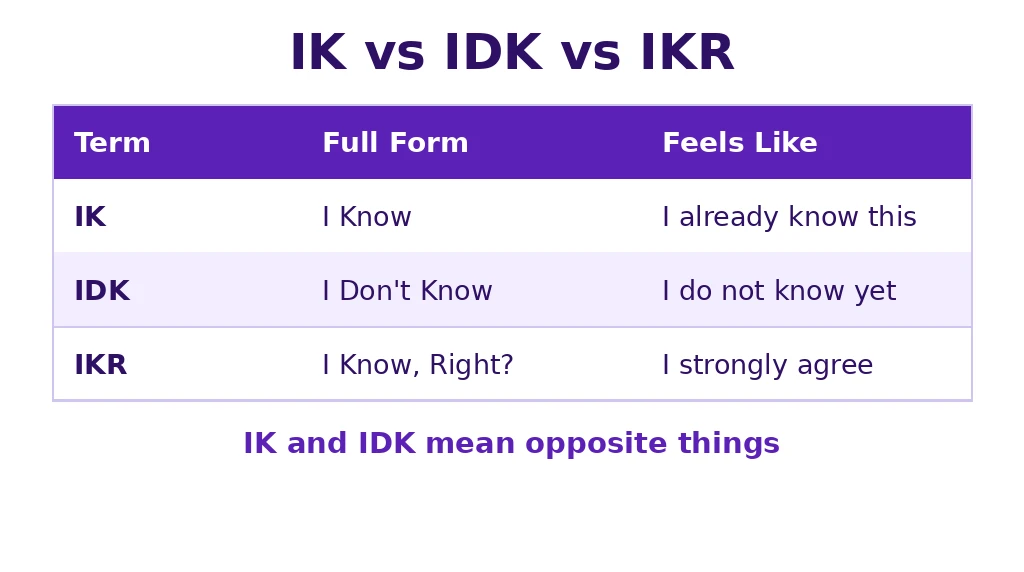
Three tiny abbreviations sit side by side in texting, and two of them mean the exact opposite of each other. Here they are, lined up so the difference is easy to see.
| Abbreviation | Full Form | What It Really Says | Tone |
|---|---|---|---|
| IK | I Know | I already understand this | Casual, agreeable |
| IDK | I Don’t Know | I do not have the answer | Casual, unsure |
| IKR | I Know, Right? | I strongly agree with you | Warm, enthusiastic |
The classic mix up is IK versus idk, because the two look almost identical on a phone screen. IK says you already have the information, while IDK says you do not have it yet. Typing one when you mean the other flips your whole reply.
IKR is the louder cousin of IK. It adds “right?” to the end, which turns a simple confirmation into a strong agreement. “IK” says “yes, I know,” while “IKR” says “yes, I know, and I feel the same way you do.”
Where IK Is Commonly Used
Texting and WhatsApp
One to one chats are where ik shows up most, usually as a quick agreement between friends and family. It answers “did you hear about this?” fast, without making the sender type a full sentence. A typical line looks like this: “ik, mum already told me.”
Instagram and Snapchat
On Instagram and Snapchat, ik appears in DMs and comment replies about relatable posts, memes and captions. A comment that says “this song is stuck in my head” often gets an “ik same” underneath it, a quick way to say “me too.”
TikTok Comments
Scroll a busy TikTok comment section and ik pops up under relatable videos and hot takes. Viewers type things like “ik, I did not see that ending coming” right after the video, a quick way to agree with the creator or with another commenter.
Group Chats
Group chats run on quick reactions, so ik fits them well. One person drops a reminder or a piece of news, and someone replies “ik, saw the email already” before anyone has time to write more.
Gaming Chats
In game chat there is no time for full sentences, so ik does quick work between rounds. Players type things like “ik, I saw him on the map” while the match is still moving, and nobody stops playing to decode it.
Discord and Forums
Discord servers and forums use ik the same way, just in longer threads. Someone posts an update or a patch note, and “ik, it took me forever to adjust” is a normal reply that keeps the discussion going.
Origin and History of IK
IK has no single inventor and no dramatic backstory, which is true of most texting shorthand. It grew out of the early 2000s, when texting and instant messaging became everyday habits and people needed shortcuts for the phrases they typed most. “I know” was one of those phrases, said dozens of times a day, so dropping the middle letters and the space was an easy save.
The old phone keypads helped it along. Tapping a number key three times just to get one letter made every keystroke feel expensive, so short forms spread fast. “You” became “u,” “are” became “r,” and “I know” became “ik.” It was never tied to one app or one meme. It was just practical, and practical things stick around.
When smartphones arrived with full keyboards, you might expect abbreviations like this to fade, since typing got easier. The opposite happened. Quick, casual texting became a style of its own, and using “ik” signals a relaxed, informal tone, not just a saved second.
Other Meanings and Variations of IK
In everyday English chat, IK almost always means “I know,” but the same letters carry other readings, and a few of them are easy to miss if you only know the main one.
- IKR: “I know, right?” is the most common variation, a stronger and warmer version of IK. People use it when they strongly agree, often with a laugh or a shared feeling behind it.
- IKTR: “I know, that’s right” is a longer variation that pops up in some chats. It means the same thing as IK, just stretched out for emphasis, and it is far less common than IKR.
- IK in Dutch: in Dutch, “ik” is the everyday word for “I,” the pronoun, not an abbreviation at all. If the rest of the message is in Dutch, the person is simply saying “I.”
- Instant kill in gaming: in some shooter and fighting game chats, IK can mean “instant kill,” a move that ends an opponent in one hit. This sense is rare, and it only fits when the chat is about a game.
How to Use IK Correctly
- Use it as a quick agreement. IK works best right after someone shares something you already knew or something you agree with. It shows you are listening and you are on the same page.
- Add a few words when the topic matters. “Ik, I was just thinking the same thing” is far warmer than a bare “ik” on its own, and it takes only a few extra seconds to type.
- Match the energy of the chat. If someone is excited or upset, a flat “ik” can feel cold. Add a little warmth or detail so your reply fits the mood of the conversation.
- Keep it lowercase in casual chats. Lowercase “ik” reads softer and more relaxed, which is the tone most chats want. Save uppercase “IK” for moments when you really want to stress the point.
- Do not use it in every single reply. IK is handy, but using it ten times in a row makes it look like you stopped engaging. Mix it in naturally, and write a full sentence when the moment deserves one.
Example Conversations Using IK
Monday mornings
Person A: “ugh, Monday mornings are the worst”
Person B: “ik, I hit snooze five times today”
A moved meeting
Person A: “guys, the meeting moved to 3 PM”
Person B: “ik, I saw the email already”
An Instagram comment
Person A: “this song is stuck in my head all day”
Person B: “ik same, I have had it on repeat since yesterday”
A TikTok reply
Person A: “the ending of this video had me shocked”
Person B: “ik, I did not see that coming at all”
Gaming with a teammate
Person A: “watch out, someone is camping near the entrance”
Person B: “ik, I saw him on the minimap already”
A Discord thread
Person A: “this update changed the whole game”
Person B: “ik, it took me forever to adjust to it”
Planning with a friend
Person A: “the cafe closes at 9, so we need to hurry”
Person B: “ik, I already booked a table for 7”
The confused one
Person A: “she just replied ‘ik’ and nothing else”
Person B: “nvm, she probably just agreed and moved on”
When Not to Use IK
- Work emails: a two letter reply looks careless in a professional inbox, so write “I understand” or “I know” in a full sentence instead.
- Job applications and interviews: even over chat, a bare abbreviation can look sloppy when the full phrase costs nothing to type.
- Teachers and bosses: anyone grading or managing you deserves a complete sentence, not a burst of shorthand.
- Customer service chats: support staff need clear answers, and “ik” tells them nothing about what you actually understood.
- Serious or emotional conversations: when someone shares bad news or asks for real support, a two letter reply can feel like you are brushing them off.
- When you actually do not know: typing IK by habit when you are unsure creates a false promise, and it will come back to bite you later.
How to Respond When Someone Sends You IK
An ik lands in your chat and the ball is suddenly in your court. The sender usually agrees with you, so the smart move is to keep the conversation going instead of letting it stall.
Patient replies work when the IK feels calm and fair:
- “Glad we are on the same page, what do you think we should do next?”
- “No worries, I just wanted to make sure you saw it.”
- “Fair enough, let me know if anything changes.”
Helpful replies suit an IK that follows a question or a plan:
- “Great, then here is the next step we need to take.”
- “Perfect, I will send you the details now.”
Playful replies fit close friends and light topics:
- “Ikr, it is so obvious at this point”
- “Of course you know, you always know first”
- “Then you already know what happens next, right”
One thing to avoid: do not fire back a cold “ok” when the IK was friendly. A short reply to a short reply can shut the chat down fast, and most of the time the person simply agreed with you.
Common Mistakes People Make With IK
- Mixing it up with IDK. IK means “I know” and IDK means “I don’t know.” They are opposites, so typing the wrong one flips your whole reply.
- Sending a bare ik in a serious chat. Two letters with no warmth can read as dismissive, even when you meant it honestly. Add a few words when the topic matters.
- Using it to dodge a decision. “Ik” is not an answer to a real question. If someone asks what you want to do, give them a real answer instead of hiding behind a shortcut.
- Using it at work. Bosses, clients and teachers expect full sentences. IK belongs in casual chats with friends, not in a professional inbox.
- Reading too much into the tone. Text has no voice, so a flat “ik” might just mean the person was busy. Ask a follow up question before assuming they were annoyed.
Frequently Asked Questions
What does IK mean in text?
IK means “I know.” People type it to show they already understand something, they agree with what was said, or they are aware of a situation. It is a quick, casual way to confirm something without typing a full sentence.
Is IK rude?
Not on its own, but a bare “ik” can sound impatient or dismissive, especially in a serious chat. Adding a few words, like “ik, I was just thinking the same thing,” keeps the tone warm and friendly.
What is the difference between IK and IDK?
IK means “I know,” while IDK means “I don’t know.” They are opposites. IK says you already have the information, and IDK says you do not have it yet. Mixing them up flips the whole meaning of your reply.
What does IKR mean?
IKR means “I know, right?” It is a stronger, more enthusiastic version of IK. People use it when they strongly agree with something, often with a laugh or a shared feeling behind it.
Can I use IK in a work email?
No, it is too casual for work emails, messages to teachers, or any formal chat. Write “I know” or “I understand” instead, in a full sentence, so the message reads as professional.
How do I reply when someone sends me IK?
Match their energy. If they agree with you, move the chat forward with the next point. If the IK feels flat or impatient, ask a follow up question or add a detail, so the conversation keeps going instead of stalling.
Final Thoughts
Two letters, one quick nod, and a tone that can flip in a second. IK is first and foremost “I know,” a shortcut people have trusted in fast chats for over twenty years, and it has earned its place in everyday talk because everyone meets moments that call for a quick agreement. Used plainly, with a little extra warmth when the moment matters, it never really causes trouble.
If you want a second opinion from a dictionary source, Dictionary.com covers “I know” as a slang expression, explaining how people use it in casual talk. Either way, you now have the ik meaning in text down, plus a decent reply ready for the next time it shows up in your messages.

1 thought on “IK Meaning in Text: What It Means, How to Use It and How to Reply”