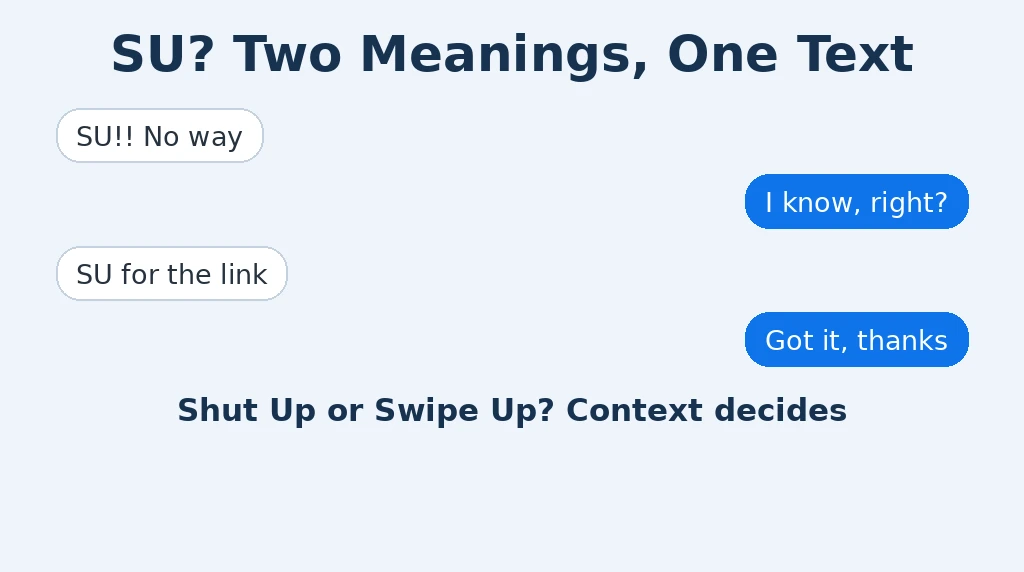
Your friend texts you one line of good news, and the reply comes back in two letters: “SU!!” You stop and stare. Are they telling you to be quiet? Are they asking you to swipe something? Or did they just pay you the strangest compliment of the day?
Here is the quick answer, and it has two halves. In a chat, SU usually means “shut up,” said with shock or excitement rather than anger, while in a story or a post about a link, SU usually means “swipe up.” The su meaning in text depends on where you see it, so this guide covers both senses, how to tell them apart, when each one sounds rude, SU vs STFU and SUP, and the best ways to reply.
What Does SU Mean in Text?
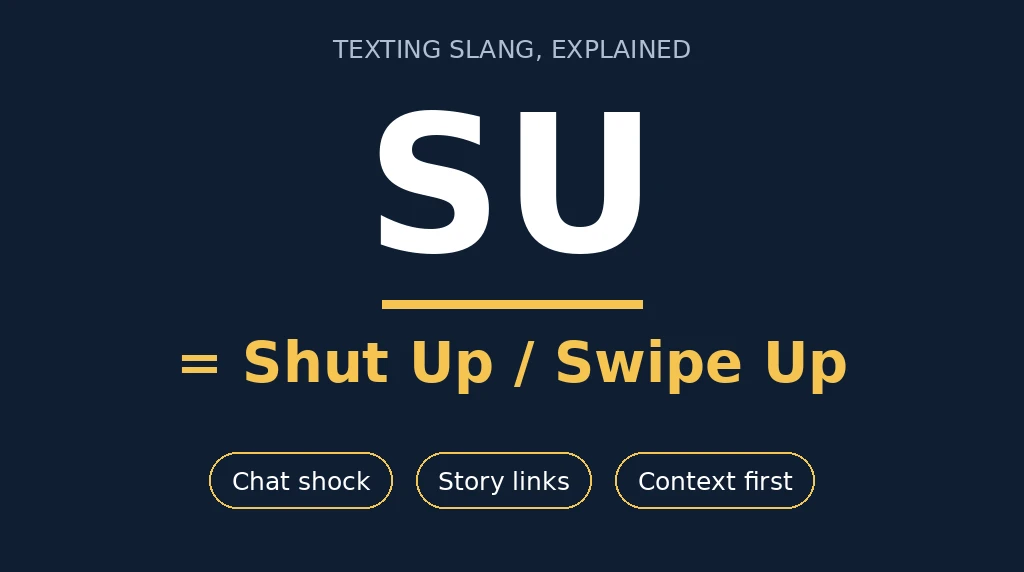
SU is a split personality in two letters. In a private chat it almost always means “shut up,” the short, sharp reaction people send when they hear something unbelievable. “I just won two concert tickets!” gets a “SU!! No way” back, and nobody in that chat thinks the sender is angry. The words say “be quiet” but the feeling says “I cannot believe this.”
On a story or a post, the same letters flip to their second job. SU means “swipe up,” an instruction to slide a finger upward on the screen to open a link. “SU for the full recipe” is not a reaction at all, it is a direction, and it only makes sense when a link is waiting on the other side of the gesture.
How do you tell them apart? Look at what sits next to the letters. Surprising news, an exclamation mark and a laughing emoji point at “shut up,” while a link, a product or the words “for the details” point at “swipe up.” Lowercase “su” feels softer, uppercase “SU” hits harder. If the chat is about news, “shut up” is the right reading. If it is about a link, “swipe up” wins.
Full Form of SU
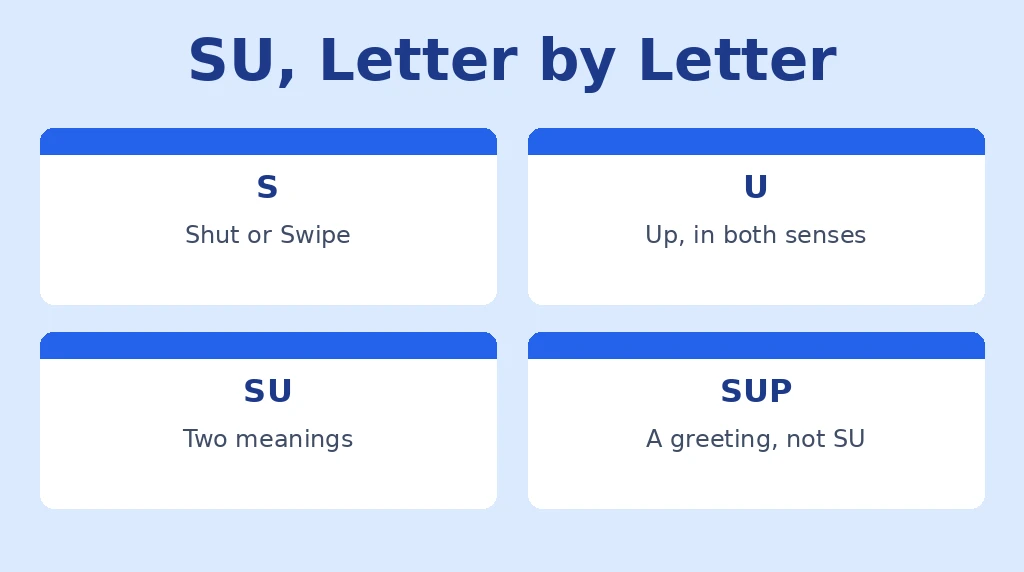
SU has two full forms, one for each job it does. Which one applies depends on the conversation:
- S: Shut, in the chat sense
- U: Up, in the chat sense
Put them together and the chat reading is “shut up.” The second reading uses the same two letters differently:
- S: Swipe, in the story and link sense
- U: Up, in the story and link sense
Together they make “swipe up,” the gesture that once opened links on story screens. People say the letters one at a time, ess you, because SU is an initialism in speech. Nobody pronounces it as a single word.
SU vs STFU vs SUP: What Is the Difference?
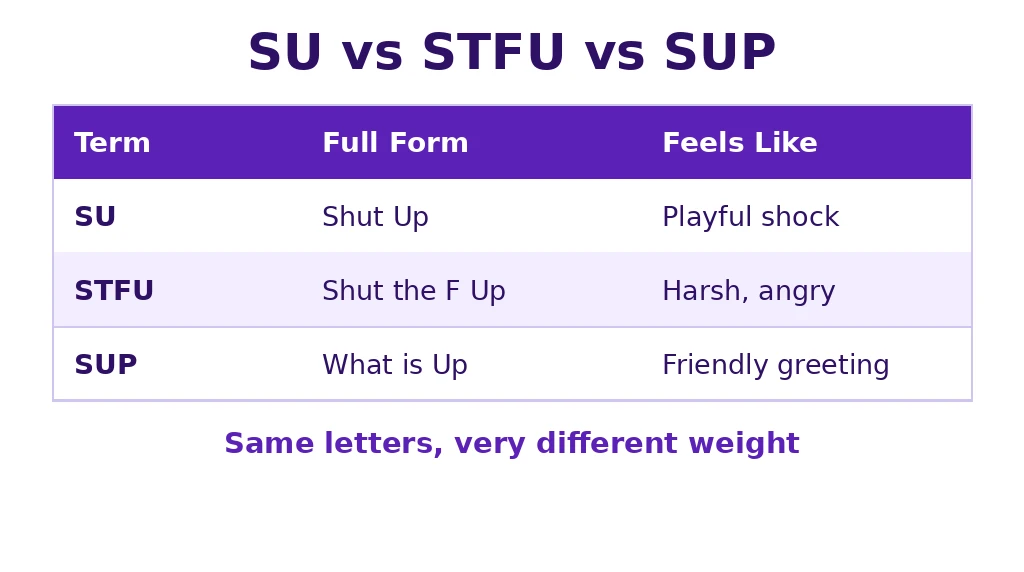
SU sits between two neighbours that look similar but feel very different. Here they are side by side.
| Abbreviation | Full Form | What It Really Says | Tone |
|---|---|---|---|
| SU | Shut Up | Playful shock, or a link instruction | Casual, sharp |
| STFU | Shut the F Up | Stop talking, and I mean it | Harsh, angry |
| SUP | What is Up | A greeting, what are you doing | Casual, friendly |
The classic mix up is SU versus STFU, because both start from the same two words. The gap is simple, though. SU is soft enough to be a joke between friends, while STFU adds a swear word and almost always means anger. “SU, you met him?” is excitement, while “STFU” on its own is a door slamming. Never use STFU where SU would do.
SUP is different again, because it is a greeting, not a reaction. “Sup?” opens a conversation the way “hey, what is up?” does, while SU reacts to something already said. And if you already know the news and someone still sends you SU, ik is the shorter way to say you got it, short for “I know.”
Where SU Is Commonly Used
Texting and WhatsApp
One to one chats are where the “shut up” sense does most of its work, usually when a friend drops surprising news. It answers shock fast, without making the sender type a full sentence. A typical line looks like this: “SU, you actually got the job?” Short, sharp, and the chat keeps moving.
Instagram and Snapchat
Instagram and Snapchat host both senses, which is why they cause the most confusion. In a DM, SU usually means “shut up” as a reaction to news. In a story caption, it usually means “swipe up” to open a link.
TikTok Comments
On TikTok, SU pops up under clips about surprising stories and big reveals. Viewers type things like “SU, that ending was unreal” right after watching.
Group Chats
Group chats run on quick reactions, so SU fits them well. One person drops big news, someone replies “SU!!!”, and a third person adds “WAIT WHAT” before anyone has time to write more. The whole group then knows the reaction is shock, not a real order to stop talking.
Gaming Chats
In game chat there is no time for full sentences, so SU does quick work between rounds. Players type it when a teammate pulls off something unbelievable, like beating a hard boss on the first try. The letters land fast, and nobody stops playing to decode them.
Discord and Forums
Discord servers and forums use SU the same way, just in longer threads. Someone posts a surprising result or a wild story, and “SU, no way” is a normal reply that keeps the discussion going. The thread around it usually makes the meaning obvious.
Origin and History of SU
Neither sense of SU has one neat birthday, because both grew out of habits that were already old. “Shut up” is a phrase people have said out loud for generations, whenever surprise, annoyance or disbelief hits. When texting took off, people started shortening familiar phrases to their first letters, and “shut up” became SU in quick chats between people who already understood each other.
The second sense arrived with stories and touchscreens. Swiping upward became the gesture that opened links, creators told followers to “swipe up” for the full post, and shortening that to SU was a natural step.
That story sense has started to fade as a literal instruction, since Instagram replaced the swipe gesture with link stickers on most accounts. The chat sense is still going strong, because surprise never goes out of fashion. Two histories, one set of letters, and the setting tells you which one you are reading.
Other Meanings and Variations of SU
In everyday talk, SU almost always means “shut up” or “swipe up,” but the same letters carry a few edge cases worth knowing.
- See You, rarely: some people use SU as a personal shortcut for “see you,” as in “SU later.” It is not a settled meaning, most readers will not recognise it, and “CU” or the full words “see you” are far clearer.
- A greeting close to “sup”: a few people type SU to open a chat. Treat this as personal style, because most readers will hear “shut up” first.
- A university or school name: outside of texting, SU can stand for the initials of a university or a student group. If the message mentions applying, classes or a campus, this is the reading that fits.
- Lowercase su vs uppercase SU: the small letters feel softer and more casual in a sentence, while the capitals hit harder, especially with exclamation marks. The meaning stays the same either way.
- SU in gaming: in some games and teams, SU can carry a specialised meaning tied to that game, so if teammates use it the same way again and again, ask what it means in that group.
How to Use SU Correctly
- Use it only where the sense is obvious. SU works best when the chat or the link makes the meaning clear on its own. “SU!! You won?” is clear, while a bare “SU” sent out of nowhere just leaves the other person guessing.
- Save the “shut up” sense for close friends. It lands as a joke only when the friendship is warm enough to carry it. With a stranger, a teacher or a colleague, the same letters can read as genuinely rude.
- Pair the “swipe up” sense with a real link. “SU for the full video” only works when a link is actually there. If the platform shows a link sticker instead, name the sticker so nobody swipes at a screen that does nothing.
- Watch the punctuation. One “SU” with a laughing emoji reads as playful, while “SU!!!” in an argument reads as a slammed door.
- Skip it when the reader might not know it. Older relatives and people outside texting culture can read SU as a plain order to be quiet. With them, spelling out “no way” or “I cannot believe it” costs a few extra seconds and saves a hurt feeling.
Example Conversations Using SU
Reacting to good news
Person A: “I just won two concert tickets!”
Person B: “SU!! No way, that is amazing”
A WhatsApp surprise
Person A: “I finished the whole project in one night.”
Person B: “SU, how did you even do that?”
An Instagram story link
Person A: “New video is up, SU for the full recipe.”
Person B: “Got it, watching now”
A group chat
Person A: “Guess who just got engaged?”
Person B: “SU!!!”
Person C: “WAIT WHAT, tell us everything”
A Snapchat reaction
Person A: “Look at this dress I found!”
Person B: “SU, I need it right now”
A TikTok comment
Person A: “I met my favourite singer at the airport!”
Person B: “SU, you are so lucky”
A Discord gaming chat
Person A: “I beat the final boss on my first try.”
Person B: “SU bro, that is unreal”
The confusing one
Person A: “SU for the details”
Person B: “nvm, I see the link now, I thought you were telling me to be quiet”
When Not to Use SU
- In a work email or a work chat: “shut up” is too sharp for a professional setting even as a joke, and “swipe up” only makes sense when a link is on screen.
- In an argument: when tempers are high, SU reads as a real order to stop talking.
- With teachers, bosses or strangers: people who do not know your joking style will hear the literal words first.
- In serious conversations: when someone shares bad news or asks for real support, a sharp two letter reaction can feel like you are brushing them off.
- When there is no link: telling someone to swipe up when nothing is there to open just confuses them and wastes their time.
- When you actually mean “see you”: most readers will not guess that reading, so write “see you” in full instead of risking the mix up.
How to Respond When Someone Sends You SU
An SU lands in your chat and the ball is suddenly in your court. First work out which SU they sent, because the two senses want two very different replies.
Shocked replies work when their SU means “shut up” and the news is good:
- “I know, right? I still cannot believe it either.”
- “Haha, I had the same reaction when I found out.”
- “Let me tell you the whole story, it gets better.”
Calm replies suit an SU that feels sharp or tense:
- “Hey, what is wrong? Talk to me.”
- “If I said something off, tell me plainly.”
Link replies fit the “swipe up” sense, when a link is waiting:
- “Got it, opening the link now.”
- “I cannot see a link, can you send it directly?”
- “Found it, thanks for sharing.”
One thing to avoid: do not fire back with a sharper SU when the chat is already tense, because two sharp replies turn a small bump into a real argument. If they ask why you reacted the way you did, a short bc and one honest line beats a long excuse, since bc is the quick way to say “because” and give your reason.
Common Mistakes People Make With SU
- Assuming SU always means “shut up.” In a story caption it can mean “swipe up,” and the wrong guess can make you answer a link with shock.
- Using it with people who do not know your humour. A stranger or a colleague hears the literal words first, and the literal words sound like an order.
- Sending it in the middle of an argument. Even meant as a joke, SU lands as a slammed door when tempers are already high.
- Mixing it up with STFU. One is soft enough to be playful, the other is almost always angry. Swapping them by accident can end a conversation you wanted to keep.
- Telling people to swipe when there is no link. The instruction only works when the link is actually there, so check the screen before you send it.
Frequently Asked Questions
What does SU mean in text?
SU has two main meanings in texting. In a chat it usually means “shut up,” said with shock or excitement, while in a story or a post about a link it usually means “swipe up.” The conversation around it tells you which one fits.
Is SU rude?
It can be, but it usually is not. Between close friends it reads as playful shock, like “no way.” It turns rude when the chat is tense, when the sender means it as a real order to stop talking, or when it lands on a stranger.
What is the difference between SU and STFU?
SU is the softer one. It can mean playful shock or a simple link instruction. STFU is much stronger and almost always angry, because it adds a swear word to the same command. Never use STFU where SU would do.
What does SU mean on Instagram?
On Instagram, SU can mean either sense. In a DM it usually means “shut up” as a reaction to surprising news. In a story caption it usually means “swipe up” to open a link, though Instagram now uses link stickers more often.
Can I use SU at work?
No, keep it out of work chats and emails. “Shut up” is too sharp for a professional setting even as a joke, and “swipe up” only makes sense when a link is actually on screen. Write the full words instead.
How do I reply when someone sends me SU?
First work out which SU they sent. If it is shock, answer the news they reacted to. If it is a link instruction, follow the link or ask where it leads. If it feels like a real order to stop talking, ask them plainly what is wrong.
Final Thoughts
SU is a small test of context, and that is exactly what makes it fun. Two letters, two jobs, and the conversation around them does the deciding. Read the room, check for a link, and you will almost always land on the right sense.
If you want a second opinion from a dictionary source, Dictionary.com lists an entry for SU. Either way, you now have the su meaning in text down, plus a decent reply ready for the next time it shows up in your messages.
