
Your teammate misses the final shot and types “nt” in the chat. Then a friend invites you out, and you reply “nt, busy tonight.” Same two letters, two completely different jobs, and no one stops to explain which one they mean.
Here is the short answer first. NT has no single meaning. In gaming chats it means “Nice Try,” a quick way to praise a good attempt that fell short, and in everyday texting it means “No Thanks,” a casual way to turn something down. This guide covers the nt meaning in text, the context split, NT vs GG vs NP, where each sense shows up, and the best replies when it lands in your chat. Read on for the full split, the tone traps, and the replies that fit each room.
What Does NT Mean in Text?
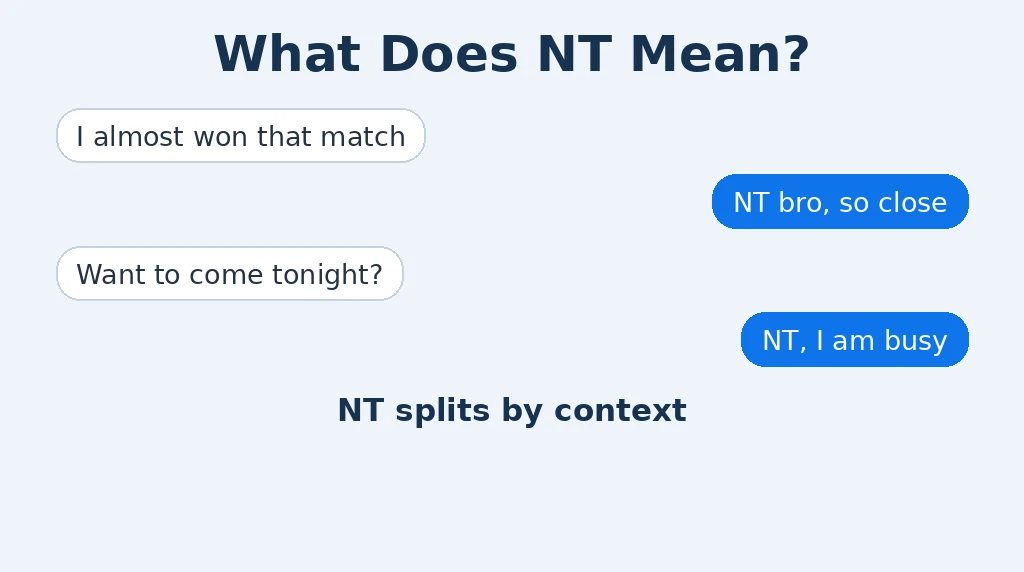
NT is a split abbreviation, which means the setting picks the meaning. In a game, NT means “Nice Try,” and players use it to acknowledge a good attempt even when it did not succeed. In a normal chat, NT means “No Thanks,” and people use it as a quick, casual way to decline an offer or an invitation. Both senses are short, friendly, and common, and the message around them tells you which one fits.
The feeling behind it is warm in one sense and polite in the other. “NT bro, you were so close” is encouragement, and nobody reads it as an insult. “NT, maybe another time” is a soft no, and nobody reads it as anger. Meanzafy calls these the two dominant meanings, and CyberDefinitions lists both readings too.
It sits close to a plain huh in one way: both can leave you guessing when they arrive with no context. The difference is that a huh says “I did not follow that,” while a bare NT usually means the sender expects you to know which NT their group means. Lowercase “nt” is the everyday typed form, and uppercase “NT” is the form you see at the start of a sentence. If you are ever unsure, read the message before it. That line almost always settles the meaning.
One honest warning helps here. Guessing the wrong sense can change the whole reply. Thanking someone for a compliment when they just turned you down would confuse everyone, and offering another date when they were praising your game would look odd.
Full Form of NT
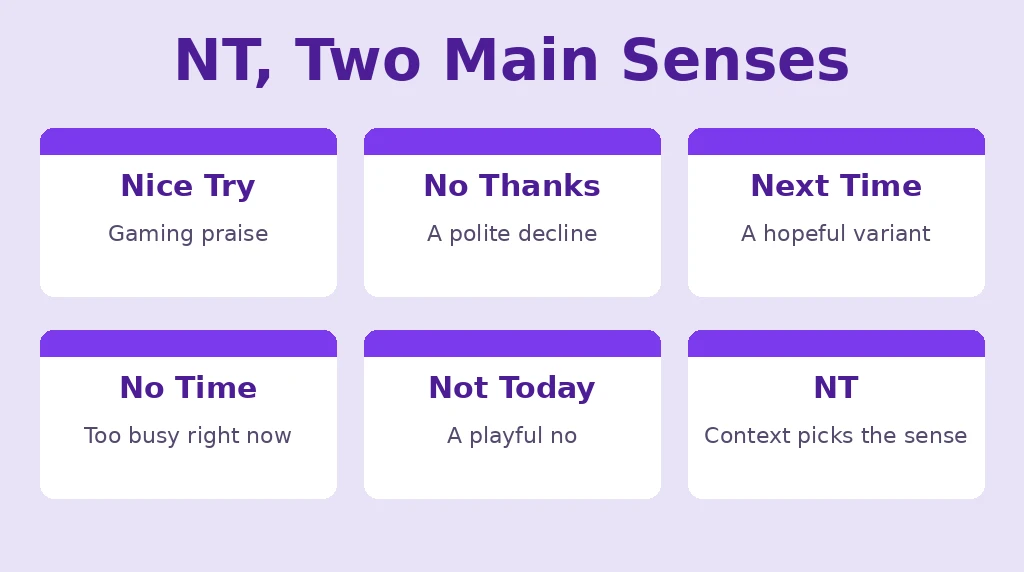
NT has more than one full form, because it grew up in different groups at the same time. Here are the two main ones:
- Nice Try: the gaming sense, used to praise an effort that fell short, as in “NT, you were so close.”
- No Thanks: the texting sense, used to turn down an offer politely, as in “NT, I am busy tonight.”
Meanzafy calls Nice Try extremely common in gaming chats and No Thanks common in everyday texting, and CyberDefinitions agrees that both readings are standard. The letters stay the same, and only the group changes. In a match, NT is almost always Nice Try. In reply to an invite, NT is almost always No Thanks.
Say the letters out loud and the pattern is clear. People say N T one letter at a time, en tee, because the abbreviation is an initialism, not a spoken word. In real conversation people say the full phrase, “nice try” or “no thanks,” and the short form works in typing and in quick game chat where every second counts.
NT vs GG vs NP: What Is the Difference?
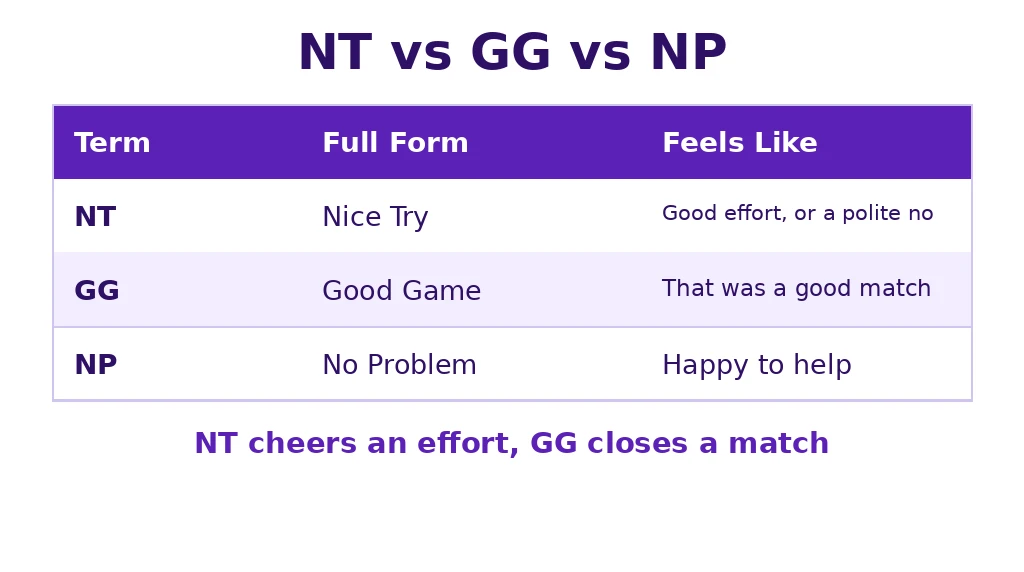
Three short forms that all live in fast chats, so here they are side by side.
| Abbreviation | Full Form | What It Really Says | Tone |
|---|---|---|---|
| NT | Nice Try / No Thanks | Good effort, or a polite no | Warm, casual |
| GG | Good Game | That was a good match | Respectful, sporting |
| NP | No Problem | Happy to help, it was nothing | Easy, friendly |
The classic mix up is NT versus GG, because both live in gaming chats. The gap is real, though. NT praises one attempt, a missed shot or a lost round, while GG praises the whole match after it ends. “NT, so close” fits mid game, and “GG, well played” fits after the final whistle.
NP is the odd one out in a useful way. It answers a thank you, not an attempt or an offer. Think of it as three jobs: NT cheers an effort or turns down an offer, GG closes a match with respect, and NP waves away thanks with a smile.
Where NT Is Commonly Used
Texting and WhatsApp
One to one chats are where NT as “No Thanks” shows up most, usually as a quick reply to an invite or an offer. It turns something down without a long excuse, which keeps the chat light. A typical line looks like this: “Want to come with us?” “NT, I am busy tonight.” Short, polite, and the chat keeps moving.
Instagram and Snapchat
On Instagram and Snapchat, NT shows up in DMs and in comment sections, usually as “Nice Try” with a joking edge. A comment like “nt bro” under a bold claim in a video means the poster does not buy it, said with a grin.
TikTok Comments
Scroll a busy TikTok comment section and nt pops up under clips of bold stunts and wild claims. Viewers type things like “nt, nice one” after a near miss in a trick video, a quick way to praise the attempt.
Group Chats
Group chats run on quick reactions, so NT fits them well. One person proposes an idea or an invite, and someone replies “NT, maybe another time” before anyone has time to write more.
Gaming Chats
In game chat there is no time for full sentences, so NT does quick work between rounds. Players type things like “NT team, that was a close round” while the next round is already starting, and nobody stops playing to decode it.
Discord and Forums
Discord servers and forums use NT the same way, just in longer threads. Someone shares a clip of a missed shot, and “nt, you almost had it” is a normal reply that keeps the discussion going.
Origin and History of NT
The history of NT is really a story of two separate abbreviations growing up on their own, shaped by very different groups. The gaming sense, “Nice Try,” grew directly out of online gaming culture, especially competitive multiplayer games where quick, supportive reactions matter during fast matches. As voice and text chat became standard in games through the 2000s and 2010s, players needed short ways to react without breaking focus, and NT became a natural fit.
The texting sense, “No Thanks,” grew out of the same shortening habit in everyday chats. People were already trimming “thanks” and “no” into quick replies, and NT slipped in as a two letter way to decline an offer without sounding rude. It spread through SMS and WhatsApp, where short replies keep a conversation moving and a long polite refusal can feel heavy.
As social media grew in the 2010s, both senses travelled into comments and captions. Today NT is part of gaming and texting alike, and most people switch between the two senses without thinking about it.
Other Meanings and Variations of NT
In everyday talk, NT almost always means Nice Try or No Thanks, but the same letters carry other readings, and a few of them are easy to miss if you only know the main two.
- Next Time: CyberDefinitions lists “Next Time” as a variant, a hopeful way to say “maybe next time” after a missed chance. It often pairs with Nice Try, as in “NT, next time for sure.”
- No Time: occasionally, NT means “No Time,” typically when someone is in a rush and wants to explain quickly that they cannot talk or do something right now.
- Not Today: in some casual chats, NT can mean “Not Today,” used like “no thanks” but with a slightly more playful or resigned tone.
- New Testament: in religious discussion, NT means “New Testament,” the second part of the Christian Bible. This reading only fits when the chat is about faith or scripture.
- Northern Territory: in Australian geography, NT means “Northern Territory,” a territory in the north of Australia. This reading only fits in a geography or travel chat.
- NT as a tag: on social media, #nt gathers gaming clips and funny attempts under one label, so the tag works as a topic label rather than a message aimed at one person. In a caption, it often marks a near miss for everyone scrolling past.
How to Use NT Correctly
- Match the sense to the room. In a game, NT means Nice Try, so use it after a missed shot or a lost round. In reply to an invite, NT means No Thanks, so use it when you are turning something down.
- Add a few words when it matters. “NT, you were so close” is far warmer than a bare “nt” on its own, and “NT, thanks for asking” is far kinder than a bare “nt” after a long invite. It takes only a few extra seconds to type.
- Use it fast in games, slow in chats. In a match, speed is the point, so a quick NT between rounds is perfect. In a normal chat, take a breath and add the reason, because the other person has time to read it.
- Keep sarcasm gentle. NT can carry a teasing edge in comments, but a sarcastic NT aimed at a stranger can sting. Save the sharp version for friends who know your humour.
- Do not use it to dodge a real answer. If someone asks a serious question, NT is not a reply. Answer it properly instead.
Example Conversations Using NT
Gaming, after a missed shot
Person A: “I almost won that match!”
Person B: “NT bro, you will get it next time”
Turning down an invite
Person A: “want to come bowling tonight?”
Person B: “NT, I am busy tonight”
A close round in a team game
Person A: “so close, we nearly had them”
Person B: “NT team, that was a close round”
A group chat plan
Person A: “movie night on Friday, who is in?”
Person B: “NT, maybe another time, plans are tbd“
A TikTok comment
Person A: “nt, nice one, almost landed it”
Person B: “thanks, next video I will stick it”
A Discord server
Person A: “check my clip, I almost clutched it”
Person B: “NT, that flick was clean though”
A live stream chat
Person A: “streamer barely missed that shot”
Person B: “nt, so unlucky”
The confused one
Person A: “she just texted me ‘NT’ with no context”
Person B: “idk, was it after a game or after an invite?”
When Not to Use NT
- As a bare reply to a long, kind invite: two letters alone can feel cold after someone took time to invite you, so add a thank you and a reason.
- In a work email: write “No thanks” or “Nice try” in full, because abbreviations can look careless in a professional message.
- Job interviews and applications: even over chat, a bare abbreviation can look careless when the full phrase costs nothing to type.
- Teachers and bosses: anyone grading or managing you deserves the full phrase on first use, not a burst of shorthand.
- Serious conversations: when someone shares bad news or asks for real support, a two letter reply can feel like you are brushing them off.
How to Respond When Someone Sends You NT
An nt lands in your chat and the ball is suddenly in your court. First, work out which sense they mean. If it came after your game, it is Nice Try. If it came after your invite, it is No Thanks. Once you know that, the reply writes itself, and a quick “no worries at all” keeps things smooth when a plan falls through.
Patient replies work when the NT sounds like a soft no:
- “No worries at all, maybe another time.”
- “All good, thanks for letting me know.”
- “Fair enough, the invite stands for next week.”
Helpful replies suit an NT that follows your game:
- “Thanks, I was so close that round.”
- “Appreciate it, I will practise that shot.”
Playful replies fit close friends and light topics:
- “Next time I am clutching it for sure”
- “Haha, I will get you next round”
- “Okay, coach, I am taking notes”
One thing to avoid: do not argue with a No Thanks. If someone turns down an invite, accept it gracefully and move on.
Common Mistakes People Make With NT
- Assuming NT always means Nice Try. In gaming it does, but in reply to an invite it usually means No Thanks. Read the message before it first.
- Sending a bare nt after a long invite. Two letters alone can sound cold when someone wrote you a warm message. Add a thank you and a short reason.
- Using NT sarcastically with strangers. A sarcastic NT in a comment can sting when the poster does not know you. Save the sharp edge for friends who know your humour.
- Mixing up NT and GG. NT praises one attempt mid game, while GG praises the whole match after it ends. Use each one at its own moment.
- Using NT as a dodge. If someone asks a real question, NT is not an answer. Reply properly, or say you need time to think, instead of hiding behind two letters.
Frequently Asked Questions
What does NT mean in text?
NT has two main meanings. In gaming it means “Nice Try,” and in everyday texting it means “No Thanks.” The chat around it picks the right one.
What is the difference between Nice Try and No Thanks?
Nice Try praises an effort that fell short, while No Thanks turns down an offer. One cheers someone on, the other says no politely.
Is NT rude?
Rarely. Nice Try is friendly, and No Thanks is a soft decline. It can sound cold if it arrives alone after a long invite, so add a few kind words when it matters.
What does NT mean in gaming?
In gaming, NT means “Nice Try.” Players type it after a teammate misses a shot or loses a close round, to say the effort was good.
What does NT mean on Instagram?
In comments it usually means “Nice Try,” often with a joking or sarcastic edge aimed at a bold claim in a post or video.
How do I reply when someone sends me NT?
If it means Nice Try, say thanks and move on. If it means No Thanks, accept the no gracefully and offer another time if you like.
Final Thoughts
Two letters, two different jobs, and the wrong guess can change the whole chat. NT is first and foremost a split abbreviation, Nice Try in a game and No Thanks in a normal chat, and it has earned its place in everyday talk because everyone meets moments that call for a quick cheer or a quick polite no.
If you want a second opinion from a dictionary source, Dictionary.com lists an entry for NT, giving the meanings behind the letters. Either way, you now have the nt meaning in text down, plus a decent reply ready for the next time it shows up in your messages.
