Your friend texts you: “saw it on FB, did you check the post?” You nod, then pause. Are they talking about a social media platform, or something else entirely? Two letters should not be this hard to read, yet here you are, stuck on a reply. It shows up in group chats, bios, comments and DMs, and the meaning shifts with the setting, so the room you are in matters as much as the letters.
Here is the short answer first. FB usually means “Facebook,” the social media platform launched in 2004, so “saw it on FB” means “saw it on Facebook.” This guide covers the fb meaning in text, the other senses like “follow back” and “feedback,” FB vs IG and FWB, where it shows up, and the best replies when it lands in your chat.
What Does FB Mean in Text?
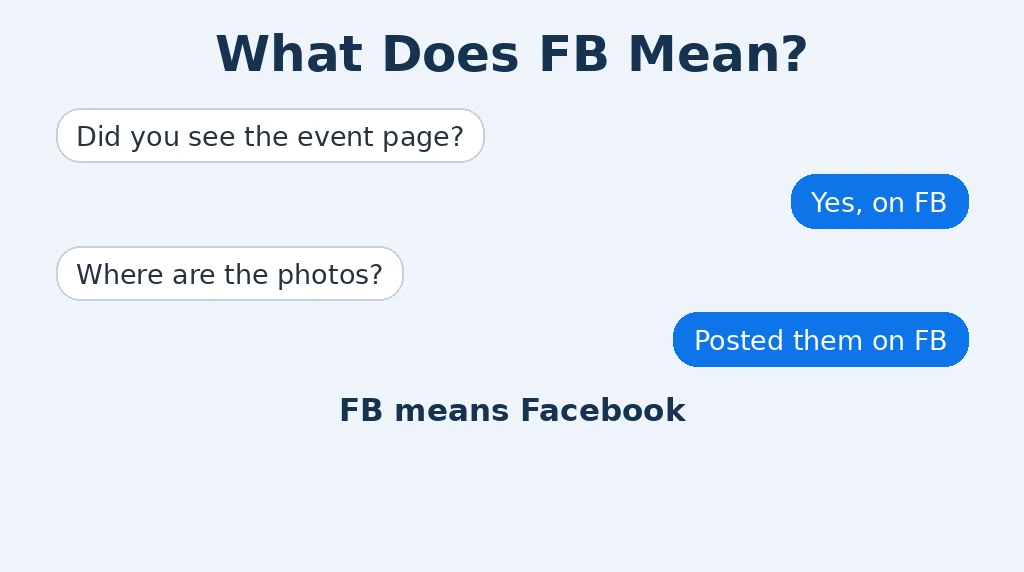
FB is the short form of “Facebook,” the social media platform where people post updates, share photos, join groups and follow events. Someone mentions it when they are talking about a post, a message, a Marketplace listing or an event page. “Did you see it on FB?” means “Did you see it on Facebook?”
The feeling behind it is plain and neutral. There is no hidden attitude in the Facebook sense, just a name people use every day. “I posted the photos on FB” is a normal way to tell friends where to look. “Mum sent me a message on FB” is a normal way to say where the message arrived. If the chat is about posts, events or groups, Facebook is the right reading.
It sits close to a plain huh in one way: both can leave you guessing when they arrive with no context. The difference is that a huh says “I did not follow that,” while a bare FB usually means the sender expects you to know which FB they mean. Lowercase “fb” is the everyday typed form, and uppercase “FB” is the formal written form you see in bios and captions. If you are ever unsure, read the message before it. That line almost always settles the meaning.
One honest warning helps here. FB has more than one meaning, so context matters more than with most abbreviations. In a public or casual chat, Facebook is the safe reading. In a private or relationship chat, the same letters can carry a very different sense, covered separately further down as a variant only.
Full Form of FB
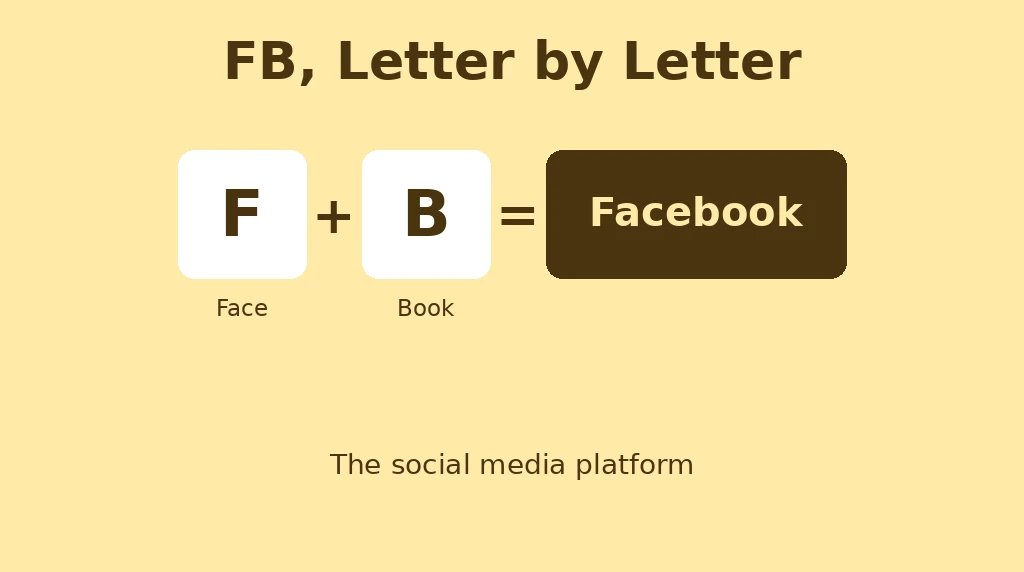
The full form is simple, because FB is built from the first letters of a plain English name:
- F: Face
- B: Book
Put together, you get “Facebook.” That is the reading most people mean, and it is the one CyberDefinitions lists first, ahead of its second sense, “Follow Back.” Dictionary.com gives Facebook as the entry for FB, and the platform itself has carried the name since it launched in 2004.
Say the letters out loud and the pattern is clear. People say F B one letter at a time, eff bee, because the abbreviation is an initialism, not a spoken word. In real conversation people say “on FB” or “on Facebook,” and the two letter form works in speech and in typing alike.
FB vs IG vs FWB: What Is the Difference?

Three short forms share the same neighbourhood, so here they are side by side.
| Abbreviation | Full Form | What It Really Says | Tone |
|---|---|---|---|
| FB | The social platform, posts and events | Neutral, everyday | |
| IG | Photos, reels and stories | Neutral, everyday | |
| FWB | Friends With Benefits | A casual relationship with a friendship | Adult, private |
The classic mix up is FB versus IG, because both name a social platform and both show up in the same chats. The gap is simple, though. FB points at Facebook, with its groups, events and Marketplace, while IG points at Instagram, with its photos, reels and stories. A post can live on one, the other, or both, and the letters tell you which one carries it.
FWB is the odd one out. It never names a platform, it names a kind of casual relationship, one that includes a friendship alongside the physical side.
Where FB Is Commonly Used
Texting and WhatsApp
One to one chats are where fb shows up most, usually about a post, a photo or an event someone just saw. It answers “where did you see that?” fast, without making the sender type a full sentence. A typical line looks like this: “I posted the vacation pics on FB.” Short, plain, and the chat keeps moving.
Instagram and Snapchat
On Instagram and Snapchat, fb appears in DMs and captions about cross-posting, events and Marketplace finds. A story captioned “also posted this on FB” is pointing at the other platform, not starting a debate. The link or the picture beside it tells you which reading fits.
TikTok Comments
Scroll a busy TikTok comment section and fb pops up under clips shared from Facebook, or under creators asking viewers to follow them elsewhere. Viewers type things like “crossposting this on FB too,” a quick way to say where else it lives.
Group Chats
Group chats run on quick reactions, so fb fits them well. One person drops an event link, and someone replies “just RSVP’d on FB” before anyone has time to write more. The event date is still tbd, but the whole group knows where to find the details.
Gaming Chats
In game chat there is no time for full sentences, so fb does quick work between rounds. Players type things like “add me on FB after the match” while the match is still moving, and nobody stops playing to decode it.
Discord and Forums
Discord servers and forums use fb the same way, just in longer threads. Someone posts a link or a group invite, and “also on FB if anyone wants it” is a normal reply that keeps the discussion going.
Origin and History of FB
The FB story starts with a date, not a guess. Facebook launched in 2004, and it quickly became one of the most talked about platforms in the world. As texting and casual online talk grew more abbreviation heavy through the 2000s and 2010s, shortening “Facebook” down to two letters made sense, especially since people were mentioning the platform constantly in daily conversation.
The letters travelled with the platform from desktop browsers to phones, then into group chats, bios and captions, where FB became a quick way to name the place a post or an event lives.
The adult slang sense grew separately, out of casual dating and hookup culture, where people looked for a discreet way to name a purely physical relationship in private chats. The two meanings rarely clash in real life, because the settings they appear in are usually very different, and the sentence around the letters tells you which one you are reading.
Other Meanings and Variations of FB
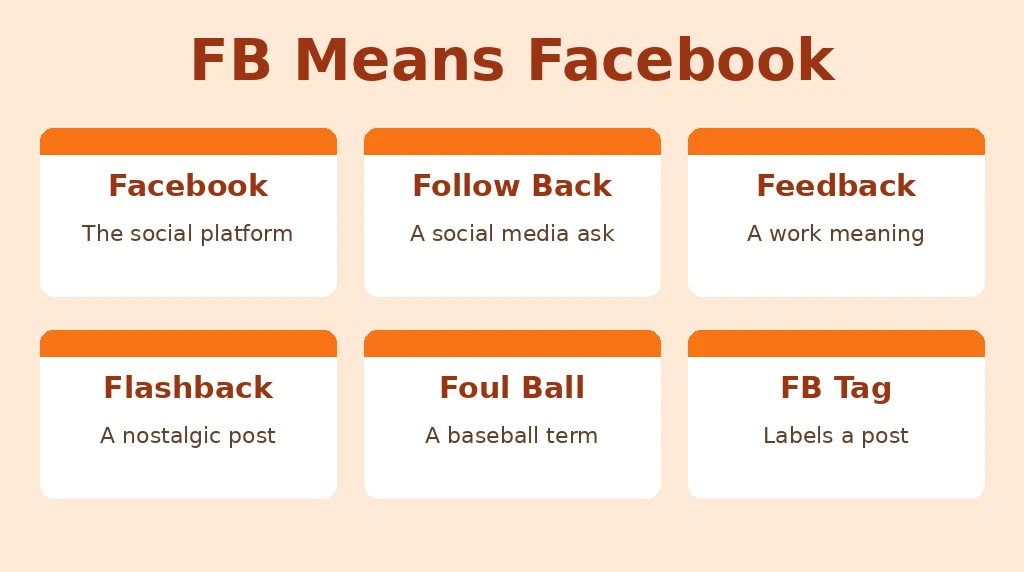
In everyday talk, FB almost always means “Facebook,” but the same letters carry other readings, and a few of them are easy to miss if you only know the main one.
- Follow Back: on Instagram, TikTok and X, FB can mean “Follow Back,” a short way to ask someone to follow you in return. You will see it in bios, comments and DMs, like “FB if you like my posts.”
- Adult slang sense: in private, adult conversations, FB is used as a short form for “F*ck Buddy,” a purely physical, no strings attached relationship. CyberDefinitions and Meanzafy both list this reading. It only fits in adult contexts, and it never belongs in a work, school or family chat.
- Feedback: in work adjacent or casual project chats, FB can mean “feedback.” “Send me your FB on the draft” is a typical line, and it only fits when a project or a piece of work is the topic.
- Flashback: in nostalgic captions, FB can mean “flashback,” as in “FB to that summer trip.” It is close to TBT, though TBT is tied to Thursdays and FB is not.
- Foul Ball: in baseball talk, FB can mean a foul ball. This is a niche use, and it only fits when the chat is about a baseball game.
- FB as a tag: on social media, #fb gathers Facebook posts, cross-posts and platform news under one label, so the tag works as a topic label rather than a message aimed at one person.
On social media, the tag use behaves differently from the chat use. In a DM, fb names the platform for one person. In a hashtag, it labels a post for everyone scrolling past, and in a bio, “FB” can be a quiet invitation to follow back.
How to Use FB Correctly
- Default to Facebook in most casual settings. Unless the conversation is clearly private or adult themed, FB almost always means Facebook, so read it that way first.
- Add the rest of the sentence. “I saw it on FB this morning” is far clearer than a bare “fb” on its own, and it takes only a few extra seconds to type.
- Keep the adult sense out of mixed company. If the chat includes work, school or family, Facebook is the only reading to use, and the adult sense should stay out of the conversation entirely.
- Use “follow back” only on social media. “FB” as follow back fits bios, comments and DMs on Instagram and TikTok, but it sounds odd in a private text to a friend.
- Spell it out when the room is unclear. If you are not sure the other person will read FB the way you mean it, write “Facebook” in full once, then use FB after that.
Example Conversations Using FB
A group chat event
Person A: “did you see the event page on FB?”
Person B: “yeah, just RSVP’d”
A WhatsApp photo share
Person A: “I posted the vacation pics on FB”
Person B: “omg, I am checking now”
An Instagram DM
Person A: “are you even on FB anymore?”
Person B: “barely, I mostly just use it for Marketplace”
A follow back ask
Person A: “just followed you, FB?”
Person B: “done, followed you back”
A TikTok comment
Person A: “crossposting this on FB too”
Person B: “good call, more people will see it there”
A family group chat
Person A: “I sent you a message on FB, did you see it?”
Person B: “just replied!”
A live stream chat
Person A: “are you streaming this on FB too?”
Person B: “yep, cross-posting live right now”
The confused one
Person A: “she just texted me ‘FB’ with no context”
Person B: “lbvs, she meant the event page”
When Not to Use FB
- As a bare reply: two letters with no context leave the other person guessing which FB you mean.
- In a work email about anything but the platform: write the full name “Facebook” the first time, then FB after that.
- Job interviews and applications: even over chat, a bare abbreviation can look careless when the full name costs nothing to type.
- Teachers and bosses: anyone grading or managing you deserves the full name on first use, not a burst of shorthand.
- Serious conversations: when someone shares bad news or asks for real support, a two letter reply can feel like you are brushing them off.
- The adult sense, anywhere outside adult chats: it never belongs in work, school, family or mixed company, and using it there can cause real offence.
How to Respond When Someone Sends You FB
An fb lands in your chat and the ball is suddenly in your court. The sender usually means Facebook, so answer the question they actually asked, and pick the lane that matches the mood.
Patient replies work when the question is fair and calm:
- “I missed it, send me the link?”
- “No worries, I will check it on FB later.”
- “Fair enough, tag me in it when you get a chance.”
Helpful replies suit an fb that asks for detail:
- “It is on FB, the event page has all the details.”
- “I will forward you the post, one second.”
Playful replies fit close friends and light topics:
- “Facebook detective mode, on it”
- “Classic FB, always first with the gossip”
- “Okay, social media scout, fill me in”
One thing to avoid: do not joke about the adult sense when the fb was about a post or an event. Most of the time the person is simply talking about Facebook, and if the meaning is unclear, ask plainly what they meant.
Common Mistakes People Make With FB
- Assuming every FB means Facebook. It usually does in a public or casual chat, but the other senses share the same letters. Read the sentence first.
- Using the adult sense in mixed company. The adult reading only fits in adult chats, and using it at work, school or home can cause real offence.
- Mixing up FB and FWB. FWB implies a friendship alongside the physical side, while the adult sense of FB does not. The two are related, not identical.
- Sending a bare fb with no context. Two letters alone tell the other person a platform is involved, but not which post or event you mean. Add one short line about it.
- Reading “follow back” into a private chat. That sense belongs on social media, in bios and comments, not in a one to one text.
Frequently Asked Questions
What does FB mean in text?
FB usually means “Facebook,” the social media platform launched in 2004. In a post, message or event chat, that is the right reading.
How do I know which meaning of FB someone means?
Read the sentence around it. A public, casual chat about posts, events or Marketplace almost always means Facebook, while a private, relationship focused chat might point to the adult sense.
Is FB the same as FWB?
No. FWB means “Friends With Benefits,” a casual relationship that includes a friendship. The adult slang sense of FB is more purely physical, with no friendship implied.
What does FB mean by follow back?
On Instagram, TikTok and X, FB can mean “Follow Back,” a short way to ask someone to follow you in return. You will usually see it in bios, comments and DMs, not in private chats.
Can I use FB at work?
Referencing Facebook casually is usually fine, but write the full name “Facebook” in formal emails. The adult slang sense should never appear in any work message.
How do I reply when someone sends me FB?
Answer the question they actually asked. If it is about a post or an event, ask for the link or say you will check it. If the context feels unclear, ask what they mean first.
Final Thoughts
Two letters, two very different meanings, and the wrong guess can change the whole chat. FB is first and foremost Facebook, a name people have used every day since 2004 to point at posts, events and groups, and it has earned its place in everyday talk because everyone meets moments that call for a quick platform reference. Used plainly, with a little extra context when the moment matters, it never really causes trouble.
If you want a second opinion from a dictionary source, Dictionary.com lists an entry for FB, giving Facebook as the meaning. Either way, you now have the fb meaning in text down, plus a decent reply ready for the next time it shows up in your messages.
