You have been stuck on the same homework problem for twenty minutes, or the same game level for an hour. You text a friend about it, hoping for a tip, and the reply comes back as three letters only: “igu”. No tip, no joke, no emoji. Just three letters sitting there while you try to work out what your friend actually meant.
Here is the short answer first. IGU usually means “I Give Up” in texting, so “IGU, this puzzle is impossible” means the sender is done trying for now. CyberDefinitions lists “I Give Up” as the most common meaning. This guide covers the igu meaning in text, the second sense your friend might have meant, IGU vs IDK and IDC, where you will see it, and the best replies when it lands in your chat.
What Does IGU Mean in Text?
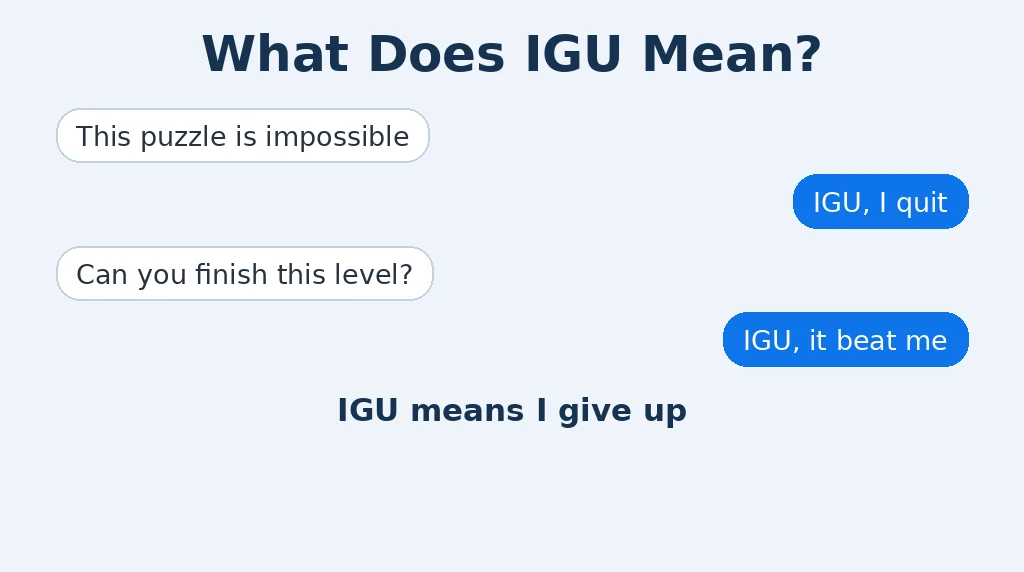
IGU is a short way of saying “I Give Up”. Someone sends it when they have tried something, hit a wall, and decided to stop for now. “IGU on this math problem” means the problem won. “IGU, I am going to bed” means the day won. The feeling is usually tired frustration, not anger, and often a little humour sits behind it too.
The tone changes with the words around it. “IGU 😂” after a failed recipe reads as a joke about a small disaster. “IGU.” with a full stop and nothing after it sounds heavier, like real defeat. Lowercase “igu” is the everyday form and feels relaxed. Uppercase “IGU” looks louder, like someone throwing their hands up.
It sits close to a plain huh, but the two do different jobs. A “huh” says you did not follow something. An “igu” says you followed it fine and still could not beat it. One more thing matters here. IGU has a second major sense, “I Got You”, which means almost the opposite, and it gets its own line in the variations section below. If the chat is about a task or a favour, that second reading may be the right one.
One honest warning helps here. IGU is a rare term, as CyberDefinitions itself notes, so not every reader will know it. With close friends it lands fine. With someone older, or someone who rarely uses slang, type the full phrase “I give up” instead.
Full Form of IGU
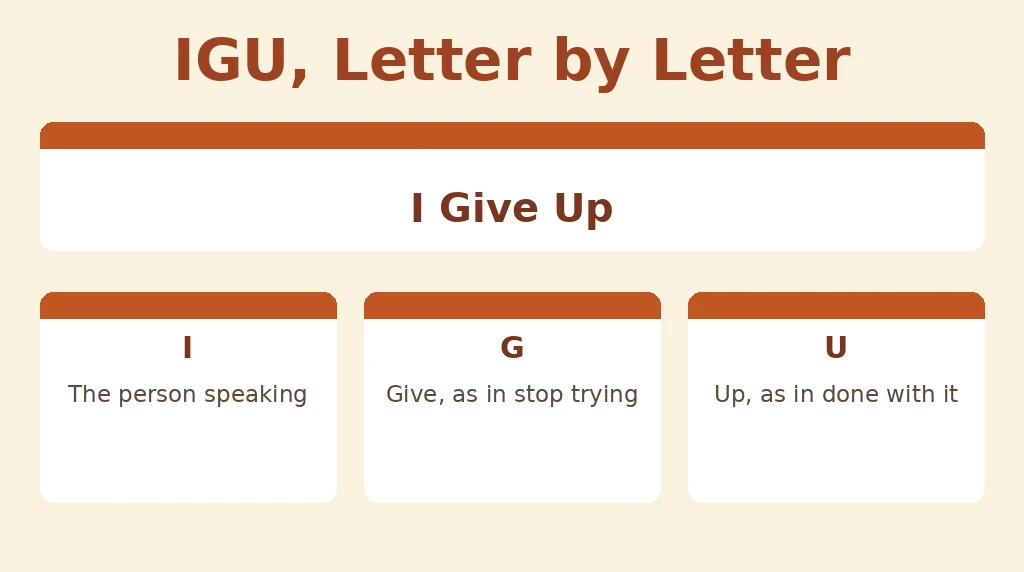
The full form is simple, because IGU is built from the first letters of a phrase:
- I: I, the person speaking
- G: Give, as in stop trying
- U: Up, as in done with it
Put together, you get “I Give Up”. That is the reading CyberDefinitions gives as the most common meaning, and it is the lead meaning used in this guide. Say the letters out loud and you get eye-gee-you, letter by letter, since nobody pronounces it as a word. In speech people say the full phrase, and the three letter form lives in typing only.
The same three letters also build the second sense, “I Got You”, where G stands for Got and U stands for You. Both phrases compress down to the same letters, which is why IGU is genuinely split. The letter breakdown alone cannot tell you which one the sender meant.
IGU vs IDK vs IDC: What Is the Difference?
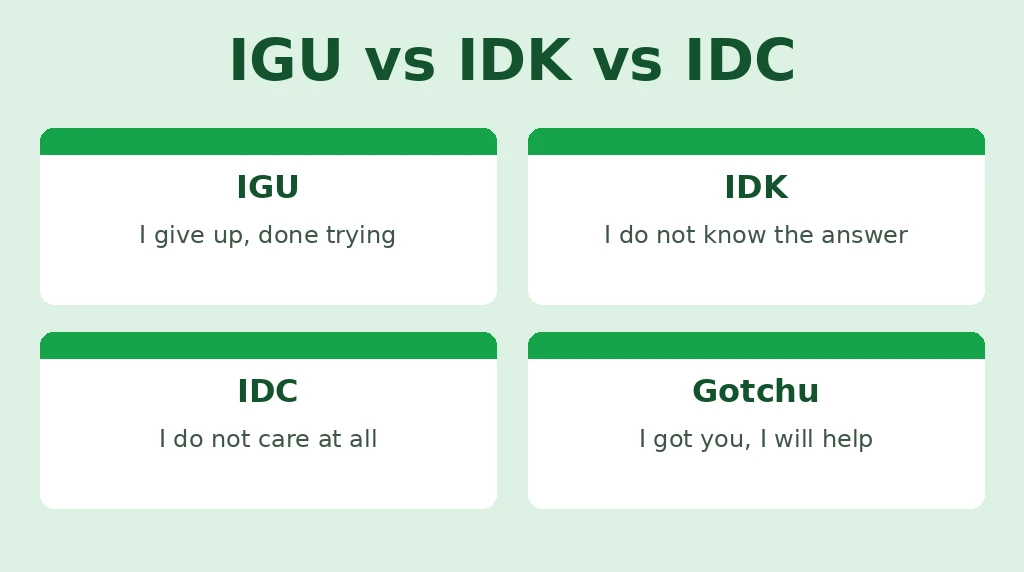
Three short forms start with the same letter, so here they are side by side.
| Abbreviation | Full Form | What It Really Says | Tone |
|---|---|---|---|
| IGU | I Give Up | I tried and I am stopping | Frustrated, sometimes joking |
| IDK | I Don’t Know | I do not have the answer | Uncertain, neutral |
| IDC | I Don’t Care | I am not interested at all | Dismissive, often blunt |
The classic mix up is IGU versus IDK, because both show up when someone is stuck. The difference is effort. IGU says you tried and stopped, as in “IGU on this level, it beat me”. IDK says you never had the answer, as in “IDK the answer to that question”. One is about quitting, the other is about not knowing.
IDC is the odd one out in a useful way. It never means you tried. It means you do not care about the topic at all, which is why it can sound rude where IGU sounds tired. Then there is the other IGU, “I Got You”, which flips the whole table. “IGU, I will send it now” is support, not surrender.
Where IGU Is Commonly Used
Texting and WhatsApp
One to one chats are where igu shows up most. It answers a hard homework question or a long day fast, without making the sender type a full sentence while they are still annoyed. A typical line looks like this: “IGU, this form makes no sense”.
Instagram and Snapchat
On Instagram and Snapchat, igu appears in DMs when someone shares a failed attempt or a burnt dinner. It also works as a caption. A photo captioned “igu trying to adult today” is a small public shrug that says the poster is done trying for now.
TikTok Comments
Scroll a busy TikTok comment section and igu pops up under videos with impossible challenges or relatable fails. Viewers type things like “igu this trend is too hard” right under the video.
Group Chats
Group chats run on quick reactions, so igu fits them well. One person drops a hard puzzle or a changed plan, and someone replies “igu” before anyone has time to write more.
Gaming Chats
In game chat there is no time for full sentences, so igu does quick work between rounds. Players type things like “IGU for today, taking a break” while the match is still moving.
Discord and Forums
Discord servers and forums use igu the same way, just in longer threads. Someone posts a bug they cannot fix, and “IGU, I have tried everything” tells the thread the person needs help or is moving on.
Origin and History of IGU
IGU has no single inventor and no confirmed first use, which is normal for shorthand built out of an everyday phrase. “I give up” has been a common English phrase for a long time, used whenever someone stops trying at something hard. As typing culture shifted toward speed, people started trimming the phrases they typed most often.
The “I give up” version grew out of gaming and online chatroom culture, where players needed a fast way to say they were beaten by a level or a boss. As texting spread through the 2000s, the habit carried over into everyday chats, especially among students dealing with tough homework. The “I got you” version developed separately, growing out of the same habit of shortening supportive phrases in fast texting. Since “I got you” is such a common way of offering help, it eventually got compressed the same way, and the two meanings collided into the same three letters.
Other Meanings and Variations of IGU
In casual texting, IGU almost always means “I Give Up”, but the same letters carry other readings worth knowing.
- I Got You: the second major sense of IGU, and almost the opposite of the lead. It means “I have this covered” or “I understand”, as in “IGU, I will grab the milk on my way home”. It shows up most after a request or a favour.
- Sarcastic “I give up”: sometimes IGU is not meant literally at all. It reacts to something mildly frustrating or funny, as in “IGU, just buy a new router at this point”, where the sender is joking rather than truly defeated.
- Casual agreement: the “I got you” version does not always mean literal help. Sometimes it simply shows agreement or understanding, close to saying “makes sense” or “got it”.
- IGU as a caption or tag: on social media, #igu gathers reaction posts under one label, so the tag works as a caption style reaction rather than a message aimed at one person.
- Gotchu: a more casual, phonetic spelling of “I got you” that carries the same supportive meaning as one side of IGU, but without the ambiguity.
- IGU as initials or a username: outside texting, IGU can simply be someone’s initials or a gaming handle, and then it has nothing to do with slang.
On social media, the caption and tag use behaves differently from the chat use. In a DM, igu speaks to one person about one moment. In a caption or a hashtag, it reacts to the post itself, a mood for everyone scrolling past.
How to Use IGU Correctly
- Add context so the meaning lands. “IGU, this problem makes no sense” is far clearer than a bare “igu” on its own, and it takes only a few extra seconds to type.
- Pair it with an emoji to set the tone. A laughing face signals a joke, as in “IGU 😂”, while a thumbs up or a heart points toward the supportive “I got you” reading.
- Save the “I got you” reading for people who know your style. Since that sense is the less common one, use it with friends who already understand your texting habits.
- Keep it casual. IGU belongs in friendly, informal chats. If the conversation would not welcome a “lol”, it will not welcome an “igu” either.
- Watch who you send it to. With close friends it is harmless fun. With a teacher, a boss or someone you barely know, the full phrase shows more respect.
Example Conversations Using IGU
A failed puzzle
Person A: “Did you finish the puzzle?”
Person B: “Nah, IGU, it is impossible”
A gaming loss
Person A: “We lost again”
Person B: “IGU for today, taking a break”
A study group struggle
Person A: “This math problem makes no sense”
Person B: “IGU too honestly, let us ask the teacher”
A supportive reply
Person A: “Can you grab milk on your way home?”
Person B: “IGU, I will get it”
A TikTok comment
Person A: “igu trying to adult today lol”
Person B: “Same, every single day”
A group chat favour
Person A: “Can someone remind me about the meeting tomorrow?”
Person B: “IGU, I will text you before”
An honest admission
Person A: “Do you know the answer to question 4?”
Person B: “idk, and honestly IGU on the whole test”
The sarcastic one
Person A: “Still trying to fix my wifi”
Person B: “IGU, just buy a new router at this point 😂”
When Not to Use IGU
- Work email: write “I have tried everything and I am stuck” instead. Three letters look careless on the record.
- Job interviews and applications: even over chat, recruiters read igu as unprepared or too casual.
- Teachers and bosses: anyone grading or managing you deserves the full sentence, not shorthand that might mean two opposite things.
- Customer service chats: on either side of the counter, igu sounds like nobody is taking the problem seriously.
- Serious conversations: when someone shares bad news or asks for real support, an ambiguous abbreviation can send the wrong message.
- When precision matters: because IGU can mean giving up or having it covered, it is the wrong choice whenever the exact meaning really matters.
How to Respond When Someone Sends You IGU
An igu lands in your chat and the ball is suddenly in your court. First work out which reading fits, then pick the lane that matches the mood.
Patient replies work when the sender gave up on something hard:
- “Do not give up yet, want some help with it?”
- “That is so annoying, I get it. Take a break and try again later.”
- “Fair enough, that one was brutal. Want a hint?”
Helpful replies suit an igu that asks for support without saying so:
- “I can walk you through it if you want.”
- “Let us figure it out together, send me where you got stuck.”
Playful replies fit close friends and light topics:
- “IGU too, this level has beaten us both 😂”
- “Okay, we surrender together, snacks first”
- “Plot twist: we try one more time and actually win”
If the igu meant “I got you”, the reply is simpler. A quick “Thanks, appreciate it” or “You are the best” closes the loop. And if you truly cannot tell which reading was meant, ask straight out: “Wait, IGU as in you got it, or you are giving up?” That question is normal, and it beats guessing wrong. A wdh reacts with shock instead of asking for help, so do not confuse the two.
Common Mistakes People Make With IGU
- Assuming the wrong reading. Since IGU can mean giving up or having it covered, misreading it flips the whole message.
- Confusing IGU with IDK. They look similar and both show up when someone is stuck, but one means quitting after trying and the other means not knowing.
- Sending a bare igu with no context. Three letters alone tell the other person very little. Add one short line about what beat you.
- Using it in formal chats. IGU is casual shorthand, so it fits badly in work, school and customer service, even when the frustration is genuine.
- Reading every IGU as real defeat. Most igu messages are a joke or a breather, not a crisis. Tone in text is easy to misjudge, so give the sender the benefit of the doubt first.
Frequently Asked Questions
What does IGU mean in text?
IGU usually means “I Give Up” in texting. CyberDefinitions lists it as the most common meaning, so “IGU, this puzzle is impossible” means the sender is giving up on something frustrating.
Can IGU also mean “I Got You”?
Yes, in some friend groups IGU also means “I Got You”, a quick way of saying “I have this covered”. The sentence around it tells you which reading fits, and a task or favour usually points to “I Got You”.
Is IGU rude?
Not usually. As “I give up” it is honest frustration, not an insult, and as “I got you” it is supportive. A bare “IGU.” with a full stop can sound blunt, so a little extra context keeps it friendly.
What is the difference between IGU and IDK?
IGU says you tried and stopped, while IDK says you do not know the answer. “IGU on this level” means the level beat you. “IDK the answer” means you never had it.
Can I use IGU in a work email?
No. IGU is casual texting shorthand and it carries two opposite readings, so it looks unprofessional and unclear in work emails. Write the full sentence instead.
How do I reply when someone sends me IGU?
Match the meaning. If they gave up, encourage them with “Take a break, try again later”. If they mean “I got you”, a simple “Thanks, appreciate it” works.
Final Thoughts
Three letters, two nearly opposite meanings, and one simple rule for reading them right. IGU usually means “I Give Up”, and that is the reading to start with, especially when the chat is about something hard. When the message follows a request or a favour, the second sense, “I Got You”, is the one to check first.
One honest note before you go: IGU itself has no full dictionary entry yet, so you will not find it listed as a slang term in the big dictionaries. If you want the closest real dictionary page, Dictionary.com has an entry for “give up”, the phrase behind the lead meaning. Either way, you now have the igu meaning in text down, plus a decent reply ready for the next time it shows up in your messages.
