You offer a friend the last slice of pizza, invite someone out for the weekend, or ask a classmate if they need help with homework. The reply comes back short and simple: “NTY.” No extra explanation, no long paragraph, just three letters closing the door. Now you are left wondering whether that was polite, cold, or something in between.
Here is the short answer first. NTY means “No, Thank You” in texting, a quick and polite way to decline an offer, an invitation or a suggestion. CyberDefinitions gives the same meaning, and meanzafy agrees, so both sources line up on this one. This guide covers the nty meaning in text, the tone behind those three letters, NTY vs NT and TBNT, where you will see it, and the best replies when it lands in your chat.
What Does NTY Mean in Text?
NTY is a short way of saying “No, Thank You”. Someone sends it when they want to turn something down without typing out the full phrase. “NTY, staying in tonight” means the person is passing on the plan, politely. “NTY, but thanks for the offer” means the same thing with a warmer edge. The words themselves carry good manners, since a thank you sits right inside the refusal.
The tone changes with the words around it. “NTY 😅” with a nervous smile reads as friendly and a little shy. “NTY, maybe next time though” keeps the door open for later. A bare “NTY.” with a full stop and nothing after it can feel blunt, almost like a door closing hard. Lowercase “nty” is the everyday form and feels relaxed. Uppercase “NTY” looks firmer, like someone who has already decided.
It sits close to a plain “no thanks”, but the abbreviation is faster to type and easier to drop into a busy chat. One thing to watch: NTY is a decline, not an insult. The sender is saying no to the offer, not no to you. If the chat has been friendly so far, read the NTY as friendly too, and let the rest of the message, or the lack of it, set the temperature.
Full Form of NTY
The full form is simple, because NTY is built from the first letters of a polite phrase:
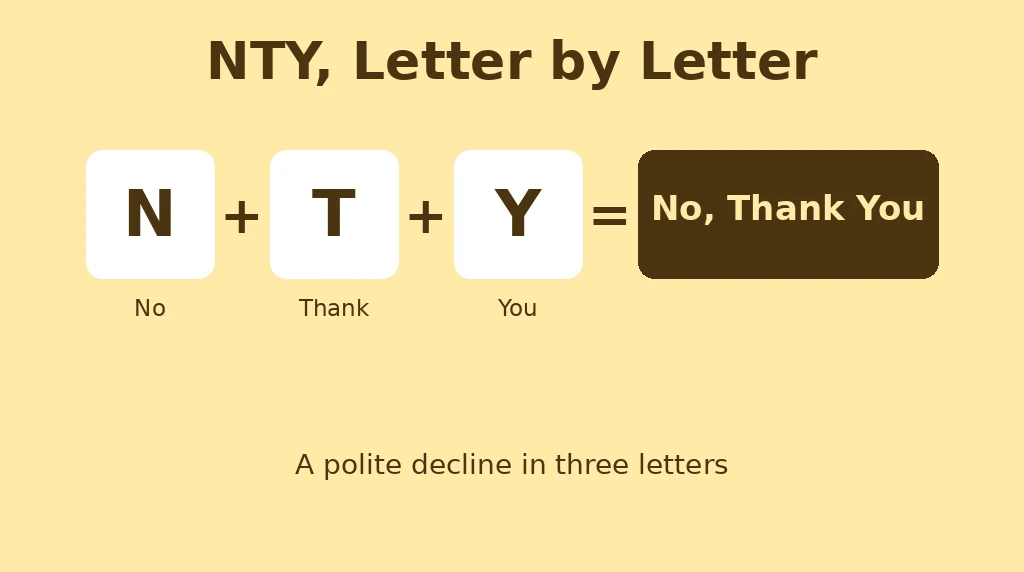
- N: No, the decline itself
- T: Thank, the polite part
- Y: You, the person being thanked
Put together, you get “No, Thank You”. That is the reading both CyberDefinitions and meanzafy give, and it is the lead meaning used in this guide. Say the letters out loud and you get en-tee-why, letter by letter, since nobody pronounces it as a word. In speech people say the full phrase, and the three letter form lives in typing only.
NTY likely grew out of TY, the widely used shorthand for “thank you”, with an N added at the front to flip the meaning into a polite decline. That history explains why the thank you stays inside the refusal, and why the term feels polite even when it is short.
NTY vs NT vs TBNT: What Is the Difference?
Three short forms look alike at a glance, so here they are side by side.
| Abbreviation | Full Form | What It Really Says | Tone |
|---|---|---|---|
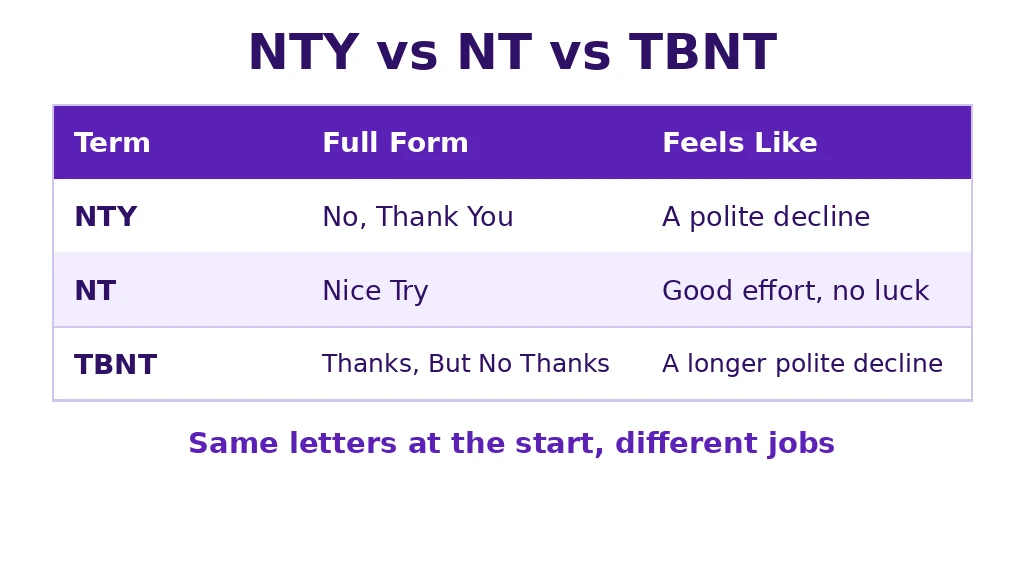
| NTY | No, Thank You | I am politely declining | Polite, sometimes blunt |
| NT | Nice Try | Good effort, no luck | Encouraging, mostly gaming |
| TBNT | Thanks, But No Thanks | I am declining, kindly | Polite, a little warmer |
The classic mix up is NTY versus NT, because the two share their first two letters and both show up in gaming chats. The difference is the job they do. NTY turns something down, as in “NTY, I will pass on that trade”. NT praises an effort that did not quite work, as in “NT, you almost had them”. One closes an offer, the other cheers a try.
TBNT is the odd one out in a useful way. It means almost exactly the same thing as NTY, only spelled out a little further, which can make it feel slightly warmer. Think of NTY as the fast version and TBNT as the fuller version of the same polite no. If you want the softest decline of the three, TBNT is the pick.
Where NTY Is Commonly Used
Texting and WhatsApp
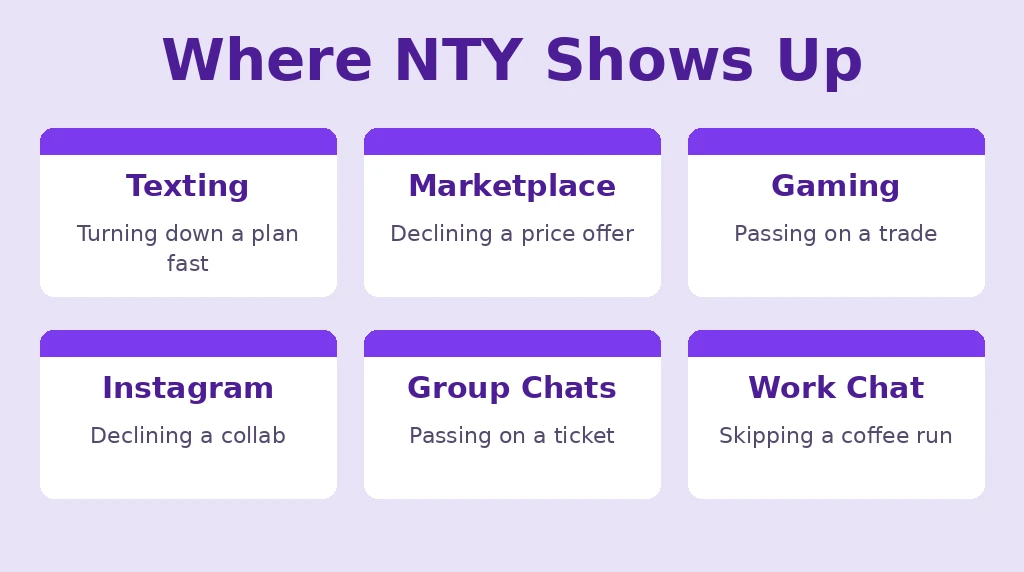
One to one chats are where nty shows up most. It turns down a hangout invite, a food order or a small favour fast, without making the sender type a full sentence. A typical line looks like this: “nty, staying in tonight”.
Instagram and Snapchat
On Instagram and Snapchat, nty appears in DMs when someone turns down a collaboration, a shoutout or a suggestion. It also works as a caption or a tag. A story reply that says “nty 😅” is not a speech, it is a quick, polite pass that keeps the chat moving.
TikTok Comments
Scroll a busy TikTok comment section and nty pops up under videos that suggest a challenge or a trend. Viewers type things like “nty, hard pass on this one” or “NTY not doing that lol” right under the video.
Group Chats
Group chats run on quick reactions, so nty fits them well. One person offers an extra concert ticket or asks who wants the last slice, and someone replies “nty, already have plans that night”. If the plan is still tbd, a softer “maybe later” usually works better than a flat no.
Gaming Chats
In game chat there is no time for full sentences, so nty does quick work between rounds. Players type things like “nty, good luck though” when offered a trade, or “nty, keeping my item” during a negotiation. Everyone understands it instantly, and nobody stops playing to decode it.
Discord and Forums
Discord servers and forums use nty the same way, just in longer threads. Someone offers help, a trade or a role in a project, and “NTY, I am good for now” is a normal reply that closes the offer without closing the conversation.
Origin and History of NTY
NTY has roots that go back further than a lot of newer internet slang, tracing to the early days of online message boards and IRC chat groups in the 1990s and early 2000s. Typing was often slower then and screen space was limited, which pushed early internet users to develop shorthand versions of common phrases.
NTY likely emerged as a natural extension of TY, the widely used shorthand for “thank you”, simply adding an N at the front to flip the meaning into a polite decline. As SMS texting became more widespread in the 2000s, character limits and slower mobile keyboards reinforced the same habit of shortening frequently used phrases. Early references to NTY on internet slang databases date back to the mid-2000s, showing just how long this abbreviation has been part of casual online conversation. As texting culture moved through instant messaging, social media and smartphone apps, NTY carried over smoothly, remaining useful anywhere quick, polite refusals are common.
Other Meanings and Variations of NTY
Unlike some texting abbreviations that carry several unrelated meanings, NTY is fairly consistent in what it stands for. Still, a few related nuances are worth knowing.
- A firmer, more abrupt decline: depending on punctuation and context, NTY can read as more blunt or final than a full “no, thank you”, especially when sent with no softening words around it. “NTY.” on its own feels final, while “NTY, maybe next time” feels open.
- Confusion with NT: NTY is sometimes mixed up with the similar looking “NT”, which usually means “Nice Try”, especially in gaming. The two are unrelated in meaning, even though they look alike at a glance.
- TBNT as a warmer twin: “Thanks, But No Thanks” works almost identically to NTY, though it spells out more of the phrase, which can make it feel slightly more expressive and a little warmer.
- NTY as a caption or tag: on social media, #nty gathers posts that decline a trend or a challenge, so the tag works as a caption style reaction rather than a message aimed at one person.
- Hard pass as a casual cousin: “hard pass” is a more casual, often humorous way of declining something, carrying more personality and emphasis than the neutral efficiency of NTY.
- Ion as a nearby slang spelling: “ion” comes from “I do not”, as in “ion know”, and it shows up in the same casual chats as NTY, though it means something completely different.
On social media, the caption and tag use behaves differently from the chat use. In a DM, nty declines one person’s offer. In a caption or a hashtag, it declines a trend or a challenge for everyone scrolling past, a mood rather than a message aimed at one person.
How to Use NTY Correctly
- Use it to politely decline offers or invitations. NTY works well as a quick way to turn something down without needing a long explanation.
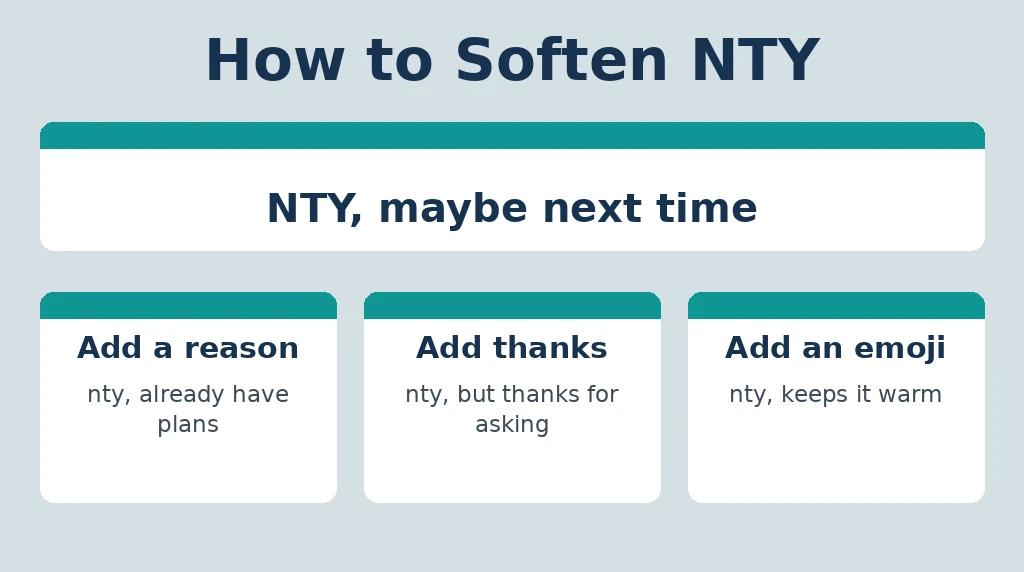
- Add context when you want to soften the tone. Pairing NTY with a brief reason, like “nty, already have plans”, helps avoid it feeling too abrupt.
- Consider your relationship with the recipient. NTY works great with close friends or casual acquaintances, but a fuller “no, thank you” might feel more appropriate with people you do not know as well.
- Use emojis to adjust the tone if needed. Adding a friendly emoji, like “nty 😅” or “nty, but thanks for asking!”, can help make sure your message does not come across as cold.
- Keep it casual. NTY belongs in friendly, informal chats. If the conversation would not welcome a “lol”, it will not welcome an “nty” either.
Example Conversations Using NTY
Declining an invitation
Person A: “Want to grab pizza tonight?”
Person B: “NTY, staying in tonight”
An online marketplace offer
Person A: “Would you take $20 for this?”
Person B: “NTY, but thanks for the offer”
A group chat ticket
Person A: “Anyone want the extra concert ticket?”
Person B: “NTY, already have plans that night”
A gaming trade
Person A: “Trade you this item for yours?”
Person B: “NTY, good luck though”
Declining help
Person A: “Need help with the assignment?”
Person B: “NTY, I already finished it”
A workplace coffee run
Person A: “Coffee run, want anything?”
Person B: “NTY, I am good for now”
A social media DM
Person A: “Interested in a collab?”
Person B: “NTY, not the right fit for me right now”
Softening the decline
Person A: “Come to the gym with me later?”
Person B: “NTY, maybe next time though”
When Not to Use NTY
- Work email: write “No, thank you” in full instead. Three letters look careless on the record.
- Job interviews and applications: even over chat, recruiters read nty as unprepared or too casual.
- Teachers and bosses: anyone grading or managing you deserves the full phrase, not a burst of shorthand.
- Customer service chats: on either side of the counter, nty sounds like nobody is taking the problem seriously.
- Sensitive conversations: when someone offers genuine help or support, a fuller, warmer response feels more appropriate than a quick abbreviation.
- Formal written documents: NTY has no place in resumes, cover letters or other professional writing where full, clear language is expected.
How to Respond When Someone Sends You NTY
An nty lands in your chat and the ball is suddenly in your court. The sender has said no, politely, so the best move is to accept it gracefully and keep the chat friendly.
Patient replies work when the decline is casual and the chat is friendly:
- “No worries at all, thanks for letting me know.”
- “All good! Let me know if you change your mind.”
- “Totally fine, just checking.”
Helpful replies suit a marketplace or work context:
- “No problem, thanks for considering it.”
- “Understood, I will keep you in mind for next time.”
Playful replies fit close friends and light topics:
- “Your loss, the pizza was amazing 😂”
- “Fine, more snacks for me then”
- “Okay okay, next time I will bring the good offer first”
One thing to avoid: do not push back with “Why not?” or “Come on, just try it” right after an NTY. The sender already answered, and pressing the point turns a polite no into an awkward moment. A quick, warm acceptance keeps the door open for next time. A smh reaction would only make it worse, since it reads as disappointment rather than acceptance.
Common Mistakes People Make With NTY
- Reading it as ruder than intended. Since NTY is so short, it can come across as colder than the sender meant, especially without any softening context. Give the sender the benefit of the doubt first.
- Confusing it with NT. Because the two abbreviations look similar, people sometimes mix up NTY, “No, Thank You”, with NT, “Nice Try”, even though they mean completely different things.
- Sending it without context. Using NTY on its own, without referencing what is being declined, can confuse the recipient, especially in fast moving group chats with several topics going at once.
- Using it in formal chats. NTY is casual shorthand, so it fits badly in work, school and customer service, even when the decline is genuine.
- Assuming it is always negative. While NTY is a decline, it is not inherently rude or upset in most everyday contexts. It is simply an efficient, polite way of saying no.
Frequently Asked Questions
What does NTY mean in text?
NTY means “No, Thank You” in texting. It is a short, polite way to decline an offer, an invitation or a suggestion, as in “NTY, I already have plans tonight”.
Is NTY rude?
Not usually. The words themselves are polite, since they include a thank you. A bare “NTY” with no extra words can feel blunt, so adding a short reason or a friendly emoji keeps it warm.
What is the difference between NTY and NT?
NTY means “No, Thank You” and declines something. NT means “Nice Try” and praises an effort that did not quite work, mostly in gaming. They look alike but do completely different jobs.
Can I use NTY in a work email?
No. NTY is casual texting shorthand, so it looks unprofessional in work emails and formal messages. Write “No, thank you” in full instead.
How can I make NTY sound warmer?
Add a short reason, a thank you, or a friendly emoji. “NTY, already have plans, but thanks for asking!” reads much warmer than a bare “NTY” on its own.
How do I reply when someone sends me NTY?
Accept it gracefully. “No worries!” or “All good, let me know if you change your mind” keeps the chat friendly and leaves the door open.
Final Thoughts
Three letters, one polite no, and a surprising amount of range packed inside. NTY is the fastest way to say “No, Thank You” in texting, and it has earned its place in everyday chats because everyone meets offers they need to turn down. Used casually, with a short reason or a friendly emoji when the moment matters, it never really causes trouble.
One honest note before you go: NTY itself has no full dictionary entry yet, so you will not find it listed as a slang term in the big dictionaries. If you want the closest real dictionary page, Dictionary.com has an entry for “thank you”, the polite phrase at the heart of NTY. Either way, you now have the nty meaning in text down, plus a decent reply ready for the next time it shows up in your messages.
