You tell a friend some shocking news, share an unexpected update, or drop a piece of juicy gossip, and the reply you get back is just three letters: “SYM.” At first glance it looks a little harsh, almost like they are telling you to be quiet. But something about the tone of the chat makes it feel like that is not quite what they mean.
Here is the short answer first. SYM means “Shut Your Mouth” in texting, but in modern chats it is almost never used as an actual command to stop talking. It works as a reaction, most often expressing shock, disbelief or playful surprise, like gasping “no way, stop it” when someone tells you something wild. This guide covers the sym meaning in text, the tone it usually carries, SYM vs OMG and SMH, where you will see it, and how to reply.
What Does SYM Mean in Text?
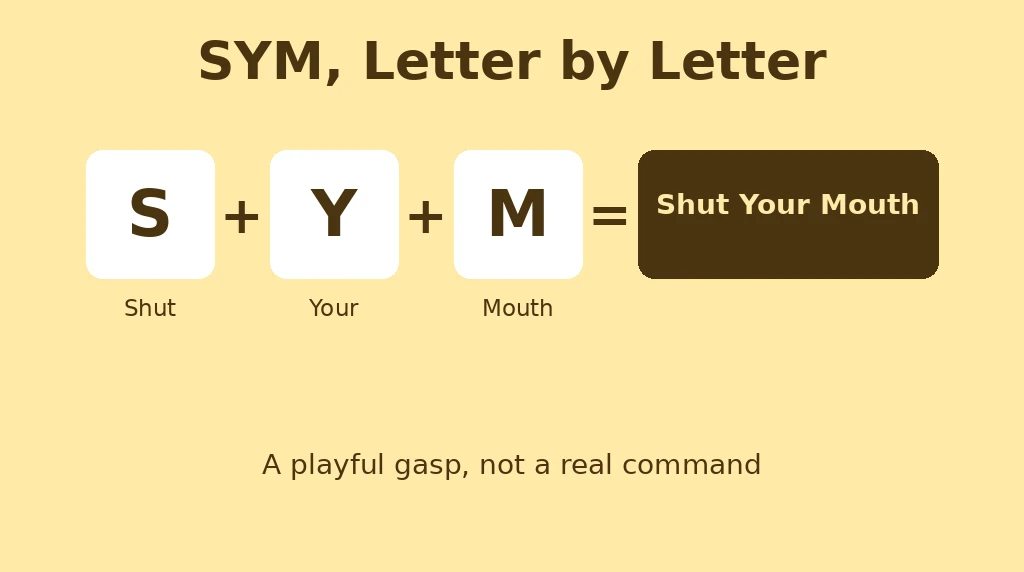
SYM is a short way of writing “Shut Your Mouth”. Taken word for word, that sounds like an order to be quiet. In real texting, though, the phrase has been softened into a reaction. Someone sends it right after surprising news, the way you would gasp out loud in a real conversation. “SYM, no way, tell me everything” means the news is shocking, not that the sender wants silence.
The tone changes with the words around it. “SYM?! 😭” reads as pure excitement. “sym, spill it right now” reads as eager curiosity. A bare “SYM.” with a full stop sounds colder, closer to the literal meaning. Lowercase “sym” feels relaxed, while uppercase “SYM” looks louder, like someone leaning in with wide eyes.
It sits close to a plain “no way”, but SYM carries more drama and more energy. The key point is the relationship. Among close friends, SYM reads as playful and excited almost every time.
Full Form of SYM
The full form is simple, because SYM is built from the first letters of a phrase:
- S: Shut, as in close it
- Y: Your, belonging to you
- M: Mouth, the thing doing the talking
Put together, you get “Shut Your Mouth”. That is the reading both CyberDefinitions and meanzafy give, and it is the lead meaning used in this guide. Say the letters out loud and you get ess-why-em, letter by letter, since nobody pronounces it as a word. In speech people say the full phrase, and the three letter form lives in typing only.
The phrase itself is much older than texting. “Shut your mouth” has been used in everyday spoken English for a long time as a blunt way of telling someone to be quiet. Texting took that familiar phrase, shortened it, and softened it into a joke reaction.
SYM vs OMG vs SMH: What Is the Difference?
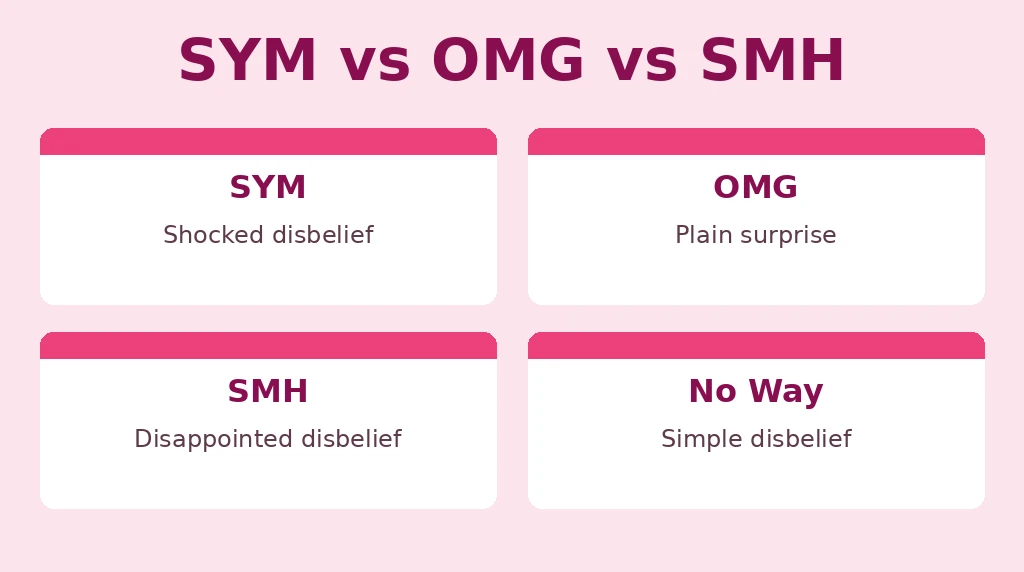
Three short reactions look similar at a glance, so here they are side by side.
| Abbreviation | Full Form | What It Really Says | Tone |
|---|---|---|---|
| SYM | Shut Your Mouth | No way, I cannot believe it | Shocked, playful, dramatic |
| OMG | Oh My God | Wow, that surprises me | Surprised, neutral, safe |
| SMH | Shaking My Head | I cannot believe you did that | Disappointed, judging |
The classic mix up is SYM versus OMG, because both react to surprising news. The difference is energy. OMG is a plain, safe exclamation that works in almost any chat. SYM is louder and more dramatic, the reaction you send when the news is so wild that a plain “omg” feels too small.
Smh is the odd one out in a useful way. It never means excitement. It means disappointment, the digital version of shaking your head at something silly or careless. SYM says “tell me more”, while SMH says “I wish you had not done that”. One invites gossip, the other judges it.
Where SYM Is Commonly Used
Texting and WhatsApp
One to one chats are where sym shows up most. It reacts to surprising news from a friend fast, without making the sender type a full sentence while they are still processing it. A typical line looks like this: “SYM, are you serious right now”.
Instagram and Snapchat
On Instagram and Snapchat, sym appears in DMs and story replies when someone shares a dramatic reveal or an unexpected photo. It also works as a caption or a tag. A comment that says “sym I was NOT expecting that” is a public gasp for everyone scrolling past.
TikTok Comments
Scroll a busy TikTok comment section and sym pops up under videos with plot twists or dramatic endings. Viewers type things like “sym that ending completely got me” right under the video.
Group Chats
Group chats run on quick reactions, so sym fits them well. One person drops gossip or a bold claim, and someone replies “SYM I did NOT know that” before anyone has time to write more.
Gaming Chats
In game chat there is no time for full sentences, so sym does quick work between rounds. Players type things like “SYM that play was insane” while the match is still moving.
Discord and Forums
Discord servers and forums use sym the same way, just in longer threads. Someone posts a surprising opinion or a strange update, and “SYM, wait, really?” is a normal reply that keeps the discussion going.
Origin and History of SYM
SYM developed the way a lot of internet slang does, growing out of the much older phrase “shut your mouth”, which has been used in everyday spoken English for a long time as a blunt way of telling someone to be quiet. As texting and instant messaging became widespread in the 2000s, phrases that were already common in casual speech began getting shortened into acronyms to save time while typing.
“Shut your mouth” was a natural candidate for this kind of compression, especially since it gets used constantly in reaction to surprising or dramatic news, not just as a literal command. Over time, texting culture leaned more into sarcasm and playful reactions, and SYM shifted from a potentially aggressive command into a common way of expressing shock or excitement instead. Social media platforms like TikTok and Instagram then pushed SYM further into mainstream casual use, especially as comment sections became a space for quick, punchy reactions to dramatic moments.
Other Meanings and Variations of SYM
While “Shut Your Mouth” used as a playful reaction is by far the most common SYM meaning in text, a few other contexts and nuances are worth knowing.
- Genuine, literal use: in tenser conversations or arguments, SYM can occasionally be used closer to its literal meaning, as a sharper way of telling someone to stop talking. This usage is less common in casual, friendly texting but it does happen.
- Vulgar second definition: CyberDefinitions also lists “Suck Your Mom” as a second definition for SYM. This reading is far less common and typically only appears in crude joking contexts, not standard casual conversation. Meanzafy hints at the same unnamed vulgar alternate in its own guide.
- SYM as a caption or tag: on social media, #sym gathers reaction posts under one label, so the tag works as a caption style reaction rather than a message aimed at one person. A caption that says “sym” reacts to the post itself, a mood for everyone scrolling past.
- STFU as a harsher cousin: STFU is a much harsher, more aggressive version of the same basic command, carrying far more genuine hostility than the playful energy typically behind SYM. Do not treat the two as equals.
- Idc as a nearby reaction: “idc” means “I do not care”, and it shows up in the same casual chats as SYM, though it means something completely different. SYM reacts with shock, while idc reacts with indifference.
- Regional or personal shorthand: certain friend groups may develop their own inside joke meaning for SYM that does not match the more common interpretation.
On social media, the caption and tag use behaves differently from the chat use. In a DM, sym reacts to one person’s news. In a caption or a hashtag, it reacts to the post itself, a mood for everyone scrolling past, not a message aimed at one person.
How to Use SYM Correctly
- Use it as a reaction, not a command. SYM works best as an expressive response to shocking or surprising news, similar to saying “no way” or “stop it”.
- Reserve it for close friends. Since the tone depends heavily on relationship familiarity, use it with people who already understand your texting style and will not take it literally.
- Pair it with punctuation or emojis for clarity. Adding exclamation points or a laughing or shocked emoji, like “SYM?! 😭”, helps make sure your excitement or disbelief comes through clearly.
- Avoid it in tense or serious conversations. Since the literal meaning is fairly blunt, keep SYM out of genuine disagreements or emotionally sensitive discussions, where it could be misread as hostile.
- Keep it casual. SYM belongs in friendly, informal chats. If the conversation would not welcome a “lol”, it will not welcome a “sym” either.
Example Conversations Using SYM
Reacting to surprising news
Person A: “Guess who just got engaged?!”
Person B: “SYM no way, tell me everything”
Group chat gossip
Person A: “Apparently they broke up last week”
Person B: “SYM I did NOT know that”
A TikTok comment
Person A: “sym that ending completely got me”
Person B: “Right? I had to watch it twice”
A Snapchat reaction
Person A: “Sent you a pic from the concert last night”
Person B: “SYM you went without me?!”
Reacting to a funny story
Person A: “You will not believe what happened at work today”
Person B: “sym, spill it right now”
An Instagram comment
Person A: “SYM I was NOT expecting that”
Person B: “Same, I gasped out loud”
A shocked reaction to a compliment
Person A: “Honestly you are one of the funniest people I know”
Person B: “sym stop being so nice 😭”
Reacting to unexpected plans
Person A: “We are actually going on that trip next month”
Person B: “SYM are you serious right now”
When Not to Use SYM
- Work email: write your reaction in plain words instead. Three letters with a blunt literal meaning look careless on the record.
- Job interviews and applications: even over chat, recruiters read sym as unprepared or too casual.
- Teachers and bosses: anyone grading or managing you deserves a full, polite sentence, not a burst of slang that could read as rude.
- Customer service chats: on either side of the counter, sym sounds like nobody is taking the problem seriously.
- Serious conversations: in discussions involving real conflict, hurt feelings or emotionally significant topics, the underlying literal meaning makes SYM a risky choice.
- With people who may not know it: since the playful tone relies on shared understanding, using it with someone less familiar with casual texting slang could easily be misread as genuinely rude.
How to Respond When Someone Sends You SYM
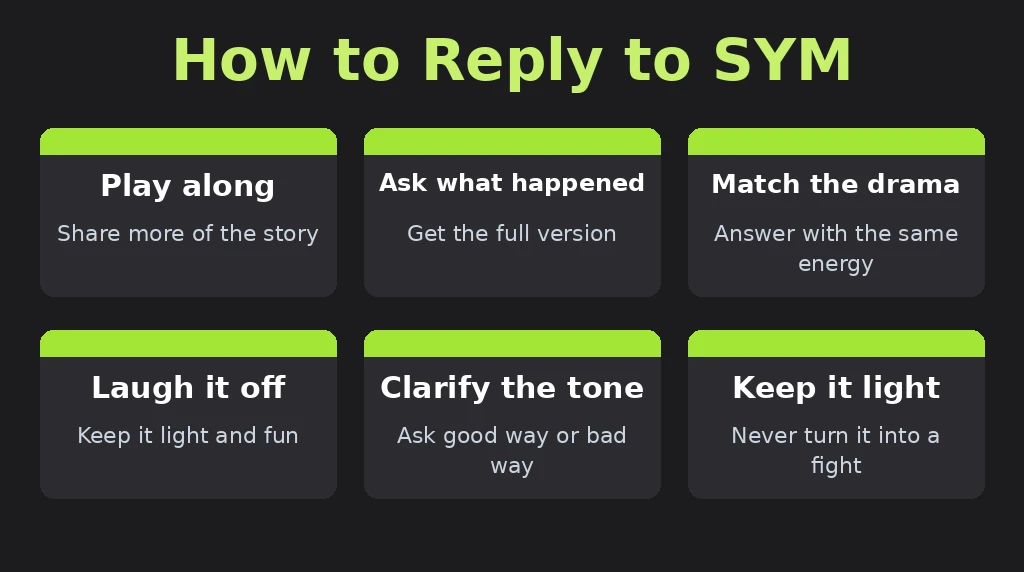
A sym lands in your chat and the ball is suddenly in your court. The sender is reacting to your news with shock or excitement, so the best move is usually to give them more of the story.
Patient replies work when the news is big and deserves detail:
- “I KNOW, right?! Let me tell you the whole story.”
- “It is true, I could not believe it either when I heard it.”
- “Okay, full version: it started last week when…”
Helpful replies suit a sym that asks for the facts:
- “Yes, really. Here is what happened, step by step.”
- “I will send you the screenshot so you can see it yourself.”
Playful replies fit close friends and light topics:
- “I know, I am still shocked too 😂”
- “Right?! My jaw dropped when I found out”
- “Wait until you hear the rest of it”
If you are unsure of the tone, ask before going on: “Wait, in a good way or a bad way?” That question is normal, and it beats guessing wrong. And if the sym felt tense or serious, a quick “Hey, did I say something wrong?” can clear the air fast. Do not answer a playful SYM with a nvm and drop the topic, since the sender is asking for more, not less.
Common Mistakes People Make With SYM
- Taking it too literally. The biggest misunderstanding happens when someone unfamiliar with texting slang assumes SYM is a genuine, rude command, when most of the time it is an excited or shocked reaction.
- Using it with the wrong audience. Sending SYM to someone unfamiliar with casual texting slang, like an older relative or a new coworker, can lead to real confusion or hurt feelings.
- Missing the tone in text form. Since text lacks vocal inflection or facial expressions, the playful intent can get lost, especially without supporting punctuation or emojis to clarify the mood.
- Confusing it with harsher alternatives. Some people mistakenly equate SYM with much more aggressive phrases like STFU, when SYM generally carries a noticeably lighter, more playful tone.
- Using it in serious chats. SYM is a casual reaction, so it fits badly in work, school and customer service, even when the news is genuinely surprising.
Frequently Asked Questions
What does SYM mean in text?
SYM means “Shut Your Mouth” in texting. In casual chats it is almost always a playful reaction to shocking or surprising news, like saying “no way, stop it”, rather than a real command.
Is SYM rude?
Not usually among friends. Its literal words sound blunt, but the common use is an excited, joking reaction. With strangers, in arguments, or without a friendly emoji, it can read as genuinely rude.
What is the difference between SYM and STFU?
SYM is a playful gasp of disbelief between friends, while STFU is a much harsher, more aggressive way of telling someone to stop talking. SYM invites more gossip, STFU shuts the chat down.
Can SYM mean something vulgar?
Yes. CyberDefinitions also lists a vulgar second definition, “Suck Your Mom”, but that reading is far less common and only shows up in crude joking contexts. The everyday meaning is “Shut Your Mouth” used playfully.
Can I use SYM in a work email?
No. SYM is casual texting slang with a blunt literal meaning, so it looks unprofessional and risky in work emails and formal messages. Write the full reaction in plain words instead.
How do I reply when someone sends me SYM?
Match their energy. If it is playful, share more details with “I KNOW, right?!” If you are unsure of the tone, ask “In a good way or a bad way?” before going on.
Final Thoughts
Three letters, one loud gasp, and a surprising amount of range packed inside. SYM usually means “Shut Your Mouth” used playfully, the texting version of gasping “no way, stop it” when a friend drops wild news. Used casually, with close friends and a friendly emoji when the moment matters, it never really causes trouble.
One honest note before you go: the slang SYM has no full dictionary entry yet. Dictionary.com does list a page for “sym”, but it covers the sym- prefix found in words like symbol and symphony, not the texting slang. Either way, you now have the sym meaning in text down, plus a decent reply ready for the next time it shows up in your messages.
