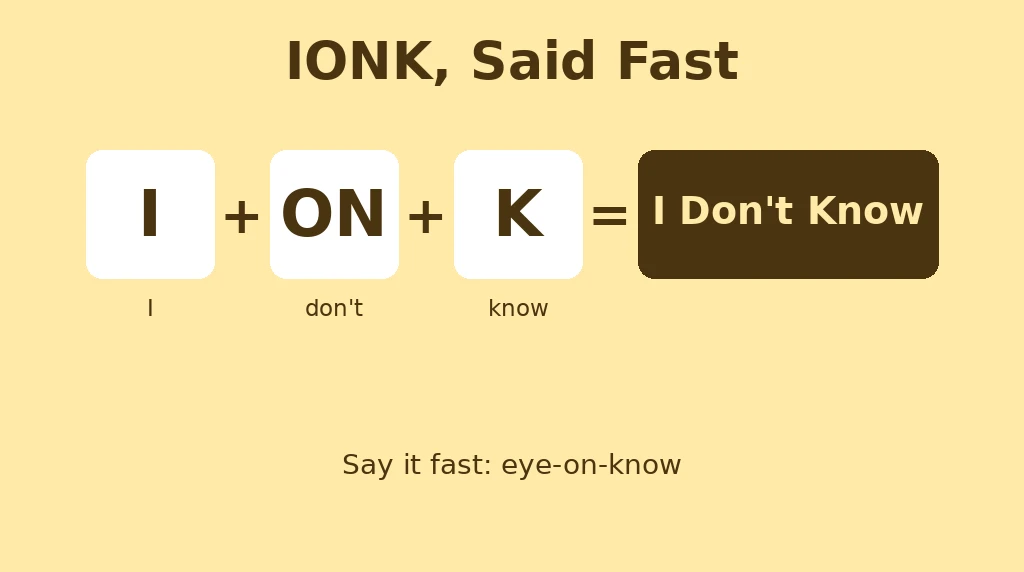
A friend asks where the charger went. You have no idea, and the chat is moving fast. You type four letters and move on: “ionk.” It looks like a typo, but it is not.
Here is the quick answer. IONK means “I don’t know”, written the way it sounds when you say it fast. Say it out loud and it clicks: eye-on-know. This guide covers the ionk meaning in text, how to say it, IONK vs IDK and IDEK, where it shows up, and the best ways to reply. By the end, you will read ionk without pausing, and you will know when it fits and when plain words work better. It is the kind of word that looks wrong until someone says it out loud, and then it makes perfect sense.
What Does IONK Mean in Text?
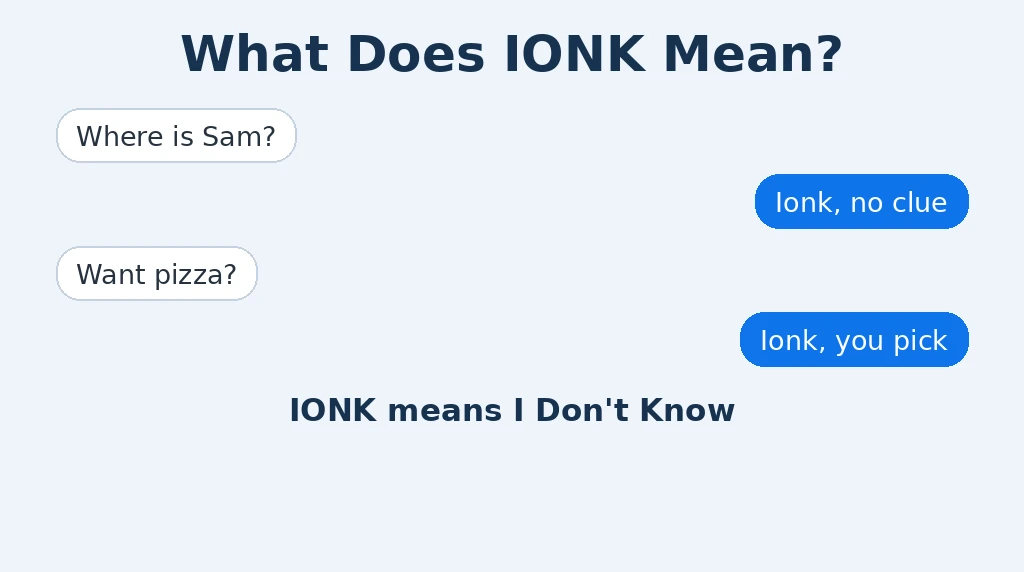
In texting, IONK stands for “I don’t know”, spelled the way the phrase sounds in fast, casual speech. When people say “I don’t know” quickly, the words blur together, and IONK copies that blur onto the screen. If a friend asks, “Where is Sam?” and you answer “ionk”, you are saying you have no clue, in the most relaxed way possible.
The tone is light and loose. IONK feels playful and unbothered, which is why it fits group chats and late night talks so well. It can read as careless in a serious chat, though, because a bare “ionk” can sound like a shrug when someone needed a real answer. Adding a few words, like “ionk, let me check”, fixes the tone fast.
Lowercase “ionk” reads softer and more casual inside a sentence, while uppercase “IONK” stands out and can look like you are shouting the shrug. The meaning stays the same either way. What changes the meaning is the chat around it, because IONK can also mean “I only know” in rare cases, and that sense is covered in the variations section below.
Full Form of IONK
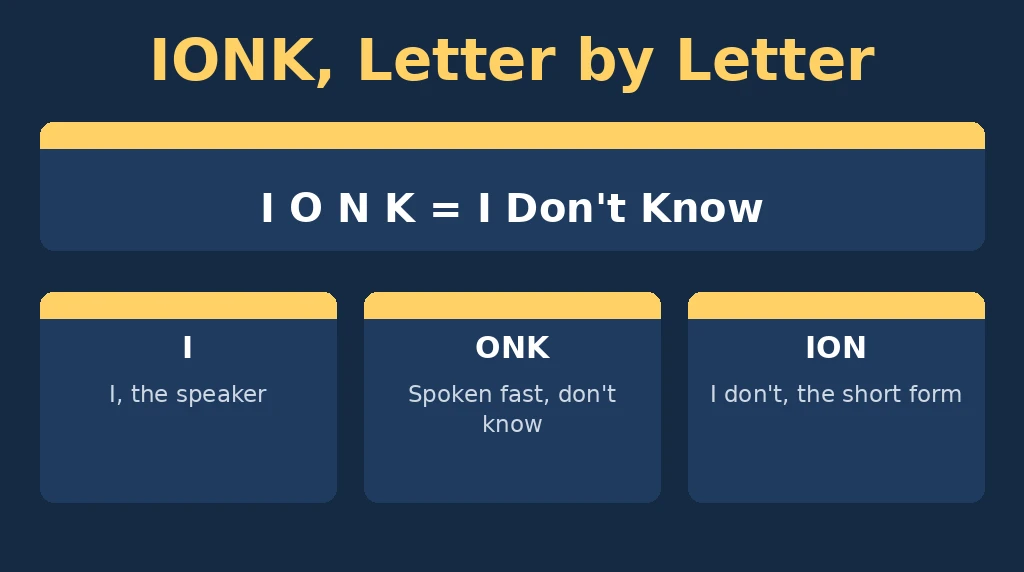
IONK is a phonetic spelling of “I don’t know”, not a set of initials to expand word by word. That point matters, because the letters copy a sound, not four separate words. Say “I don’t know” fast three times and you will hear it: the “don’t” melts away and what is left sounds like “onk”.
- I: I, the person speaking
- ONK: “don’t know” said fast, the sound that remains when the words blur together
Say it out loud and the pattern is simple. People say it as one quick word, eye-onk, or stretched a little longer, eye-on-know. Nobody spells the letters out one at a time, because IONK is a sound word, not an initialism.
IONK is closely related to “ion”, a short spoken form of “I don’t” that shows up in lines like “ion know”. Think of IONK as the next step: where “ion” drops the “know” and leaves it to context, IONK keeps the whole phrase in one fast package.
IONK vs IDK vs IDEK: What Is the Difference?
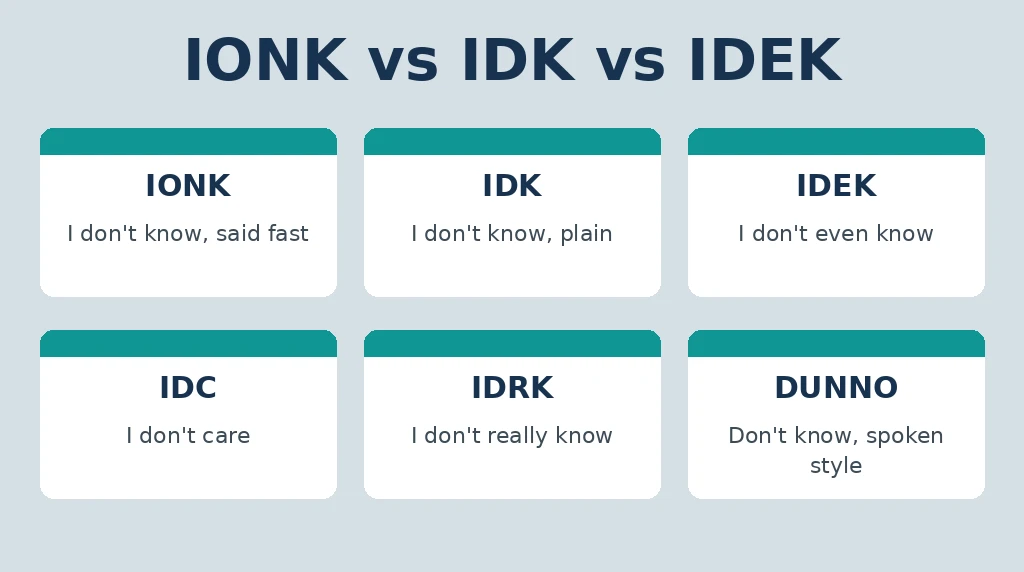
IONK belongs to a small family of “I don’t know” words, and the family members look alike at a glance. Here they are side by side.
| Abbreviation | Full Form | What It Really Says | Tone |
|---|---|---|---|
| IONK | I Don’t Know | No clue, said fast | Loose, playful |
| IDK | I Don’t Know | No clue, plain and clear | Neutral, standard |
| IDEK | I Don’t Even Know | No clue, and I am lost | Stronger, baffled |
The classic mix up is IONK versus IDK, because the two mean exactly the same thing. The gap is style, not meaning. IDK is the plain initialism, clean and standard, while IONK is the sound spelling, loose and playful. If you want to sound calm and clear, pick IDK. If you want to sound relaxed and a little funny, pick IONK.
IDEK sits one step further along. “I don’t even know” adds disbelief or frustration to the missing answer, so it fits moments when the question itself feels wild. IONK says you do not know. IDEK says you do not know and you cannot believe the question.
Where IONK Is Commonly Used
Texting and WhatsApp
In one to one chats, IONK shows up in quick questions with no clear answer. A typical line looks like this: “Where did you put the keys?” “Ionk, check the kitchen.” Short, relaxed, and the chat keeps moving.
Instagram and Snapchat
On Instagram and Snapchat, IONK shows up in comments and story replies. A friend posts a mystery photo and the replies come fast: “Whose dog is that?” “Ionk, ask her.” The picture beside it usually makes the meaning obvious.
TikTok Comments
On TikTok, IONK appears under videos that ask the audience a question. A viewer writes “ionk but this song is stuck in my head” and the clip itself, a catchy tune, does the explaining.
Group Chats
Group chats are the natural home of IONK. When a question floats to the whole group and nobody knows, the answers roll in as a chorus of “ionk” before anyone has time to write more. One person asks “who is coming on Friday?” and three people answer “ionk” at once.
Gaming Chats
In gaming chats, IONK shows up between rounds, when there is no time for full sentences. A player types “ionk where he went” and keeps playing, and nobody stops the game to decode it. The shrug is the whole point.
Discord and Forums
Discord servers and forums use IONK in longer threads about games, shows and plans. Someone asks “does this update drop today?” and the replies debate dates and rumours in detail, with “ionk” doing the honest work of admitting nobody is sure.
Origin and History of IONK
IONK grew out of the phonetic spelling trend that swept social media in the late 2010s. Young texters started writing words the way they sounded in fast speech, and “I don’t know” was an obvious target, because everyone says it and everyone slurs it. The spelling caught on first in tweets and TikTok comments, where sounding casual matters more than spelling right.
The word “ion” paved the way. “Ion” is a short spoken form of “I don’t” that shows up in lines like “ion know”, and once people were comfortable writing “ion”, the full form “ionk” was a small step. The two words now travel together, and you will often see them in the same chat.
Texting speed kept it alive. When a chat moves fast, four letters that copy the sound of the phrase beat a longer answer every time. IONK never needed a dictionary to spread, because the sound was already in everyone’s mouth.
Other Meanings and Variations of IONK
In everyday talk, IONK almost always means “I don’t know”, but the same letters carry a few other readings worth knowing.
- “I only know” as a variant: a few texters use IONK to mean “I only know”, as in “ionk that part, not the rest.” It is rare, and it only works when the chat makes the limit clear.
- “Ionk fr” for emphasis: adding “fr”, short for “for real”, turns a plain shrug into a stronger one. It fits moments when you really have no idea and want the other person to believe you.
- ion, the shorter cousin: “ion” means “I don’t” and shows up in lines like “ion know”. It is the root that IONK grew from, and the two words share the same sound.
- Lowercase ionk vs uppercase IONK: the small letters feel softer and more casual in a sentence, while the capitals stand out and can look like you are shouting the shrug. The meaning stays the same either way.
- “Dunno” as a spoken cousin: “dunno” is the older sound spelling of “don’t know”, and it does the same job in a slightly different style. IONK is the newer, chat native version.
How to Use IONK Correctly
- Use it for honest uncertainty. IONK works when you truly do not know. It is a shrug in letters, so keep it near questions you cannot answer.
- Add a few words when the chat is serious. A bare “ionk” can sound like you do not care, so a quick extra phrase nearby, like “ionk, let me check”, settles the tone fast and avoids confusion.
- Keep it in casual chats. IONK belongs with friends, in group chats and in gaming lobbies. It is not a word for teachers, bosses or formal messages.
- Match the spelling to the room. If everyone in the chat types phonetic slang, IONK fits right in. If the chat is plain and careful, IDK is the safer pick.
- Do not force it outside its natural home. IONK works best when the conversation already makes the meaning obvious. Dropping it into an unrelated sentence just creates confusion.
Example Conversations Using IONK
A missing charger
Person A: “Where is the charger?”
Person B: “Ionk, check the kitchen drawer”
A group chat question
Person A: “Who is coming on Friday?”
Person B: “Ionk, ask in the group”
A TikTok comment
Person A: “What song is this?”
Person B: “Ionk but it is stuck in my head”
A gaming chat
Person A: “Where did he go?”
Person B: “Ionk, he vanished mid round”
A food decision
Person A: “Pizza or burgers tonight?”
Person B: “Ionk, you pick, I am fine either way”
An Instagram reply
Person A: “Whose dog is that in your story?”
Person B: “Ionk, my cousin posted it”
The unsure one
Person A: “Does the update drop today?”
Person B: “idk either, ionk is all I have got”
The confusing one
Person A: “Ionk what to wear tomorrow”
Person B: “Same, nothing in my closet feels right”
When Not to Use IONK
- In a work email: using IONK instead of “I don’t know” will make you look careless to readers who do not know the spelling.
- In formal writing: reports, applications and official documents should always use full words.
- With teachers and bosses: a phonetic shrug reads as lazy in a message to someone in authority, so write the full phrase instead.
- In serious conversations: when someone shares bad news or asks for real support, a loose “ionk” can feel like you are brushing them off.
- When you are dodging a decision: if the question needs an answer and you keep saying “ionk”, it starts to look like you are avoiding the choice.
- When the other person does not know slang: if they never use phonetic spellings, IONK will read like a typo to them, so spell it out instead.
How to Respond When Someone Sends You IONK
An IONK lands in your chat and the ball is suddenly in your court. They have told you they do not know, so help them move forward instead of asking the same question twice.
Patient replies work when someone is honestly unsure:
- “No worries, let us ask Sam.”
- “Fair enough, I will check and tell you.”
- “Same here, we will figure it out together.”
Helpful replies suit an IONK that asks for a plan:
- “Let us look it up, it will take two minutes.”
- “I will ask the group, someone must know.”
Playful replies fit close friends and light topics:
- “Ionk is not an answer, pick one”
- “Classic ionk energy, love it”
One thing to avoid: do not answer an honest IONK with a bare “ok” and then keep asking the same question. If you typed the wrong question, send a quick nvm and ask the right one instead.
Common Mistakes People Make With IONK
- Assuming it is a typo. IONK looks like a misspelling, but it is a deliberate sound spelling. Correcting it misses the joke.
- Confusing IONK with IDK. The meaning is the same, but the style differs. IONK is loose and playful, while IDK is plain and standard.
- Using it to dodge decisions. Saying “ionk” to every question can look like you are avoiding a choice, even when you only meant to be honest.
- Using it at work or school. A phonetic shrug in a formal message reads as careless, so save IONK for casual chats.
- Reading rudeness into a shrug. A bare “ionk” is usually just a quick answer, not an insult. Check the chat before assuming the worst.
Frequently Asked Questions
What does IONK mean in text?
IONK means “I don’t know.” It is a phonetic spelling of the phrase, written the way it sounds when you say it fast in a casual chat.
How do you pronounce IONK?
Say it fast as eye-on-know, or eye-onk for short. The sound comes from slurring “I don’t know” together, the same way people say “gonna” for “going to.”
What is the difference between IONK and IDK?
The meaning is the same, only the style differs. IDK is the plain initialism, I D K, while IONK is a phonetic spelling that copies fast speech. IONK feels looser and more playful, while IDK feels cleaner and more standard.
Is IONK rude?
Not on its own. IONK is a casual way to say you do not know, and it only sounds rude when the chat is serious and a bare “ionk” feels like a shrug. Adding a few words, like “ionk, let me check,” fixes the tone.
Can I use IONK in a work email?
It is best not to. In a work email, write “I don’t know” in full, or say what you do know and what you will find out. IONK belongs in quick chats with friends, not in formal writing.
How do I reply when someone sends me IONK?
Help them move forward. Ask someone else, suggest a guess, or look it up together. A good reply sounds like “no worries, let us ask Sam” or “fair enough, I will check and tell you.”
Final Thoughts
IONK is a small set of letters with a loose, playful job. It means “I don’t know”, written the way the phrase sounds when you say it fast, and it exists for moments when a quick shrug is the honest answer. The letters never change, but the chat around them changes everything about how they land.
If you want a second opinion from a dictionary source, Wiktionary lists an entry for IONK. Either way, you now have the ionk meaning in text down, plus a decent reply ready for the next time it shows up in your messages.
