You ask your friend if they are coming to the game tonight. The reply comes back fast: “igh.” One word, three letters, no emoji, no extra detail. Did they just agree, or did they brush you off?
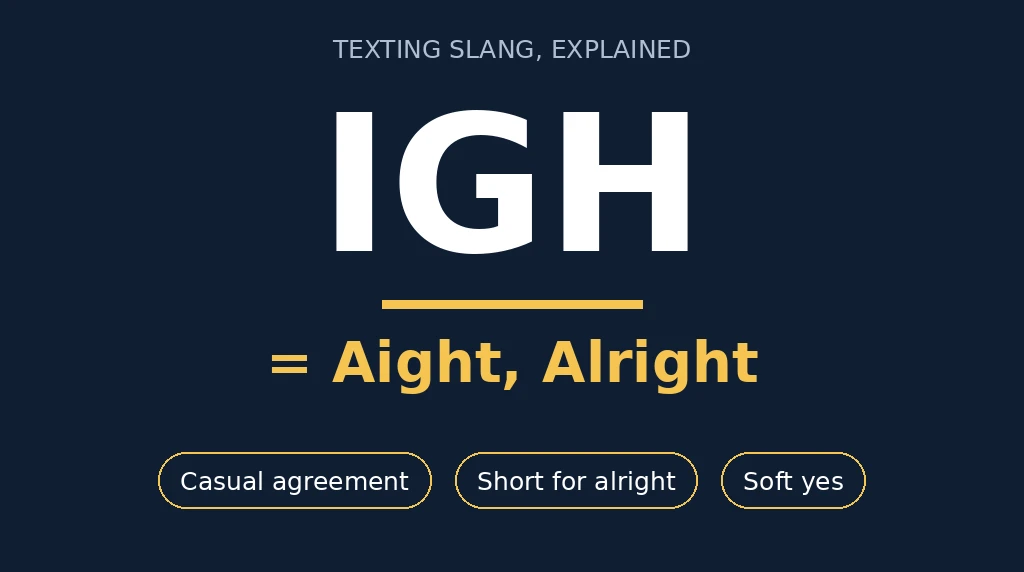
Here is the quick answer. IGH means “aight,” a casual shortened spelling of “alright.” It is a yes, but often a soft one, the kind that says “fine, okay” rather than “yes, I would love to.” This guide covers the igh meaning in text, the reluctant tone that makes it tricky, IGH vs IGHT vs AIGHT, where it shows up, and the best ways to reply. By the end, you will know exactly when a short “igh” means yes, when it means “not really,” and what to send back.
What Does IGH Mean in Text?

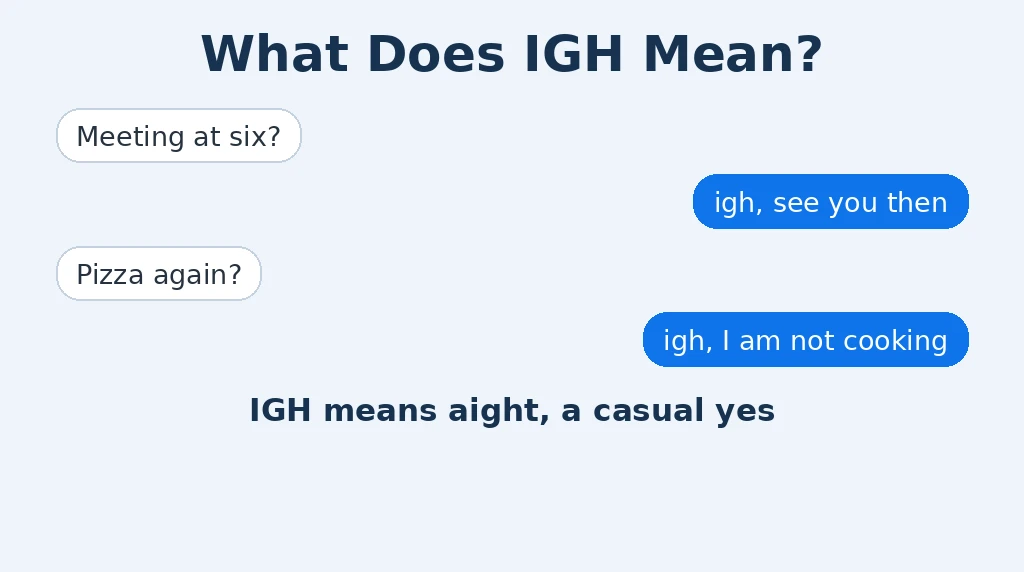
In texting and on social media, IGH means “aight,” which is a relaxed way of writing “alright.” People use it to agree with a plan, to accept a suggestion, or to say okay when they do not feel like typing a full sentence. If a friend texts, “we are meeting at six, right?” and you answer “igh,” you have said yes.
The tone is where IGH gets interesting. It usually carries a hint of reluctance, like a shrug in text form. It can mean “okay, I guess” or “fine, if that is what we are doing.” That does not make it rude, but it does make it different from an excited yes. A bare “igh” after a big question can leave the other person wondering whether you are really on board.
Lowercase “igh” reads softer and more casual than uppercase “IGH.” The capitals can look blunt, almost like a sigh, while the small letters blend into a relaxed chat.
Full Form of IGH
Here is the honest part, and it matters. IGH is not initials, so there is no full form to expand:
- I: does not stand for a word on its own
- G: does not stand for a word on its own
- H: does not stand for a word on its own
Instead, the whole word is a respelling of “aight,” which is itself a casual respelling of “alright.” Say it out loud and the pattern is clear. People pronounce it like “ight,” one smooth sound, because that is how “alright” sounds when you say it quickly in everyday speech. Nobody reads the letters one at a time, and treating IGH like initials would confuse everyone in the chat.
That spelling has a history in spoken English. “Aight” grew out of the way “alright” is said in relaxed conversation, especially in African American Vernacular English and hip hop culture, where it has been common for decades. IGH is simply a shorter texting version of the same sound, dropping a letter to save a keystroke.
IGH vs IGHT vs AIGHT: What Is the Difference?

IGH belongs to a small family of spellings that all point at the same word. Here they are side by side.
| Spelling | Full Form | What It Really Says | Tone |
|---|---|---|---|
| IGH | Aight | Okay, fine, agreed | Casual, a bit flat |
| IGHT | Aight | Okay, fine, agreed | Casual, most common |
| AIGHT | Alright | Okay, all right, agreed | Casual, clear |
| ALRIGHT | Alright | Okay, I agree with you | Plain, neutral |
The classic mix up is IGH versus IGHT, because they look almost the same and mean exactly the same thing. IGHT is the spelling most people recognise, and it shows up far more often in chats and comments. IGH is the shorter cousin, used by people who type fast and do not mind an unusual spelling. If you are unsure which one to use, IGHT is the safer pick because more people will read it at a glance.
AIGHT sits one step closer to standard English. It keeps the extra letters, so it reads clearly as “alright” even to someone who has never seen the shorter forms. And when the conversation turns formal, none of these spellings fit, and plain “alright” or “sounds good” does the job better. The meaning never changes across the family, only the spelling and the vibe.
Where IGH Is Commonly Used
Texting and WhatsApp
In one to one chats, IGH shows up as a quick yes to a plan or a question. A typical line looks like this: “We are leaving at seven, okay?” “igh.” Short, plain, and the chat keeps moving, though the other person may double check that you are really fine with it.
Instagram and Snapchat
On Instagram and Snapchat, IGH pops up in comments and direct messages, often as a reaction to a story or a plan. Someone posts, “game night at mine, who is in?” and a reply of “igh, I will be there” does the whole job in five words.
TikTok Comments
In TikTok comments, IGH works as a quick agreement with a video or a joke. A creator says, “who else does this every single morning?” and a commenter answers “igh, literally me,” which reads as a nod and a laugh at the same time.
Group Chats
Group chats are where IGH does a lot of quiet work. When ten people are deciding where to eat, one “igh” from each person is enough to settle it. Someone asks, “pizza again?” and the replies roll in: “igh,” “igh, fine,” “igh I guess.”
Gaming Chats
In gaming chats there is no time for full sentences, so IGH fits right in. A teammate types, “rush the left side?” and a quick “igh” says yes without slowing anyone down. The game keeps moving, and nobody stops to type a paragraph.
Discord and Forums
Discord servers and forums use IGH in casual channels where friends hang out between games. Someone suggests a movie for the night, and “igh, I am down” closes the discussion in one line. It never shows up in serious announcement channels, only in the relaxed ones.
Origin and History of IGH
The story of IGH starts with “aight,” a spelling that captures how “alright” sounds in relaxed, everyday speech. That pronunciation has been part of African American Vernacular English for a long time, and hip hop music carried it into the wider culture through the 1990s and 2000s. By the time texting took off, “aight” was already a familiar word in songs, movies, and everyday talk.
Early texting culture did the rest. Small phone keypads and character limits pushed people to shorten everything, and “aight” became “ight,” then “ight” picked up variants like IGH, a version that drops a letter and keeps only the sound.
Dictionaries have been slower to catch up with the shortest forms. While “aight” now appears in slang dictionaries, IGH still lives mostly in chats and comments rather than in formal word lists. That is normal for slang this short. The meaning is settled among the people who use it, even if the spelling is still finding its place.
Other Meanings and Variations of IGH
In everyday talk, IGH almost always means “aight,” but the same letters and sounds carry a few variations worth knowing.
- Ight, the common twin: IGHT is the spelling most people know, and it means exactly the same as IGH. If you see one, you can read it as the other without changing a thing.
- Aight, the fuller form: AIGHT is the most complete casual spelling of “alright.” It is clearer to new readers and still sounds relaxed in a chat.
- Ight bet, the agreement plus: “ight bet” adds a promise to the yes, as in “ight bet, I will be there.” It turns a flat agreement into a commitment.
- A reluctant “igh” vs an eager “igh”: the same three letters can sound flat or cheerful depending on what follows them. “Igh, fine” leans reluctant, while “igh, let us go” leans eager. The words around it do the work.
- Lowercase igh vs uppercase IGH: the small letters feel softer and more casual in a sentence, while the capitals can look blunt or tired. The meaning stays the same either way.
- IGH as a tag: on social media, #igh sometimes gathers posts and clips that use the word, so the tag works as a topic label rather than a message aimed at one person.
How to Use IGH Correctly
- Use it as a casual yes. IGH works best when you agree with a plan or a suggestion among friends. It says “okay” without making a big deal of it, which is exactly what most quick chats need.
- Add a few words when the tone matters. A bare “igh” can sound flat, so pair it with something warm when you care about the answer. “Igh, sounds good” or “igh, I am in” removes all doubt about your mood.
- Keep it out of serious talks. If someone is upset, asking for help, or sharing real news, a one word “igh” can feel like you are brushing them off. Use full sentences when the moment deserves them.
- Match the spelling your friends use. If your group writes “ight,” use “ight.” If they write “igh,” use “igh.” Slang works best when everyone in the chat reads it the same way.
- Do not force it into formal settings. IGH belongs in chats with friends, not in emails, applications, or messages to people you barely know. In those places, “alright” or “sounds good” is the right choice.
Example Conversations Using IGH
Agreeing to a plan
Person A: “We are meeting at six, okay?”
Person B: “igh, see you then”
The reluctant yes
Person A: “Can you help me move this box?”
Person B: “igh, fine, give me a minute”
A group chat decision
Person A: “Pizza again tonight?”
Person B: “igh, I am not cooking anyway”
A gaming lobby
Person A: “Rush the left side?”
Person B: “igh, let us go”
A TikTok comment
Person A: “Who else does this every morning?”
Person B: “igh, literally me”
Checking in with a friend
Person A: “You coming to the game?”
Person B: “igh, I will be there”
The flat reply
Person A: “We need to talk about the trip”
Person B: “igh”
The friendly one
Person A: “Thanks for the lift yesterday”
Person B: “igh, anytime. Say thx to your brother for me too”
When Not to Use IGH
- In a work email: using IGH instead of “alright” will likely confuse readers and look unprofessional.
- When someone is upset: a one word “igh” can feel cold when a friend needs real support or a real answer.
- With teachers and bosses: people in authority expect full words, and slang can read as careless in those chats.
- In formal writing: reports, applications and official messages should always use the full word.
- When the answer needs detail: if someone asked a real question, “igh” alone does not give them the information they need.
- When you are not sure you agree: if you are not really on board, say so plainly instead of hiding behind a flat “igh.”
How to Respond When Someone Sends You IGH
An IGH lands in your chat and the ball is suddenly in your court. Check the tone first, then pick the lane that matches.
Patient replies work when the yes felt flat and you want to check in:
- “You good with that, or do you want to change the plan?”
- “No pressure, we can do it another day if you like.”
- “Sounds good, let me know if anything changes.”
Helpful replies suit an IGH that agreed to a plan with details still open:
- “Great, I will send you the address in a bit.”
- “Perfect, we meet at six then.”
Playful replies fit close friends and light topics:
- “That was the most reluctant yes I have ever seen”
- “Igh? That is all I get? I expected a speech”
One thing to avoid: do not answer a flat “igh” with a bare “ok” and then assume everything is settled. If the plan matters, confirm the detail once, then move on. And if someone greets you with a quick “sup” right after, they have already moved on, so you can too.
Common Mistakes People Make With IGH
- Treating it as initials. IGH is not three words joined together, so trying to expand the letters leads nowhere. It is one sound, a respelling of “aight.”
- Reading it as rude every time. A flat “igh” often just means someone is typing fast, not that they are angry. Check the rest of the chat before deciding how they feel.
- Using it when you actually disagree. A reluctant “igh” can be read as a yes, and then you are stuck with a plan you never wanted. Say no clearly when you mean no.
- Using it at work. Slang that works with friends can look careless in a professional chat. Write the full word when the reader is a colleague or a client.
- Assuming everyone knows it. Older readers or people outside slang culture may not recognise IGH at all. If they reply with a confused “idk what that means,” switch to “alright” and keep the chat moving.
Frequently Asked Questions
What does IGH mean in text?
IGH means “aight,” a casual shortened spelling of “alright.” It is used to agree with something, to say okay, or to accept a plan, often with a slightly reluctant or resigned tone. It is the same word as “ight,” just spelled with an extra letter at the front.
Is IGH rude?
Not usually, but it can feel that way. A bare “igh” after a question can read like a shrug, as if the person agreed only because they did not want to argue. Adding a few words, like “igh, sounds good,” keeps the tone warm and clear.
What is the difference between IGH and IGHT?
There is almost no difference. Both are spellings of “aight,” the casual form of “alright.” IGHT is the more common spelling, while IGH is a shorter variant that shows up in fast texting. They mean the same thing and carry the same tone.
What does IGH stand for?
Nothing. IGH is not initials, so the letters do not expand into separate words. It is a respelling of “aight,” which itself is a casual respelling of “alright.” The whole word is one sound, not three words joined together.
Can I use IGH in a work email?
It is best not to. In a work email, write “alright” or “sounds good” in full so nobody has to guess what you meant. IGH belongs in casual chats with friends, not in messages to a boss, a teacher, or a client.
How do I reply when someone sends me IGH?
Take it as a yes and move on. If the tone felt flat, a light check like “you good with that?” clears it up fast. If you asked a real question and got only “igh,” you can follow up with the detail you still need.
Final Thoughts
IGH is a small word with a soft yes inside it. It means “aight,” the casual form of “alright,” and it usually carries a shrug along with the agreement. That shrug is the whole point. Once you hear it, you can tell a warm yes from a flat one, and you can answer in a way that keeps the chat friendly.
If you want a second opinion from a slang dictionary, CyberDefinitions lists an entry for IGHT. Either way, you now have the igh meaning in text down, plus a decent reply ready for the next time it shows up in your messages.
