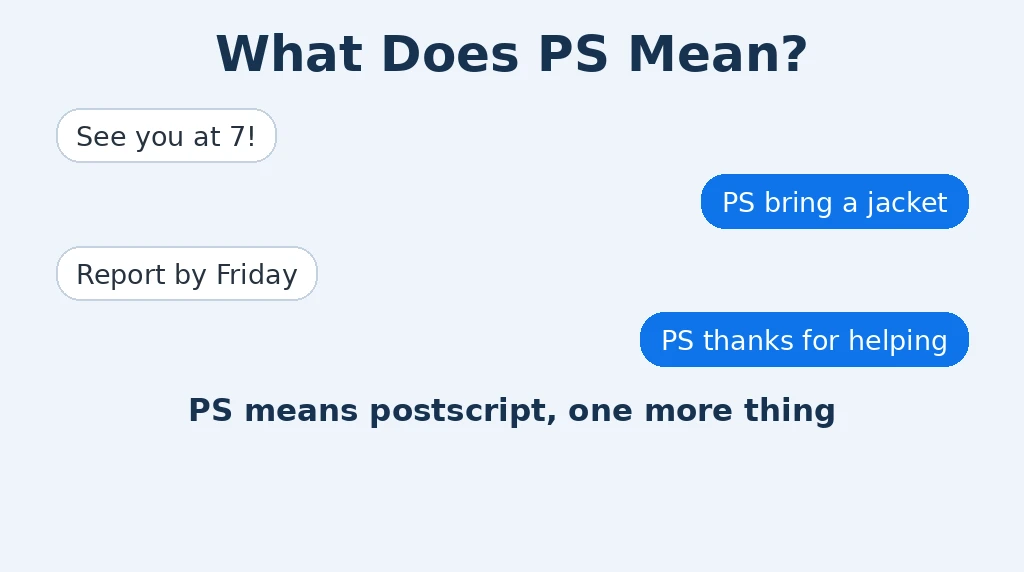
You finish reading a long text from a friend, plans for Saturday, a time, a place, and then right at the bottom, after everything is already said, one more line: “ps bring a jacket, it might get cold.” That tiny extra line feels like an afterthought, yet somehow it ends up being the most useful part of the whole message.
Here is the quick answer. PS stands for “postscript,” from the Latin “post scriptum,” meaning “written after.” It adds one extra thought after the main message is done. This guide covers the ps meaning in text, where it came from, PS vs BTW and FYI, where it shows up, the PlayStation and Photoshop mix ups, and how to reply.
What Does PS Mean in Text?
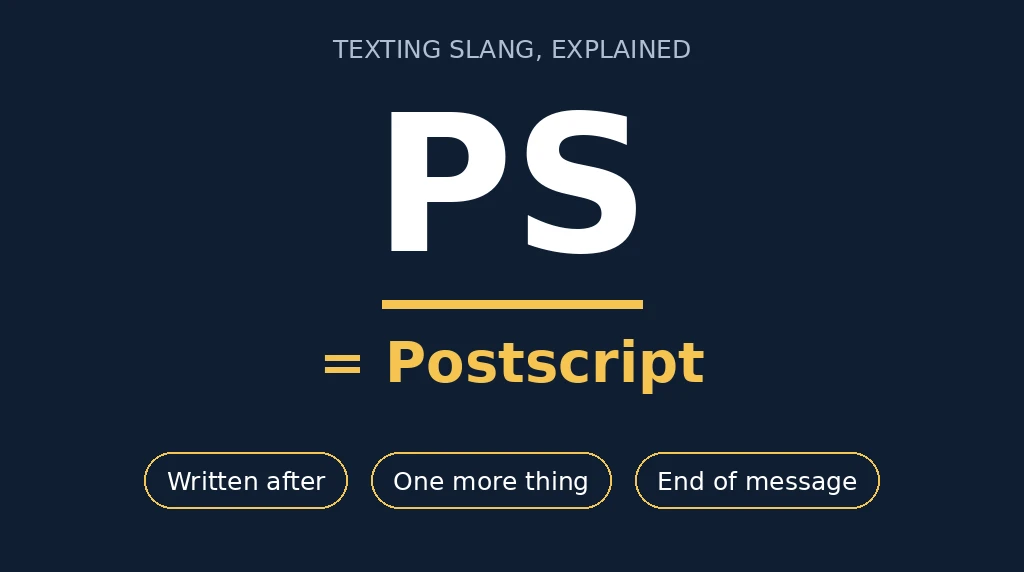
PS stands for “postscript.” In texting and casual chat, it is used to add a quick extra thought, detail or comment after the main part of your message is already done. It is the digital version of writing a letter, signing off, and then adding “oh wait, one more thing” right underneath.
The tone shifts with what follows it. Sometimes PS carries something important that got left out, like a changed meeting time. Other times it is playful, tacking on a joke or a compliment after a serious message. And sometimes it is the real point, dressed up as an afterthought, like “ps I actually miss you.”
Lowercase “ps” is the everyday typed form in casual chats, and it blends into a sentence without drawing attention. Uppercase “PS” is the classic form from letters and emails, and it stands out more at the end of a message. The meaning stays the same either way.
Full Form of PS
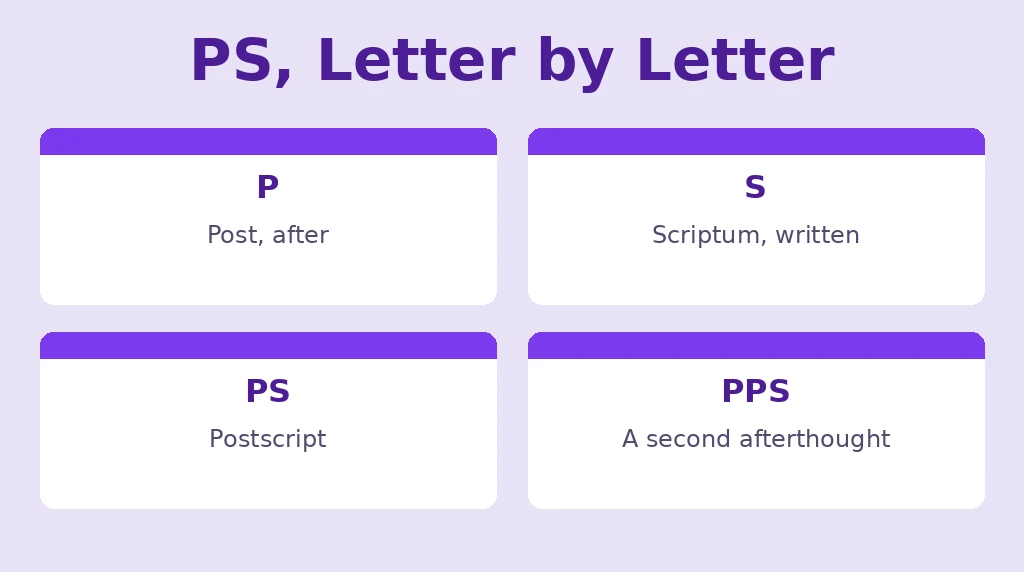
PS has a real, documented origin in written language, unlike most internet born slang. Here is the breakdown:
- P: Post, from the Latin word for “after”
- S: Scriptum, from the Latin word for “written”
Put together, the Latin phrase is “post scriptum,” which literally means “written after.” In English this became the single word “postscript,” and PS is simply the shortened form of that word.
Say it out loud and the pattern is simple. People say the letters one at a time, pee ess, because PS is an initialism in speech. There is also a related version worth knowing: PPS stands for “post post scriptum,” a second afterthought added after the first PS, mostly seen in longer emails.
PS vs BTW vs FYI vs PPS: What Is the Difference?
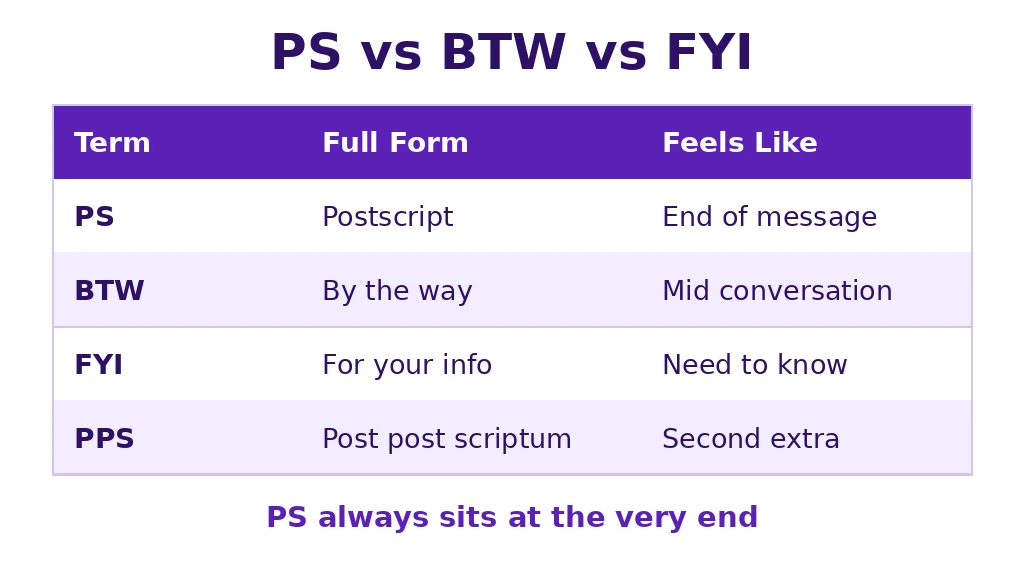
PS belongs to a small family of add on phrases, and the family members look alike at a glance. Here they are side by side.
| Abbreviation | Full Form | What It Really Says | Tone |
|---|---|---|---|
| PS | Postscript | One more thing, after the main point | Warm, casual |
| BTW | By the way | A side note, mid conversation | Casual, light |
| FYI | For your information | Something you should know | Neutral, direct |
| PPS | Post post scriptum | A second afterthought | Old style, formal |
The classic mix up is PS versus BTW, because both add a side thought. The gap is simple, though. BTW introduces a side note in the middle of a conversation, while PS is reserved for the very end, after the main point has already been made. “BTW, bring a jacket” fits mid chat, while “PS bring a jacket” only works after you have said everything else.
FYI is different again, because it shares information the reader should know, often at the start or in the middle of a message, while PS is about tacking something on after the fact. And if the plan itself is still undecided, people reach for tbd, which means “to be determined” and has nothing to do with afterthoughts at all.
Where PS Is Commonly Used
Texting and WhatsApp
In personal texting, PS usually caps off a message with one more small detail. Someone sends a longer text about weekend plans, then adds “ps bring a jacket, it might get cold.” The reminder lands better at the end.
Instagram and TikTok
On Instagram and TikTok, PS shows up at the end of captions to add a bonus thought, a joke or a shoutout. A travel post might end with “ps the full video is on fb,” a small nudge that keeps the caption clean.
Emails
This is where PS has stuck around the longest. Even in professional emails, people use PS to slip in something outside the main topic, like a friendly add on. “PS, thanks for jumping in on such short notice” is a classic closing line.
Group Chats
In group chats, PS often introduces a reminder or a small detail that almost got forgotten, like a time or a last minute change. One person posts the plan, then adds “ps bring your ID too, they check at the door,” and the whole group sees it.
Comment Sections
In comment threads, people use PS to tack on a second point after already replying to something, like a mini follow up. “This recipe looks amazing, definitely trying it this weekend. ps your editing is so clean” is a typical example.
Letters and Notes
Even outside of digital talk, handwritten notes and letters still use PS the same way. A note left for a roommate might read, “took the trash out already. ps we are out of coffee, can you grab some?”
Origin and History of PS
Unlike most texting slang, which grew out of internet chat rooms or SMS character limits, PS has a genuinely old history. The phrase “post scriptum” dates back centuries, used in formal letter writing long before phones, computers or the internet existed. Writers would finish their letter, sign it, and then realise they had one more thing to add. Rather than rewriting the entire letter, they simply added a line at the bottom labelled PS.
This became standard practice in letter writing, and the abbreviation eventually became more common than spelling out the full Latin phrase. By the time typewriters came around, PS was already a fully normal part of written communication.
When texting and instant messaging took off in the 2000s, PS made a smooth move into digital talk. Unlike newer internet born slang, PS was already familiar to almost everyone from emails, letters and school assignments. As social media grew, PS slid easily into captions and comments too, since it fits short form writing where people want to add one more quick thought.
Other Meanings and Variations of PS
In everyday talk, PS almost always means “postscript,” but the same letters carry a few other readings worth knowing.
- PlayStation: in gaming talk, PS is very commonly shorthand for Sony’s PlayStation console, like PS4 or PS5. It is usually paired with a number or a game title, which makes it obvious.
- Photoshop: in creative and design communities, PS is frequently used as shorthand for Adobe Photoshop. “Did you edit that in PS?” is clearly about the software, not a postscript.
- Public School: in some conversations, especially among students or parents, PS can mean a public school, often followed by a number, like PS 122. The number gives it away.
- PPS, the second afterthought: when one PS is not enough, PPS adds a second extra thought after the first. It is rare in quick texts and more common in longer emails.
- Lowercase ps vs uppercase PS: the small letters feel softer and more casual in a chat, while the capitals carry the classic letter writing feel. The meaning stays the same either way.
- PS as a tag: on social media, #ps gathers posts with postscripts, PlayStation clips and Photoshop edits under one label, so the tag works as a topic label rather than a message aimed at one person.
How to Use PS Correctly
- Always put it at the end. The whole point of PS is that it comes after your main message, not before or in the middle of it. A PS at the start is just a confusing first line.
- Keep it short. A postscript is meant to be a quick add on, not a whole new paragraph. One sentence is usually enough, and two is the most you should ever need.
- Save it for things that feel slightly separate. If the detail is actually essential to your message, it probably should not be a PS. Save PS for things that are genuinely secondary, like a small reminder or a fun extra thought.
- Use it to soften or lighten a message. Adding a playful or sweet PS after a serious text can shift the tone nicely. “Ps you were right about the directions” can melt a tense moment.
- Do not stack them. One PS is charming. A PS followed by a PPS makes the message feel disorganised, like you keep forgetting things. If you have three extra thoughts, rewrite the message instead.
Example Conversations Using PS
A text between friends
Person A: “See you at 7! ps wear something warm, it is freezing tonight”
Person B: “Good call, grabbing my coat now”
A WhatsApp family chat
Person A: “Dinner is at 6 today. ps grandma is coming too, so behave”
Person B: “Ha, I will be on my best behaviour”
An Instagram caption
Person A: “Best trip ever, cannot wait to go back. ps swipe to see the sunset pic”
Person B: “That sunset is unreal, wow”
A work email
Person A: “Let us finalise the report by Friday. PS, thanks for jumping in on such short notice”
Person B: “Of course, happy to help”
A group chat reminder
Person A: “Do not forget tickets are non refundable. ps bring your ID too, they check at the door”
Person B: “Got it, ID is in my bag already”
A TikTok comment
Person A: “This recipe looks amazing, definitely trying it this weekend. ps your editing is so clean”
Person B: “Thank you, that means a lot”
A text after an argument
Person A: “Sorry again about earlier. ps you were right about the directions”
Person B: “smh, I told you so, but apology accepted”
A DM between coworkers
Person A: “Sending the file over now. ps double check slide 4, I think there is a typo”
Person B: “Thanks, I will fix it before the meeting”
When Not to Use PS
- In highly formal or legal documents: in contracts, official letters or formal reports, it is better to weave extra information into the body rather than tacking it on with PS.
- When the information is actually important: if what you are adding is genuinely critical, do not bury it in a PS where it might get skimmed over. Put it directly in the main message instead.
- When you use it in every single message: using PS in every text can start to feel repetitive, like you are always forgetting something important the first time around.
- In serious or sensitive conversations: tacking on a PS after delivering serious news can sometimes come across as minimising the moment, depending on what follows it.
- When the PS hides the real point: if the afterthought is the thing you actually care about, say it plainly in the main message instead of dressing it up as an extra.
How to Respond When Someone Sends You PS
A PS lands at the end of a message and the ball is suddenly in your court. The tricky part is that the PS is easy to miss, since it sits after everything else, so read to the very last line before you reply.
Patient replies work when the PS is a fair reminder or a small detail:
- “Got it, thanks for the reminder.”
- “Noted, I will bring my ID too.”
- “Fair enough, I will double check slide 4.”
Helpful replies suit a PS that asks for something or adds a task:
- “Sure, I will grab coffee on my way.”
- “I will send the file tonight, promise.”
Playful replies fit close friends and light topics:
- “PS received, loud and clear”
- “Noted, and yes, you were right about the directions”
One thing to avoid: do not ignore the PS entirely, because it is often the part the sender cared about most. If you are not sure what they meant, just ask. And if you typed something wrong in your own message, correct it plainly instead of hiding behind another shortcut.
Common Mistakes People Make With PS
- Overlooking it entirely. Because it comes at the very end of a message, people sometimes skim past the PS without registering it, especially in longer texts or emails. That can mean missed reminders or unanswered questions.
- Confusing it with PlayStation. In gaming adjacent chats, PS without context can briefly mix up “postscript” and “PlayStation,” though the surrounding words usually clear it up fast.
- Using it for essential information. Some people use PS for details that are actually important, when it is really meant for secondary, non critical add ons. Key information can get missed that way.
- Overloading a message with multiple postscripts. Piling on extra thoughts with repeated PS or PPS lines can make a message feel disorganised.
- Putting it in the wrong place. A PS only works at the end. Dropping it in the middle of a message confuses the reader, because the “afterthought” arrives before the thought is finished.
Frequently Asked Questions
What does PS mean in text?
PS stands for “postscript,” from the Latin “post scriptum,” meaning “written after.” In texting it adds one extra thought after the main message is finished, like saying “oh wait, one more thing.”
Is PS rude?
No, PS is polite and friendly in most cases. It can feel sharp only when it sneaks in a criticism after a kind message, or adds a demand after saying goodbye. The words after the PS decide the tone, not the letters themselves.
What is the difference between PS and BTW?
BTW means “by the way” and introduces a side note mid conversation. PS comes only at the very end of a message, after the main point is done. They do a similar job, but they sit in different places.
What does PS mean in gaming?
In gaming talk, PS usually means “PlayStation,” Sony’s console, especially when it is paired with a number, like PS5, or a game title. The postscript meaning only fits when PS sits at the end of a message with an extra thought after it.
Can I use PS in a work email?
Yes, PS is one of the few texting shortcuts that works fine in work emails, as long as the extra thought is small and friendly. Do not hide anything important in a PS, because busy readers skim past it.
How do I reply when someone sends me PS?
Reply to the PS itself, not just the main message. If it is a reminder, say you noted it. If it is sweet or funny, react to that part. If it asks a question, answer it, because a PS question is still a question.
Final Thoughts
PS has survived for centuries because it does one small job very well. It lets you add one more thought without rewriting the whole message, with a warmth a plain extra sentence rarely carries. Used plainly, kept short, and placed at the very end, it never really causes trouble.
If you want a second opinion from a dictionary source, Dictionary.com lists an entry for PS. Either way, you now have the ps meaning in text down, plus a decent reply ready for the next time it shows up in your messages.
