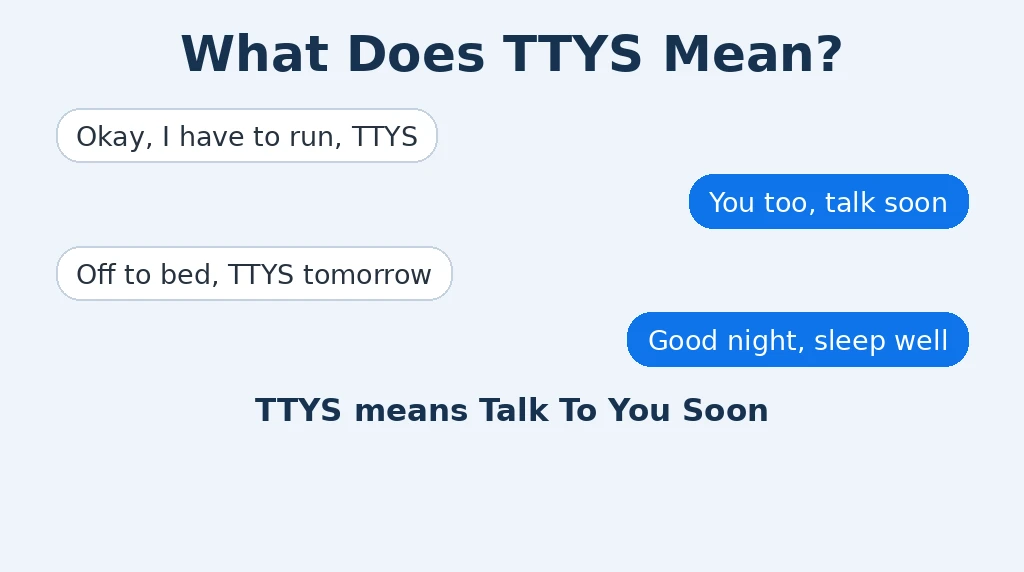
You are halfway through a good chat when your friend wraps it up with four letters: “TTYS”. The conversation felt warm, the goodbye felt friendly, but you are left wondering whether “soon” means tonight, tomorrow, or just whenever.
Here is the quick answer. TTYS stands for “Talk To You Soon”, a casual sign off that ends a chat on a warm note and promises another talk before long. This guide covers the ttys meaning in text, how it differs from TTYL and TTFN, where it shows up, and the best ways to reply when it lands in your chat. The sections below cover the close cousins TTYL and TTFN, the places it appears most, and the replies that fit each kind of chat. By the end, you will close a chat with TTYS the way you close a door gently, without slamming it.
What Does TTYS Mean in Text?
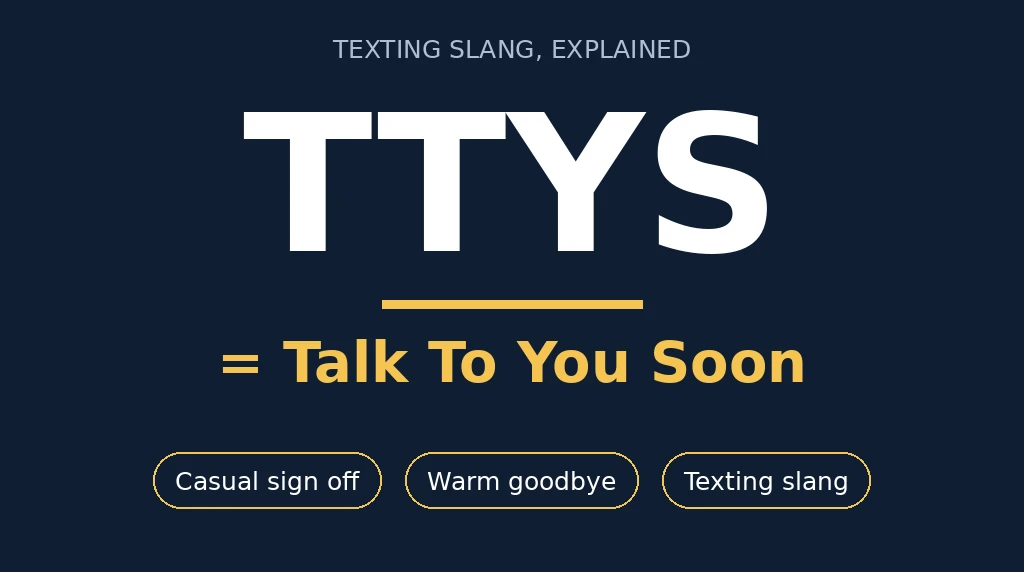
In texting, TTYS stands for “Talk To You Soon”. It is the friendly way to say goodbye in a chat, and it carries a small promise inside it: we will talk again before long. A friend who ends a message with TTYS is not cutting you off. They are closing this chat while keeping the next one in sight, the way you wave goodbye to someone you will see tomorrow.
The tone is warm and relaxed, because TTYS is a sign off between people who expect to talk again. It feels closer than a bare “bye” and softer than a formal farewell. A TTYS at the end of a long chat says the conversation was good and the friendship is safe, while a TTYS after a short exchange simply keeps things light and easy.
Lowercase “ttys” reads softer and more casual inside a sentence, while uppercase “TTYS” stands out and can feel more definite. The meaning stays the same either way. What changes the meaning is the chat around it, because TTYS after a deep talk feels like a promise, while TTYS in the middle of an argument can feel like someone walking away.
Full Form of TTYS
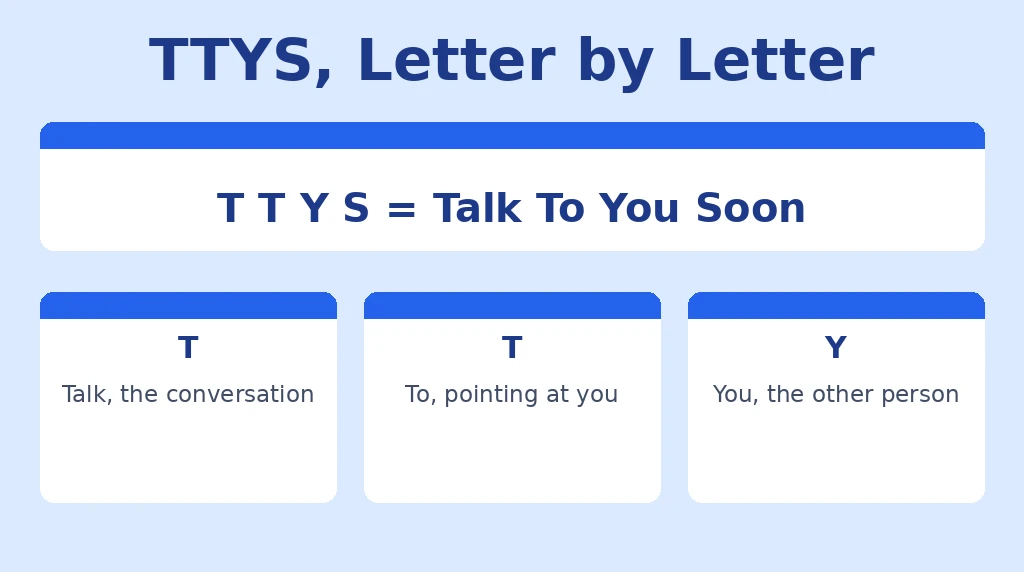
TTYS is an acronym for “Talk To You Soon”, four words that match the four letters one by one. That point matters, because each letter stands for a real word, and the phrase only makes sense when you read it as a whole.
- T: from “Talk”, the conversation itself
- T: from “To”, the small word that points the talk at you
- Y: from “You”, the person on the other end
- S: from “Soon”, the promise that the next chat is not far away
Say it out loud and the pattern is simple. People say the letters one at a time, tee tee why ess, because TTYS is read letter by letter. Nobody pronounces it as a single word, and trying to do so is the fastest way to confuse the person you are talking to.
The word “soon” does most of the work in the phrase. It is vague on purpose, promising another talk without pinning down a time. That vagueness is a feature, not a flaw: it lets friends part warmly without booking a meeting, and the next chat happens whenever it happens.
TTYS vs TTYL vs TTFN: What Is the Difference?
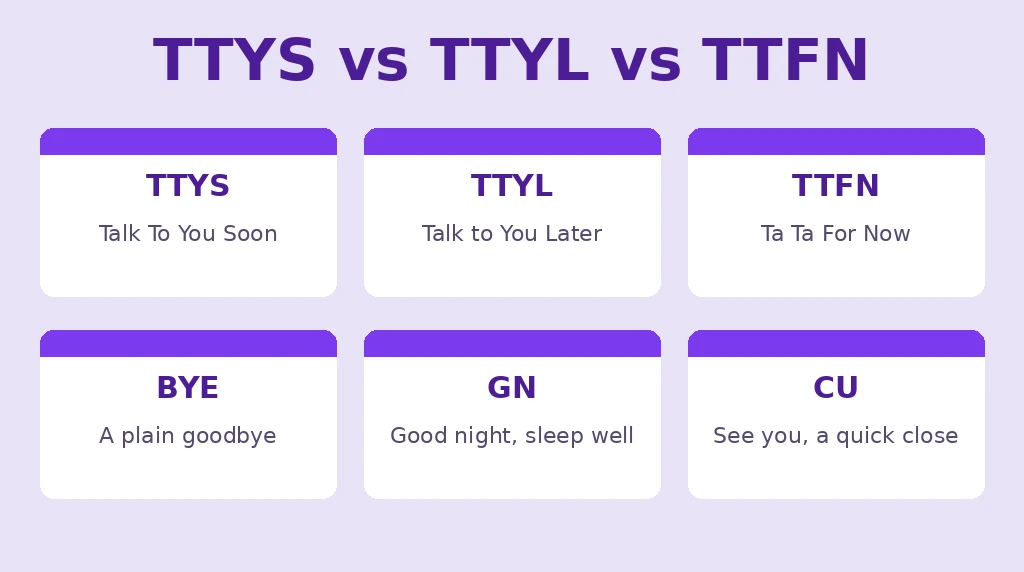
TTYS belongs to a small family of short goodbyes, and the family members look alike at a glance. Here they are side by side.
| Abbreviation | Full Form | What It Really Says | Tone |
|---|---|---|---|
| TTYS | Talk To You Soon | Goodbye, we will talk again soon | Warm, hopeful |
| TTYL | Talk to You Later | Goodbye, we will talk later | Friendly, open ended |
| TTFN | Ta Ta For Now | Goodbye for now, cheerful | Playful, old style |
The classic mix up is TTYS versus TTYL, because the two share the first three letters and both close a chat. The gap is simple, though. TTYS promises a talk “soon”, which feels near and warm, while TTYL promises a talk “later”, which leaves the timing wide open. If you want the other person to feel close, pick TTYS. If you have no idea when you will talk again, TTYL is the honest pick.
TTFN is a different flavour altogether. It is an older, playful goodbye that sounds cheerful and a little old fashioned, like something from a cartoon. It works best with friends who enjoy the joke, while TTYS works with almost anyone. Pick the goodbye that matches the friendship, not just the letters.
Where TTYS Is Commonly Used
Texting and WhatsApp
In one to one chats, TTYS shows up at the very end of a conversation, closing it gently. A typical line looks like this: “Okay, I have to run, TTYS.” Short, warm, and the chat ends without an awkward silence.
Instagram and Snapchat
On Instagram and Snapchat, TTYS shows up as a reply to a story or at the end of a snap streak chat. A friend who has to go writes “TTYS” and the streak stays friendly until the next snap arrives.
TikTok Comments
On TikTok, TTYS appears under videos where a creator promises part two. A viewer writes “TTYS, waiting for the next one” and the comment doubles as a goodbye and a promise to return.
Group Chats
Group chats use TTYS when one person has to leave the conversation early. One person writes “got to go, TTYS all”, and the rest of the group carries on without a fuss. When the exact plan is still undecided, someone drops in tbc, which means “to be continued” or “to be confirmed” and keeps the plan moving.
Discord and Forums
On Discord and forums, TTYS shows up when a friend logs off for the night. A line like “off to bed, TTYS tomorrow” tells the group when to expect them back, without a long farewell.
Gaming Chats
In gaming chats, TTYS shows up between matches, when a player has to leave the lobby. A line like “GG, TTYS” closes the game on a friendly note, even after a loss.
Origin and History of TTYS
TTYS grew out of early internet chat culture, when people needed a quick way to leave a conversation without sounding rude. In chatrooms and instant messaging, a plain “bye” could feel abrupt, so texters reached for a goodbye that promised a return. “Talk to you soon” was already a common thing to say out loud, so the four letter version spread fast through SMS, chat apps and then social media.
The phrase found a second home on phones, where chats end in the middle of real life. A friend who has to run for a bus or answer the door needs a goodbye that takes one second to type, and TTYS fits that moment perfectly. It closes the chat, keeps the friendship warm, and asks nothing of the other person.
Dictionary sources have caught up with the habit. CyberDefinitions lists TTYS as “Talk To You Soon”, the meaning that leads in everyday texting, and competitor guides on the same term agree. The entry matters, because it confirms the reading most texters already use, and it rules out the rarer guesses that float around the same four letters.
Other Meanings and Variations of TTYS
In everyday talk, TTYS almost always means “Talk To You Soon”, but the same letters carry a few other readings worth knowing.
- “TTYS” as a promise, not a time: the “soon” in TTYS is a feeling, not a clock. It means “before long”, and nobody should count the hours against it.
- “TTYS” in a flirty chat: between people who like each other, TTYS can carry a warm edge, meaning “I will be thinking of you till we talk again”. The chat around it tells you whether the flirty reading fits.
- “TTYS” as a polite exit: in a chat that has run its course, TTYS is a polite way to leave without a long explanation, as in “this was fun, TTYS”.
- Lowercase ttys vs uppercase TTYS: the small letters feel softer and more casual in a sentence, while the capitals stand out and can feel more definite. The meaning stays the same either way.
- “TTYS” in other fields: outside texting, TTYS can stand for technical or business terms, so check the chat before you assume the texting reading. In a normal chat with friends, “Talk To You Soon” is the right one.
How to Use TTYS Correctly
- Use it at the end of a chat. TTYS is a goodbye, so save it for the last message. Dropping it in the middle of a conversation will confuse the other person.
- Use it when you mean to talk again. The “soon” in TTYS is a small promise, so send it only when you do expect another chat. A TTYS followed by months of silence feels hollow.
- Keep it in friendly chats. TTYS belongs in texts and messages with friends. In formal writing, close with a clear next step instead, so every reader understands you.
- Pair it with a warm word when you can. A bare TTYS works fine, but a small extra word nearby, like “great chat, TTYS”, makes the goodbye feel real instead of automatic.
- Match the tone of the chat. If the conversation was light, a quick TTYS fits right in. If the chat was serious, a fuller goodbye with a kind word will read warmer and clearer.
Example Conversations Using TTYS
A chat that has run its course
Person A: “Okay, I have to run, TTYS”
Person B: “You too, talk soon”
A good night goodbye
Person A: “Off to bed, TTYS tomorrow”
Person B: “Good night, sleep well”
A plan for later
Person A: “Great chat, TTYS after work”
Person B: “Deal, message me when you are free”
A gaming goodbye
Person A: “GG, TTYS”
Person B: “GG, same time tomorrow”
A flirty close
Person A: “TTYS, I will miss our chats”
Person B: “Miss you too, talk soon”
An unsure reply
Person A: “TTYS”
Person B: “huh? Already leaving? Okay, talk soon then”
A group chat exit
Person A: “Got to go, TTYS all”
Person B: “Bye, see you tomorrow”
A story reply close
Person A: “Loved the photos, TTYS”
Person B: “Thank you, talk soon”
When Not to Use TTYS
- In a work message: using TTYS instead of a clear next step can look vague to a colleague who needs a date, not a promise.
- In the middle of a serious talk: if someone is sharing something heavy, a TTYS can feel like you are walking away from them.
- When you do not mean it: if you have no plan to talk again, TTYS is a hollow promise. A simple “bye” is more honest.
- As the first message: TTYS is a goodbye, so sending it to open a chat will only confuse the other person.
- In formal writing: reports, applications and official documents should always use a proper closing, not a texting shortcut.
- When something is still unresolved: if a question is still open, answer it first, then say goodbye. A TTYS does not close a loose end.
How to Respond When Someone Sends You TTYS
A TTYS lands in your chat and the ball is suddenly in your court. The sender is saying goodbye, so pick the lane that matches how the chat felt.
Warm replies work when the chat was good and you want to keep it warm:
- “You too, talk soon.”
- “Sounds good, bye for now.”
- “Great talking to you, TTYS.”
Helpful replies suit a TTYS that closes a chat with a loose end:
- “Talk soon, and send me that link when you can.”
- “Bye for now, let me know about tomorrow.”
Playful replies fit close friends and light topics:
- “TTYS? You are not getting rid of me that easily”
- “Soon better mean soon, I have gossip for you”
One thing to avoid: do not answer a warm TTYS with a bare “ok” and then keep messaging anyway. If you still need something, say it before the goodbye lands. A quick imyt, “I miss you too”, keeps a close chat warm without reopening a chat that already ended.
Common Mistakes People Make With TTYS
- Confusing TTYS with TTYL. TTYS promises a talk soon, TTYL leaves the timing open. Mixing them up changes the warmth of your goodbye.
- Using it in the middle of a chat. TTYS is a goodbye. Dropping it mid conversation tells the other person you are leaving, even when you are not.
- Sending it after a serious message. A TTYS right after bad news can feel cold, so use a fuller goodbye when the chat was heavy.
- Using it in formal writing. A work message or an application is not the place for a texting shortcut. Write a proper closing there.
- Treating “soon” as a deadline. Soon is a feeling, not a time. Do not count the hours and take offence when the next chat comes a day later than you hoped.
Frequently Asked Questions
What does TTYS mean in text?
TTYS stands for “Talk To You Soon.” It is a casual sign off that ends a chat on a warm note and promises another talk before long, without naming an exact time.
Is TTYS rude?
No, TTYS is friendly and polite. It only feels cold when it cuts off a conversation that clearly needed more time, so save it for chats that have already reached a natural end.
What is the difference between TTYS and TTYL?
TTYS means “Talk To You Soon” and promises a chat quite soon, while TTYL means “Talk to You Later” and leaves the timing open. TTYS feels a little warmer and a little sooner than TTYL.
What does TTYS mean on Snapchat?
On Snapchat, TTYS means the same thing as anywhere else, “Talk To You Soon.” It often closes a snap streak chat or a story reply, keeping the friendship warm until the next message.
Can I use TTYS in a work message?
It is best not to. In a work message, close with a clear next step instead, such as “I will follow up tomorrow.” TTYS belongs in friendly chats, not in formal writing.
How do I reply when someone sends me TTYS?
A short warm close works best, for example “you too, talk soon” or “sounds good, bye for now.” If you still need something from them, say it before the goodbye, so it does not get lost.
Final Thoughts
TTYS is a small set of letters with one warm job. It stands for “Talk To You Soon”, a casual sign off that ends a chat on a friendly note and promises another talk before long. The letters never change, but the chat around them changes everything about how they feel, from a quick goodbye between busy friends to a warm promise after a long talk.
If you want a second opinion from a dictionary source, CyberDefinitions lists TTYS as “Talk To You Soon”. Either way, you now have the ttys meaning in text down, plus a decent reply ready for the next time it shows up in your messages.
