
It is late, your phone lights up, and the message is just three letters: “TTM”. No question mark, no explanation, no emoji. Your friend is clearly reaching out, but you are not sure whether they want news, gossip, or a shoulder to lean on.
Here is the quick answer. TTM stands for “Talk to Me”, an invitation to open up and start a real conversation. This guide covers the ttm meaning in text, how it differs from TTYL and similar terms, where it shows up, and the best ways to reply when it lands in your chat. The next sections explain the difference from similar shortcuts, the places it appears most, and the replies that work best in each mood. By the end, you will know exactly what to do the next time those three letters appear.
What Does TTM Mean in Text?
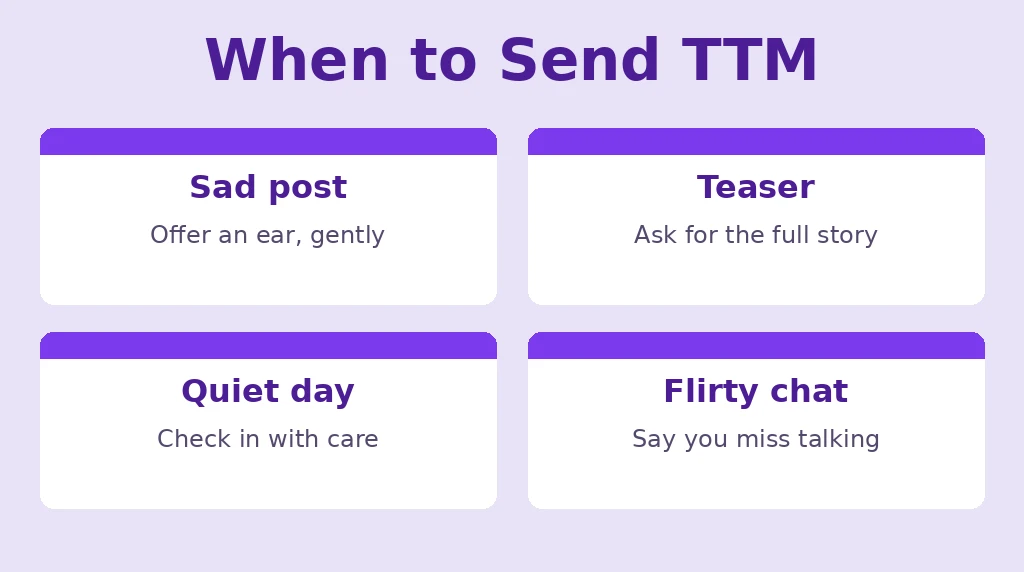
In texting, TTM stands for “Talk to Me”. It is a short, warm invitation, sent when someone wants to hear from you. Most often it means “tell me what is going on” or “I am here, talk to me”. A friend who sends TTM after a sad post or a quiet day is opening a door, not demanding an answer, and the three letters carry that care in a very small package.
The tone is friendly and open, because TTM is a request for connection. It can also be playful, as when a friend sends TTM after you post something mysterious, meaning “spill the details, I want to know”. In both cases the message is the same: the sender wants a conversation, not a one word answer. A bare TTM with no context can feel a little vague, so the chat around it usually tells you which kind of talk they want.
Lowercase “ttm” reads softer and more casual inside a sentence, while uppercase “TTM” stands out and can feel more direct. The meaning stays the same either way. What changes the meaning is the moment, because TTM from a close friend after a hard day is a caring check in, while TTM from someone you barely know can feel like a random demand for attention.
Full Form of TTM
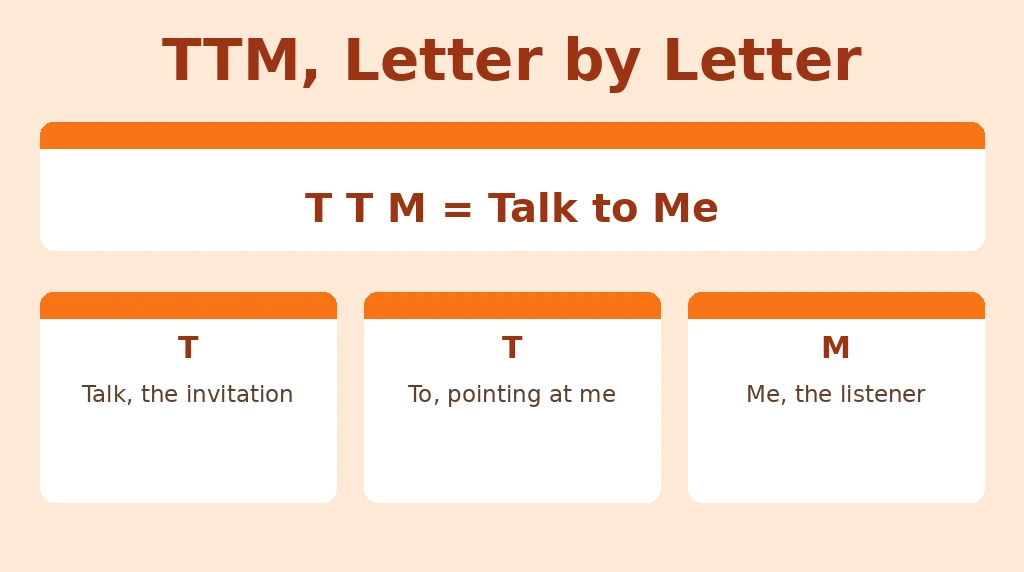
TTM is an acronym for “Talk to Me”, three words that match the three letters one by one. That point matters, because each letter stands for a real word, and the phrase only makes sense when you read it as a whole.
- T: from “Talk”, the invitation to speak
- T: from “to”, the small word that points the talk at the sender
- M: from “Me”, the person asking to listen
Say it out loud and the pattern is simple. People say the letters one at a time, tee tee em, because TTM is read letter by letter. Nobody pronounces it as a single word, and trying to do so is the fastest way to confuse the person you are talking to.
The phrase itself is plain English, and that is why it works so well. “Talk to me” is something people say out loud every day, in kitchens, classrooms and car rides. The texting version just shortens a sentence everyone already knows, so the meaning survives the cut.
TTM vs TTYL vs TMI: What Is the Difference?
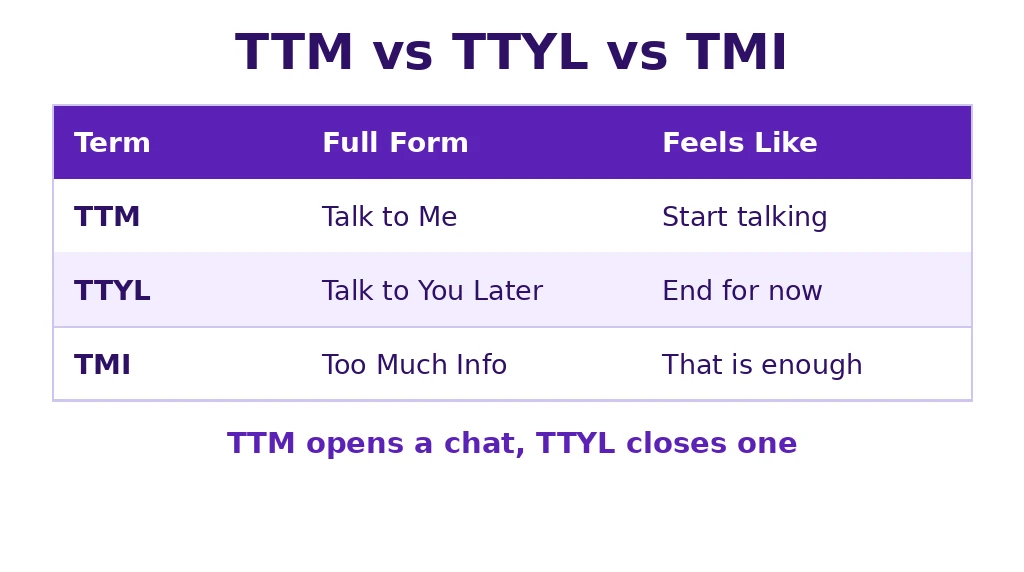
TTM belongs to a small family of short talk words, and the family members look alike at a glance. Here they are side by side.
| Abbreviation | Full Form | What It Really Says | Tone |
|---|---|---|---|
| TTM | Talk to Me | Start a conversation with me | Warm, inviting |
| TTYL | Talk to You Later | End this chat for now | Friendly, closing |
| TMI | Too Much Info | That detail was more than I needed | Playful, teasing |
The classic mix up is TTM versus TTYL, because the two share the first two letters and both deal with talking. The gap is simple, though. TTM opens a conversation, while TTYL closes one. If you send TTM when you meant TTYL, you have just invited someone to talk when you were trying to say goodbye, and the chat will keep going when you wanted it to stop.
TMI is a different kind of confusion. It shares the letter T and the talk theme, but it means the opposite of an invitation. TMI tells someone to stop sharing, while TTM asks them to share more. Read the letters carefully before you reply, because the wrong one flips your message upside down.
Where TTM Is Commonly Used
Texting and WhatsApp
In one to one chats, TTM shows up when a friend senses something is wrong or wants the full story. A typical line looks like this: “You seemed quiet today, TTM.” Short, caring, and the chat keeps moving from there.
Instagram and Snapchat
On Instagram and Snapchat, TTM shows up as a reply to a story or a caption on a moody post. A friend who sees a sad song lyric in your story replies “TTM” and the invitation is clear, even without a long message.
TikTok Comments
On TikTok, TTM appears under storytime clips and confession videos. A viewer writes “TTM, I need the full story” and the creator knows the audience wants part two.
Group Chats
Group chats use TTM when someone drops a teaser and the group wants details. One person writes “something big happened today”, another replies “TTM right now”, and the story comes out before anyone has time to write more. When the exact plan is still undecided, someone drops in tbc, which means “to be continued” or “to be confirmed” and keeps the plan moving.
Discord and Forums
On Discord and forums, TTM shows up in direct messages between friends who met in a server. A line like “saw your post, TTM if you want” offers a private chat without putting the whole conversation in public.
Gaming Chats
In gaming chats, TTM shows up between matches, when a teammate wants to talk through a loss or a plan. A line like “TTM after this round” keeps the game going while promising a real talk later.
Origin and History of TTM
TTM grew out of early texting culture, when short phrases were cut down to save time and keystrokes. “Talk to me” was already a common thing to say out loud, so it was a natural pick for the shortcut treatment. As phones got smaller and chats got faster, the three letter version spread through SMS, instant messaging and then social apps, carried by friends who wanted a quick way to say “I am here, tell me”.
The phrase found a second home on social media, where a short reply to a story or a post had to carry a lot of meaning in very few letters. A single TTM under a sad photo says what a paragraph would say, and the person who posted it understands the offer at once. That is why the term survived while many other shortcuts faded: it does a real job in a real moment.
Dictionary sources have caught up with the habit. CyberDefinitions lists TTM as “Talk to Me”, the meaning that leads in everyday texting, and competitor guides on the same term agree. The entry matters, because it confirms the reading most texters already use, and it rules out the rarer guesses that float around the same three letters.
Other Meanings and Variations of TTM
In everyday talk, TTM almost always means “Talk to Me”, but the same letters carry a few other readings worth knowing.
- “Talk to Me” as a song or show title: the phrase turns up in song titles and show lines, where it means the same thing, an invitation to speak, just dressed up for entertainment.
- “TTM” as a flirty nudge: between people who like each other, TTM can carry a flirty edge, meaning “message me, I want to hear from you”. The chat around it tells you whether the flirty reading fits.
- “TTM” as a check in: after a hard day, TTM works as a gentle check in, as in “hey, TTM when you are ready”. The sender is offering an ear, not demanding a reply.
- Lowercase ttm vs uppercase TTM: the small letters feel softer and more casual in a sentence, while the capitals stand out and can feel more direct. The meaning stays the same either way.
- “TTM” in other fields: outside texting, TTM can stand for technical or business terms, so check the chat before you assume the texting reading. In a normal chat with friends, “Talk to Me” is the right one.
How to Use TTM Correctly
- Use it when you really want to listen. TTM is a promise of attention, so send it only when you are ready to hear the answer. A TTM followed by silence feels worse than no message at all.
- Add a little context when you can. A bare TTM can float, so a quick extra word nearby, like “TTM, you seemed off today”, settles the meaning fast and makes the invitation feel real.
- Send it once, then wait. One TTM is an invitation. Three in a row feel like pressure, and the other person may pull away instead of opening up.
- Keep it in friendly chats. TTM belongs in texts and messages with friends. In formal writing, write the full request instead, so every reader understands you.
- Match the tone of the chat. If the conversation is light, a playful TTM fits right in. If the chat is serious, a gentle TTM with a kind word beside it will read warmer and clearer.
Example Conversations Using TTM
A quiet day
Person A: “You seemed quiet today, TTM”
Person B: “Thanks, just a long day, I will tell you about it”
A mysterious post
Person A: “TTM, I need the full story”
Person B: “Okay, call me in five, it is a long one”
A sad story reply
Person A: “Saw your post, TTM if you want”
Person B: “Thank you, I might take you up on that”
A flirty nudge
Person A: “TTM, I miss our chats”
Person B: “Miss you too, tell me about your day”
A gaming break
Person A: “TTM after this round”
Person B: “Deal, I have a plan for tomorrow”
An unsure reply
Person A: “TTM”
Person B: “idk where to start, it has been a weird week”
A group chat teaser
Person A: “Something big happened today”
Person B: “TTM right now, no waiting”
A gentle check in
Person A: “Hey, TTM when you are ready, no rush”
Person B: “That means a lot, I will message you tonight”
When Not to Use TTM
- In a work message: using TTM instead of a clear request can look vague to a colleague who needs details, not an invitation.
- When someone asked for space: if they said they need time alone, a TTM right after can feel like you are not listening.
- Repeatedly in one chat: sending TTM again and again turns an invitation into pressure, and the other person may stop replying.
- With strangers: a bare TTM to someone you barely know can feel random, so add context or skip it entirely.
- In serious conversations: when someone shares bad news, a lone TTM can feel too small. A full sentence of support will read kinder.
- When you cannot actually listen: if you are busy or about to sleep, do not send TTM. Say when you will be free instead.
How to Respond When Someone Sends You TTM
A TTM lands in your chat and the ball is suddenly in your court. The sender is offering an ear, so pick the lane that matches how you feel right now.
Open replies work when you want to talk and trust the sender:
- “Okay, I have had a rough day, thanks for asking.”
- “Honestly, a lot happened, can I tell you about it?”
- “Yes please, I needed someone to talk to.”
Busy replies suit a TTM that arrives at the wrong moment:
- “Can we talk tonight? I am in the middle of something.”
- “I want to, just give me an hour and I will message you.”
Playful replies fit close friends and light topics:
- “You asked for it, here comes the whole story”
- “TTM? You are going to regret that, it is a long one”
One thing to avoid: do not answer a caring TTM with a bare “ok” and then go silent. If you are not ready to talk, say so kindly and name a time. A quick thx for the offer keeps the door open without forcing a talk you are not ready for.
Common Mistakes People Make With TTM
- Confusing TTM with TTYL. TTM opens a conversation, TTYL closes one. Mixing them up flips your message upside down.
- Sending it over and over. One TTM is an invitation. Repeating it turns care into pressure, and the other person may pull away.
- Sending it without meaning it. A TTM followed by silence hurts more than no message at all, so send it only when you can actually listen.
- Using it in formal writing. A work message or an application is not the place for a texting shortcut. Write the full request there.
- Assuming it is always flirty. TTM is often just a friendly check in. Read the chat around it before you assume a romantic meaning.
Frequently Asked Questions
What does TTM mean in text?
TTM stands for “Talk to Me.” It is an invitation to open up, usually sent when someone wants to chat, hear what is on your mind, or help with something that is bothering you.
Is TTM rude?
No, TTM is normally warm and caring. It only feels pushy when it is repeated again and again after someone has said they need space, so one gentle TTM is enough.
What is the difference between TTM and TTYL?
TTM means “Talk to Me” and starts a conversation, while TTYL means “Talk to You Later” and ends one. They point in opposite directions, so mixing them up flips the meaning of your message.
What does TTM mean on Snapchat?
On Snapchat, TTM usually means the same thing as anywhere else, “Talk to Me.” It often shows up as a caption or a reply to a story, inviting the other person to start a chat.
Can I use TTM in a work message?
It is best not to. In a work message, write the full request instead, such as “let me know when you are free to talk.” TTM belongs in friendly chats, not in formal writing.
How do I reply when someone sends me TTM?
If you want to talk, say so and share a little of what is on your mind, for example “okay, I have had a rough day.” If you are busy, say that kindly and name a time, like “can we talk tonight?”
Final Thoughts
TTM is a small set of letters with one warm job. It stands for “Talk to Me”, an invitation to open up that works in sad moments, funny moments and everything in between. The letters never change, but the moment around them changes everything about what they mean, from a caring check in to a playful demand for the full story.
If you want a second opinion from a dictionary source, CyberDefinitions lists TTM as “Talk to Me”. Either way, you now have the ttm meaning in text down, plus a decent reply ready for the next time it shows up in your messages.
