Your friend texts you after a long day out: “Tired, but worth it tho.” You read the message twice. The first half makes sense, but that little word at the end, tho, leaves you wondering whether they are agreeing with you, arguing with you, or just typing fast.
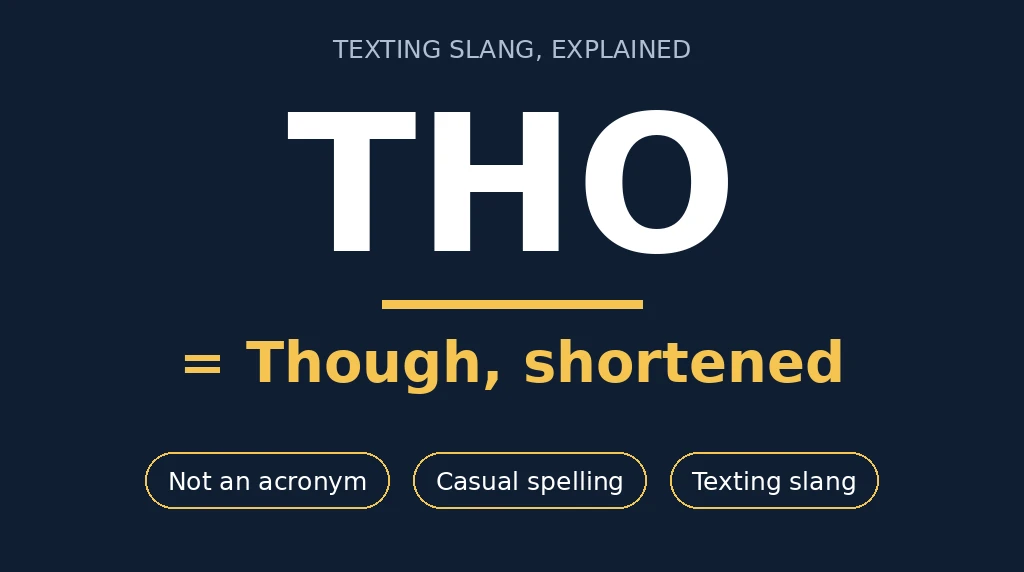
Here is the quick answer. THO is a shortened spelling of “though”, the everyday word we use to add a contrast or a soft afterthought. This guide covers the tho meaning in text, how it differs from though and although, where it shows up, and the best ways to reply when it lands in your chat. By the end, you will read tho the way you read any normal word, without a second thought.
What Does THO Mean in Text?
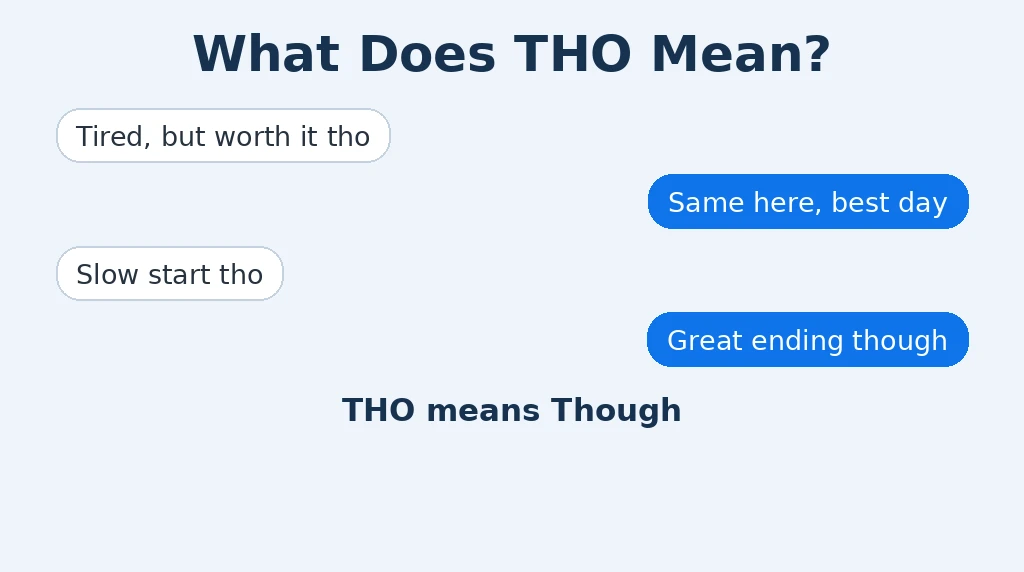
In texting, THO means “though”. It is not an acronym and it does not stand for three separate words. It is simply “though” with the middle letters dropped, the way people shorten long words when they are typing fast. When someone writes “it was fun tho”, they mean “it was fun though”, with a small contrast tucked in at the end, as if to say the fun still counted even though something else went wrong.
The word usually sits at the end of a sentence, and that spot is part of its job. A tho at the end adds a gentle pushback or a second thought to whatever came before it. “I liked it tho” means you liked it despite some flaw, and “I know tho” means you agree while hinting that the other side of the story matters too. Move tho to the start of a sentence and it works the same way as though, setting up a contrast before the main point arrives.
The tone is casual and relaxed, because tho is a spoken style spelling. It sounds like the way people actually talk, with the word clipped short at the end of a thought.
Full Form of THO
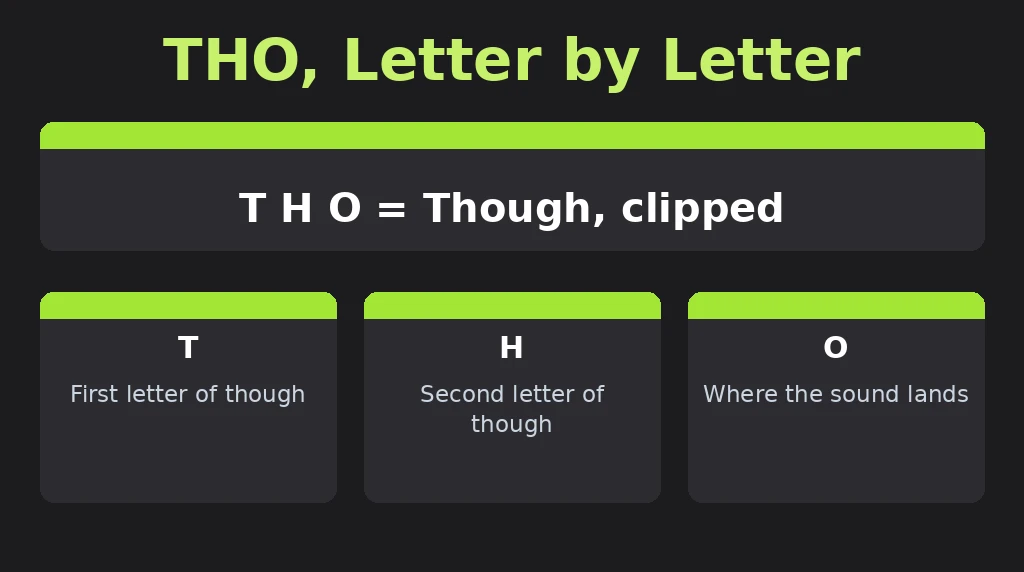
THO has no full form made of separate words, because it is not an acronym. It is a shortened spelling of one single word, “though”. Say that plainly, because it is the one fact that clears up most of the confusion about THO. The letters T, H and O are the first three letters of though, with the “ugh” dropped off the end, the way a spoken word gets clipped when people talk fast.
- T: the first letter of though
- H: the second letter of though
- O: the third letter of though, where the spoken sound lands
Pronunciation follows the full word. People say “though”, which sounds like “thoh”, with a soft th at the start and a long o at the end. Nobody pronounces THO letter by letter, because it is not a set of initials. You read it the same way you would read though, just spelled shorter.
You may also see “tho” written with an apostrophe, as “tho'”. The apostrophe marks the missing letters, the same way “do not” becomes “don’t”. Both spellings mean the same thing, and the version without the apostrophe is far more common in texts and on social media today.
THO vs Though vs Although: What Is the Difference?
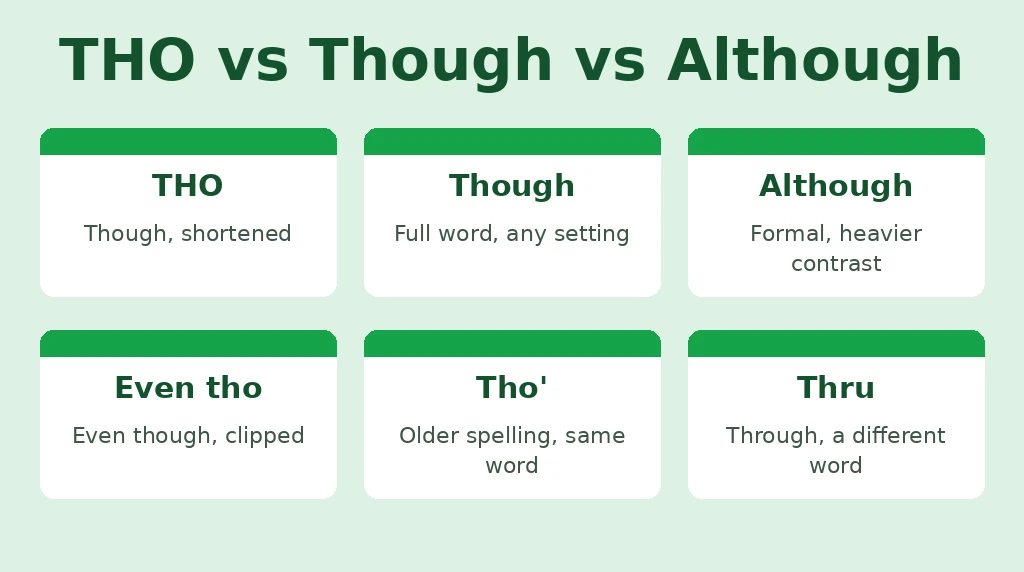
THO, though and although are close cousins, and the family likeness causes most of the mix ups. Here they are side by side.
| Word | Full Form | What It Really Says | Tone |
|---|---|---|---|
| THO | Though, shortened | A casual contrast or afterthought | Relaxed, chatty |
| Though | Though | The same contrast, spelled in full | Neutral, works anywhere |
| Although | Although | A stronger, more formal contrast | Formal, careful |
The classic mix up is THO versus although, because both words deal in contrast. The gap is simple, though. THO is the informal, shortened form of though, used at the end of a sentence or at the start of a casual remark. Although is a heavier word that usually opens a sentence in careful writing, as in “although it rained, we went out”. You would never write “although” at the end of a text, and you would never write “tho” in a formal report.
Another common confusion is thinking THO stands for something, like an acronym with a hidden meaning. It does not. If someone wanted an acronym they would have picked letters that stand for words, but THO is just a clipped spelling, and the dictionary entry for tho lists it as an informal spelling of though, nothing more.
Where THO Is Commonly Used
Texting and WhatsApp
In one to one chats, THO shows up at the end of short messages, adding a soft contrast to a quick thought. A typical line looks like this: “It was long tho, worth it in the end.” The word keeps the chat moving without a long explanation.
Instagram and Snapchat
On Instagram and Snapchat, THO shows up in captions and story replies, often with a photo doing half the talking. A caption like “Rainy day tho” lets the picture carry the mood while tho adds the shrug.
TikTok Comments
On TikTok, THO appears under clips where the commenter agrees with a twist. A viewer writes “funny tho” under a video that is also a little sad, and the single word holds both feelings at once.
Group Chats
Group chats use THO when someone wants to agree with a small reservation. One person says a plan sounds good, another replies “expensive tho”, and the whole group understands the worry without a long debate. When the exact plan is still undecided, someone drops in tbd, which means “to be determined” and keeps the plan moving.
Twitter and X Posts
On Twitter and X, THO fits the short post style, where every letter counts. A post like “Good game tho” packs praise and a small complaint into three words, and readers fill in the rest from context.
Gaming Chats
In gaming chats, THO shows up between rounds, when players react fast and type even faster. A line like “close tho” after a lost match means the game was tight even though the result went the wrong way.
Origin and History of THO
The word though is old, and its short form is older than texting. Writers have been clipping “though” down to “tho” for centuries, in letters, poems and dialect writing, whenever they wanted the words to sound like real speech. The spelling “tho” turns up in old books and in regional writing, where it mirrors the way people actually said the word, dropping the tail end of it in fast talk.
Texting gave the old spelling a second life. As people started typing on small phone keyboards, they reached for the shortest spelling that still read clearly, and “tho” fit perfectly. It saved four letters every time it appeared, and it looked friendly and spoken, so it spread through chats, comments and captions without anyone having to learn it.
Dictionaries caught up with the habit. Wiktionary lists “tho” as a nonstandard spelling of “though”, and Oxford Learner’s lists “tho'” as an informal spelling. That matters, because it confirms what the history already shows: THO is not a new code word invented by teenagers, but a very old spelling that found a new home on phone screens.
Other Meanings and Variations of THO
In everyday talk, THO almost always means “though”, but the same letters carry a few other readings worth knowing.
- “Tho” with an apostrophe, “tho'”: the older spelling, with the apostrophe marking the dropped letters. It means the same thing, and it turns up more in books and older writing than in texts.
- “Tho” as an emphatic ending: at the end of a sentence, tho can add punch rather than contrast, as in “that was good tho”, where it means “that was really good, I mean it”.
- “Tho” in “even tho”: a common pairing where “even though” gets clipped down to “even tho”, as in “even tho it rained, we stayed”. It is the same contrast, just spelled shorter.
- Lowercase tho vs uppercase THO: the small letters feel softer and more casual in a sentence, while the capitals stand out and can feel louder. The meaning stays the same either way.
- “Tho” as a name or word in other languages: outside English chats, “tho” can be a name or a word in another language, so check the chat language before you assume the though reading.
How to Use THO Correctly
- Use it for a small contrast. THO works best when you are adding a second thought to what you just said, like “tired tho, still happy”. It is a contrast word, so keep it near a contrast.
- Put it at the end for a soft touch. A tho at the end of a sentence lands gently, as an afterthought. A tho at the start works too, but it sounds more like a direct reply than a shrug.
- Keep it in casual chats. THO belongs in texts, comments and posts with friends. In formal writing, spell out “though” in full so every reader understands you.
- Do not stack it with other slang. One short word per sentence is enough. A message packed with clipped words becomes hard to read, and the tho gets lost in the pile.
- Match the tone of the chat. If the conversation is light, tho fits right in. If the chat is serious, a full sentence with “though” spelled out will read kinder and clearer.
Example Conversations Using THO
A long day out
Person A: “Tired, but worth it tho”
Person B: “Same here, best day in weeks”
A movie review
Person A: “Slow start tho, great ending”
Person B: “Agreed, the last half hour saved it”
A food verdict
Person A: “Spicy tho, I liked it”
Person B: “You handled it better than I did”
A close game
Person A: “Close tho, we almost had it”
Person B: “Next time, we win it for sure”
An unsure plan
Person A: “Expensive tho, should we still go?”
Person B: “idk, let me check my budget first”
A gentle pushback
Person A: “I know tho, you told me twice”
Person B: “Sorry, just making sure”
A rainy day
Person A: “Rainy day tho, still going out”
Person B: “Take an umbrella, the wind is picking up”
A compliment with a twist
Person A: “Good game tho, you played well”
Person B: “Thanks, you were not bad yourself”
When Not to Use THO
- In a work email: using THO instead of “though” can look sloppy to a boss or a client who expects full words.
- In formal writing: reports, applications and official documents should always use the full spelling, “though”.
- As a brush off: a bare “whatever tho” can sound dismissive, so use a full sentence when someone needs a real answer.
- When the contrast is the whole point: if the contrast matters a lot, spell out “though” or “although” so nobody misses it.
- In serious conversations: when someone shares bad news or asks for real support, a clipped “tho” can feel like you are not listening.
- With people who do not text much: if they never use short spellings, THO may read like a typo to them, so spell it out instead.
How to Respond When Someone Sends You THO
A THO lands in your chat and the ball is suddenly in your court. Reply to the point they were making, not to the word itself, and pick the lane that matches their tone.
Agreeing replies work when their tho carries a point you share:
- “Yeah, exactly, I felt the same way.”
- “True tho, I had not thought of it like that.”
- “Same here, worth it in the end.”
Helpful replies suit a tho that raises a real worry, like cost or time:
- “Fair point, let me check and get back to you.”
- “I get it, we can find a cheaper option.”
Playful replies fit close friends and light topics:
- “Tho? You sound like you enjoyed it more than you admit”
- “Okay okay, you win this one tho”
One thing to avoid: do not answer a thoughtful tho with a bare “ok” and then ignore the point they raised. If you typed the wrong meaning, send a quick nvm and restate what you meant before the chat moves on.
Common Mistakes People Make With THO
- Thinking it is an acronym. THO does not stand for three words. It is a shortened spelling of though, and treating it like initials only causes confusion.
- Reading it as rude every time. A tho at the end of a friendly sentence is usually just a soft contrast, not a dismissal. Check the sentence around it before you take offence.
- Using it in formal writing. A work email or an application is not the place for a clipped spelling. Write “though” in full there.
- Confusing THO with although. Although is a heavier, more formal contrast word. THO is light and casual, and the two do not swap places cleanly.
- Overusing it in one message. One tho per message is plenty. Two or three in the same sentence make the message harder to read, not friendlier.
Frequently Asked Questions
What does THO mean in text?
THO is a shortened spelling of “though.” It carries the same meaning as though, a word used to add a contrast or a soft afterthought, as in “it was cold tho” or “I liked it tho.”
Is THO rude?
Not on its own, but it can sound dismissive when it sits at the end of a short brush off, like “whatever tho.” The tone comes from the sentence around it, so a friendly sentence keeps tho friendly.
What is the difference between THO and THOUGH?
There is no difference in meaning. THO is simply the shorter, casual spelling of though, used in texts and on social media to save time. Though is the full form you should use in formal writing.
What does THO mean at the end of a sentence?
At the end of a sentence, tho adds a small contrast or a second thought. “It was fun tho” means the fun part still counts even though something else went wrong, and “I know tho” means you agree while adding a gentle pushback.
Can I use THO in a work email?
It is best not to. In a work email, write “though” in full, or reword the sentence so you do not need it at all. THO belongs in quick chats and social posts, not in formal writing.
How do I reply when someone sends me THO?
Reply to the point they were making, not to the word itself. If they wrote “it was good tho,” answer about the thing that was good, for example “yeah, better than I expected.” If their tho sounded dismissive, a calm follow up question works best.
Final Thoughts
THO is a small set of letters with one clear job. It is not an acronym and it does not hide a secret meaning. It is simply “though” spelled shorter, a contrast word that adds a soft afterthought to a sentence, most often at the very end. The letters never change, but the sentence around them changes everything about how they feel.
If you want a second opinion from a dictionary source, Dictionary.com lists an entry for tho. Either way, you now have the tho meaning in text down, plus a decent reply ready for the next time it shows up in your messages.
