
Your friend texts the plan for Saturday, then adds three small letters at the end: “time TBC.” You read it twice. Is the plan on or off? Is Saturday happening at all? Then a video ends with the same three letters on screen, “TBC,” and you realise they mean something completely different there.
Here is the quick answer. In texting, TBC most often stands for “To Be Confirmed,” meaning a detail, a plan or a date is not final yet. It also stands for “To Be Continued,” the line at the end of a story or an episode that promises more is coming. This guide covers the tbc meaning in text, both everyday senses, TBC vs TBD and TBA, where each sense shows up, and the best ways to reply.
What Does TBC Mean in Text?

In texting and planning chats, TBC stands for “To Be Confirmed.” It is used when a plan exists but one detail is still waiting on a final answer. A friend writes “dinner Saturday, time TBC” and everyone knows dinner is happening, only the hour is still open. The plan is real, the detail is pending, and nobody needs to panic.
The second sense, “To Be Continued,” lives in stories rather than plans. It appears at the end of a video, an episode or a written story to tell the audience the tale is not over yet. A creator ends a cliffhanger with “TBC” and the viewers know part two is coming, even if nobody knows when.
The tone is calm and practical in both senses. “To Be Confirmed” sounds organised rather than vague, because it promises an answer is on the way. “To Be Continued” sounds exciting rather than unfinished, because it promises more story. Lowercase “tbc” reads softer in a chat, while uppercase “TBC” stands out as a clear label.
Full Form of TBC
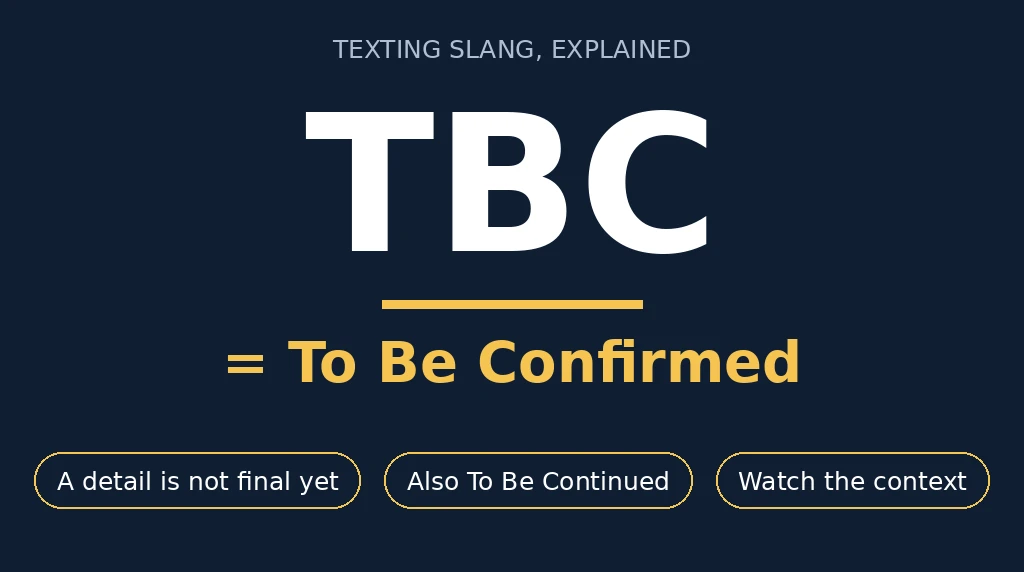
TBC carries two main full forms, and each one belongs to a different setting:
- T: To, in both senses
- B: Be, in both senses
- C: Confirmed, in a planning chat, or Continued, at the end of a story
Say it out loud and the pattern is simple. People say the letters one at a time, tee bee cee, because TBC is an initialism in speech. Nobody pronounces it as a single word, and trying to do so is the fastest way to confuse the person you are talking to.
The split is the interesting part. Meanzafy says “To Be Confirmed” is the most common sense in texting, while CyberDefinitions lists “To Be Continued” first. Neither source is wrong. They are describing two different rooms, the planning chat and the story, and in each room one sense leads.
TBC vs TBD vs TBA: What Is the Difference?
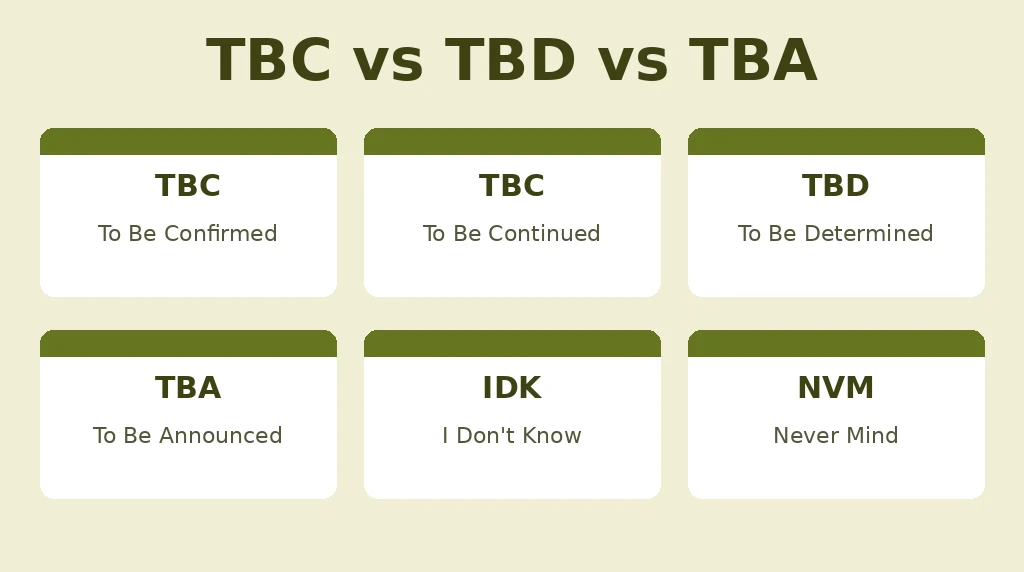
TBC sits in a small family of waiting and planning terms, and the family members look alike at a glance. Here they are side by side.
| Abbreviation | Full Form | What It Really Says | Tone |
|---|---|---|---|
| TBC | To Be Confirmed | A detail is not final yet | Organised, calm |
| TBC | To Be Continued | The story will go on | Exciting, open |
| TBD | To Be Determined | A decision is still open | Open, undecided |
| TBA | To Be Announced | News is coming later | Formal, patient |
The classic mix up is TBC versus TBD, because both describe something that is not settled. The gap is simple, though. TBC means a detail exists and is waiting for one last check, like a time that needs a final yes. TBD means a decision is still open, like a venue nobody has picked yet. TBC is a confirmation waiting to happen, while TBD is a choice waiting to be made.
TBA sits one step further away, used when news will be shared later, often in a formal announcement. And when a chat is still open and nobody knows what to say next, people reach for dttm, which means “don’t talk to me” and says the conversation is closed, not pending.
Where TBC Is Commonly Used
Texting and WhatsApp
In one to one chats, TBC appears after plans that are nearly set. A typical line looks like this: “dinner Saturday, time TBC.” The plan is real, only the hour is still open.
Instagram and Snapchat
On Instagram and Snapchat, TBC shows up in story replies and captions about events. A story that says “party details TBC” tells followers the event is happening and the details will follow soon.
TikTok and YouTube
On TikTok and YouTube, TBC is the “To Be Continued” sense, flashed at the end of a part one video. A creator ends a cliffhanger with “TBC” and the comments fill up with viewers asking when part two arrives.
Group Chats
Group chats are the natural home of TBC, because a plan shared with ten people always has one detail still open. Someone writes “venue TBC, will confirm tonight” and the group relaxes, knowing the answer is coming.
Work Chats and Emails
In work chats and emails, TBC is standard business shorthand for a detail waiting on confirmation. A message that says “meeting room TBC” tells the team the meeting is set and only the room is still open.
Gaming and Streaming
In gaming chats and streams, TBC marks a series or a session that will continue. A streamer ends the night with “TBC tomorrow” and the viewers know the game will pick up where it stopped.
Origin and History of TBC
The “To Be Confirmed” sense of TBC comes from business and office writing, where schedules, meetings and bookings always have details that need a final check. It travelled from memos and letters into emails, then into texting and group chats, because the problem never changed: a plan is nearly set, one detail is still open, and three letters say so faster than a full sentence.
The “To Be Continued” sense comes from an older place, the world of serial stories, comics and television. For decades, episodes and chapters have ended with the words “to be continued” to keep the audience coming back, and the three letter short form followed naturally once those stories moved onto screens and social feeds.
The two senses grew up separately, one in offices and one in stories, and they met again in texting, where the same three letters now serve both rooms. That shared history is why context matters so much: a planning chat and a story ending look nothing alike.
Other Meanings and Variations of TBC
In everyday talk, TBC almost always means “To Be Confirmed” or “To Be Continued,” but the same letters carry a few other readings worth knowing.
- To Be Confirmed, the planning sense: this is the sense meanzafy names most common in texting. If the message is about a plan, a date or a booking, this is the reading that fits.
- To Be Continued, the story sense: CyberDefinitions lists this sense first. If the message ends a story, an episode or a video, this is the reading that fits.
- To Be Cancelled, the rare joke: in a few group chats, people joke that TBC means “To Be Cancelled” when a plan keeps slipping. It is a joke, not a real meaning.
- Lowercase tbc vs uppercase TBC: the small letters feel softer and more casual in a chat, while the capitals stand out as a clear label. In a work email or a post title, the capitals are the usual choice.
- TBC as a tag: on social media, #tbc gathers posts about plans still waiting on details and stories waiting for a next part, so the tag works as a topic label rather than a message aimed at one person.
How to Use TBC Correctly
- Match the sense to the setting. Use “To Be Confirmed” for plans and bookings, and “To Be Continued” for stories and series. The room you are in decides which sense the reader will hear.
- Put it next to the open detail. TBC works best right beside the thing that is waiting, like “time TBC” or “venue TBC.” Dropping it alone at the end of a long message leaves people guessing.
- Follow up when you promised you would. TBC is a promise that an answer is coming, so send the confirmation when you have it. A TBC with no follow up turns a small delay into real frustration.
- Spell it out for people who may not know it. In a mixed group, write “to be confirmed” in full the first time, then use TBC after that. The first full spelling costs a few words and saves a lot of confusion.
- Do not use it to dodge a decision. TBC is for a detail that genuinely needs a check, not for a plan you are avoiding. If you can decide now, decide now and skip the tag.
Example Conversations Using TBC
Planning dinner with a friend
Person A: “Dinner Saturday, time TBC”
Person B: “Sounds good, just let me know when you confirm”
A group chat about a trip
Person A: “Venue TBC, will confirm tonight”
Person B: “No rush, we will keep Saturday free”
A work chat about a meeting
Person A: “Meeting room TBC, I will update the invite”
Person B: “Thanks, I will watch for the update”
A story ending on TikTok
Person A: “Wait, the video just ends with TBC?”
Person B: “Yeah, part two drops tomorrow, I cannot wait”
A party invite in progress
Person A: “Party details TBC, save the date for now”
Person B: “Saved, send the details when you have them”
A gaming stream sign off
Person A: “Streamer just said TBC tomorrow”
Person B: “Nice, same time then, see you there”
Checking a plan that keeps slipping
Person A: “Is the time still TBC or do we have it now?”
Person B: “idk yet, still waiting on the venue to reply”
The confusing one
Person A: “The show ended with TBC, so what happens next?”
Person B: “It means to be continued, the story is not over”
When Not to Use TBC
- When everything is already decided: if the time, the place and the plan are all set, there is nothing to confirm, and TBC only adds confusion.
- As a way to avoid deciding: tagging a plan TBC when you could simply decide now is not planning, it is stalling, and people notice.
- In a formal document: reports, contracts and official writing should use the full phrase “to be confirmed” instead of the short form.
- When the story is actually over: ending a finished story with TBC promises a next part that will never come, and the audience will feel misled.
- With people who do not know the term: in a mixed group, a bare TBC can confuse readers who have never seen it, so spell it out the first time.
- When precision matters: if the detail is the whole point of the message, write it out in full instead of hiding behind a tag.
How to Respond When Someone Sends You TBC
A TBC lands in your chat and the ball is suddenly in your court. The sender is telling you something is still open, so your reply should show you understood that.
Patient replies work when the detail can wait:
- “No worries, just let me know when it is confirmed.”
- “Sounds good, I will keep the day free.”
- “Take your time, no rush at all.”
Helpful replies suit a TBC you can help settle:
- “Want me to check with the venue while you sort the rest?”
- “I can confirm the time if that helps.”
Playful replies fit close friends and light topics:
- “TBC? You love keeping us in suspense”
- “Fine, but part two better be worth the wait”
One thing to avoid: do not answer a TBC with a bare “ok” and then act as if the plan is final, because the detail really is still open. If you are not sure which sense they meant, send a quick tbd check and ask, “do you mean to be confirmed, or to be continued?” before you plan around the wrong one.
Common Mistakes People Make With TBC
- Assuming TBC has only one meaning. TBC means both “To Be Confirmed” and “To Be Continued,” and reading only one sense is the fastest way to misunderstand a message.
- Confusing TBC with TBD. TBC is a confirmation waiting to happen, while TBD is a decision waiting to be made. They describe different kinds of waiting.
- Treating a TBC plan as final. A plan marked TBC still has an open detail, so booking travel or telling others it is set can backfire when the detail changes.
- Never following up on a TBC. If you tag something TBC, you owe the group an answer. Leaving it open forever turns a small delay into a broken promise.
- Using it in a story that is over. Ending a finished story with TBC promises more story, and the audience will wait for a part two that never arrives.
Frequently Asked Questions
What does TBC mean in text?
TBC has two everyday meanings. In texting, it most often stands for “To Be Confirmed,” meaning a detail, a plan or a date is not final yet. It can also stand for “To Be Continued,” meaning a story, a show or a series will go on.
Which meaning of TBC is more common?
In texting and planning chats, “To Be Confirmed” is the more common sense, and meanzafy names it the most common use in texting. “To Be Continued” is the sense you will meet at the end of a story, an episode or a video. CyberDefinitions lists “To Be Continued” first, so both senses carry real weight.
What is the difference between TBC and TBD?
TBC means “To Be Confirmed” and points at a detail that exists but is not final yet, like a date waiting for one last check. TBD means “To Be Determined” and points at a decision that is still open, like a venue nobody has picked yet.
Does TBC mean To Be Continued?
Yes, that is one of its two main meanings. “To Be Continued” is the sense used at the end of a story, a TV episode or a video series to promise that the story will go on. In a planning chat, though, the same letters usually mean “To Be Confirmed.”
Can I use TBC in a work email?
Yes, TBC is fine in a work email when you mean “To Be Confirmed,” because it is a standard business shorthand. Write it in full the first time if the reader may not know it, and use it only for a detail that really is waiting on confirmation.
How do I reply when someone sends me TBC?
Ask what is still waiting, or offer to help settle it. A simple “no worries, just let me know when it is confirmed” works well. If TBC means “To Be Continued,” reply with excitement about the next part instead.
Final Thoughts
TBC is a small abbreviation with two honest lives. In a planning chat it means “To Be Confirmed,” a detail that exists but is not final yet. At the end of a story it means “To Be Continued,” a promise that more is coming. The letters never change, but the room you are in changes everything about what they mean.
If you want a second opinion from a dictionary source, Dictionary.com has an entry for TBC. Either way, you now have the tbc meaning in text down, plus a decent reply ready for the next time it shows up in your messages.

4 thoughts on “TBC Meaning in Text: What It Means, How to Use It and How to Reply”