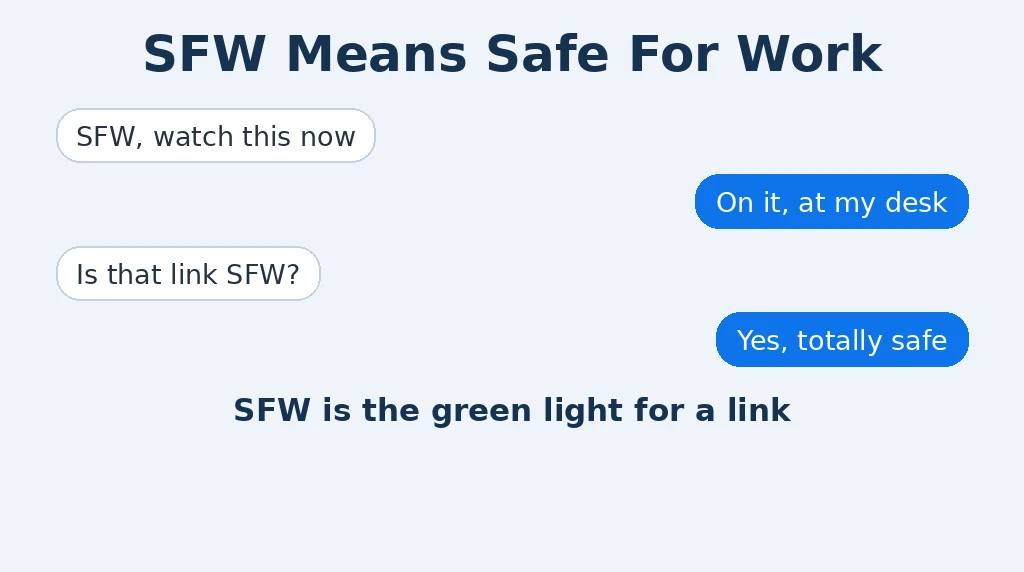
You are at your desk when a friend drops a link in the group chat with three small letters in front of it: “SFW, you have to see this.” Your boss is two seats away, the screen is bright, and you have one second to decide whether clicking is safe.
Here is the quick answer. SFW stands for “Safe For Work,” a label that says a link or post is fine to open at work, at school or around other people. It is the opposite of NSFW, which warns you to wait until you are alone. This guide covers the sfw meaning in text, how the tag works, SFW vs NSFW and NSFL, where it shows up, and the best ways to reply.
What Does SFW Mean in Text?
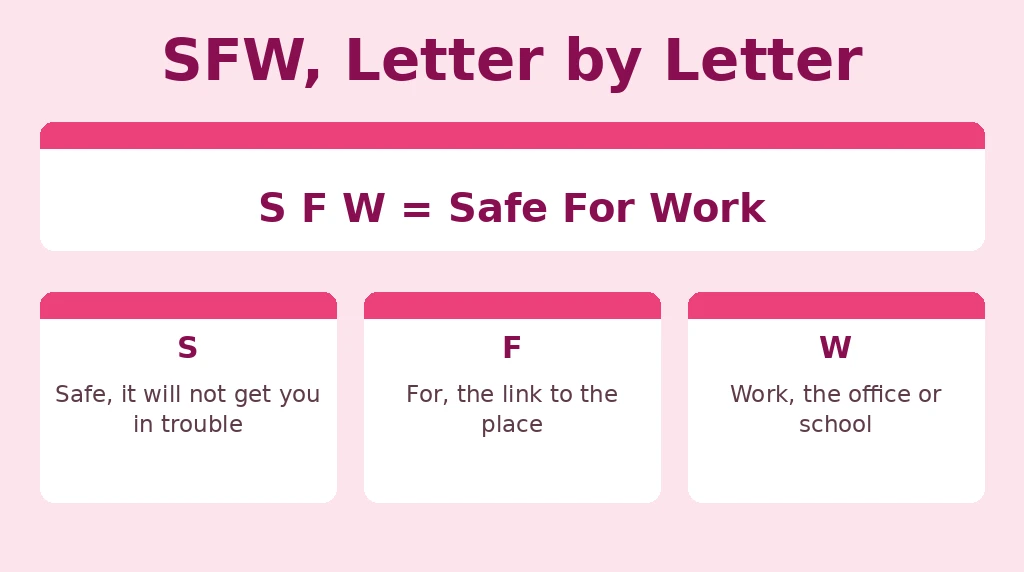
In texting, forums and social media, SFW stands for “Safe For Work.” It is a tag placed before a link, an image, a video or a post to promise that the content is clean enough to open in public. No nudity, no graphic violence, no strong sexual content, and nothing that would make you slam your laptop shut when a colleague walks past.
The tag exists because the internet does not come with a warning label of its own. Before SFW and NSFW became common, people clicked links blind and learned the hard way. Now a sender can put SFW in front of a link and the reader knows the coast is clear before a single pixel loads.
The tone is practical and helpful rather than playful. SFW is not a joke or a piece of slang you use to sound cool. It is a piece of labelling, closer to a sign on a door than a punchline. Lowercase “sfw” reads softer in a chat, while uppercase “SFW” stands out as a clear tag, which is why the capitals are the usual form.
Full Form of SFW
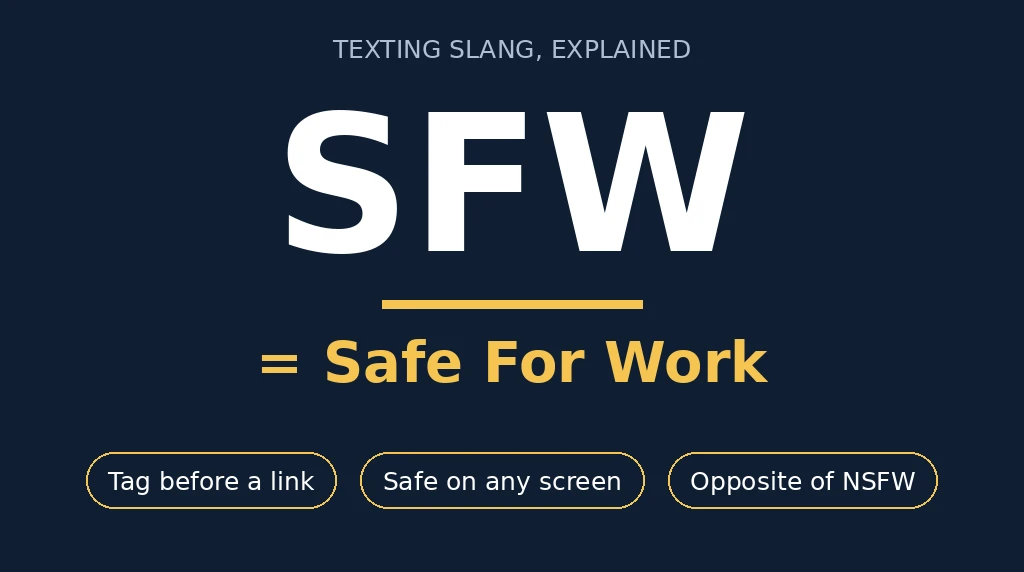
SFW has one main full form, and each letter carries part of the promise:
- S: Safe, the content will not get you in trouble
- F: For, the link between the promise and the place
- W: Work, the office, the classroom, anywhere public
Say it out loud and the pattern is simple. People say the letters one at a time, ess eff double you, because SFW is an initialism in speech. Nobody pronounces it as a single word, and trying to do so is the fastest way to confuse the person you are talking to.
The second meaning, “Software,” follows the same letter pattern but lives in a different world. In tech talk, SFW can be short for software, the programs and apps that run on a computer. That sense is far rarer, and it almost never appears in a chat or a social media post.
SFW vs NSFW vs NSFL: What Is the Difference?
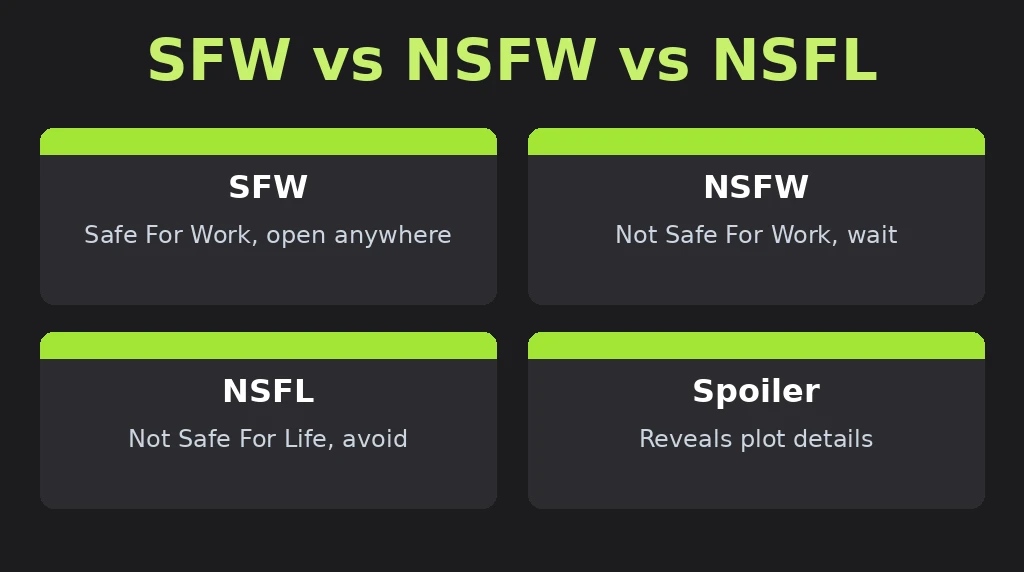
SFW belongs to a small family of content warning tags, and the family members look alike at a glance. Here they are side by side.
| Abbreviation | Full Form | What It Really Says | Tone |
|---|---|---|---|
| SFW | Safe For Work | Fine to open anywhere | Reassuring, clear |
| NSFW | Not Safe For Work | Wait until you are alone | Warning, direct |
| NSFL | Not Safe For Life | Disturbing, even alone | Serious warning |
| Spoiler | Spoiler warning | Reveals plot details | Considerate, light |
The classic mix up is SFW versus NSFW, because the two tags are mirror images of each other. The gap is simple, though. SFW is a green light, a promise that the content is clean. NSFW is a warning sign, a promise that it is not. One letter, the N for “Not,” flips the whole meaning, so reading the tag carefully matters more than it looks.
NSFL is the stronger warning of the pair, used for content that is graphic or disturbing enough that even opening it alone is a bad idea. A spoiler tag is different again, since it warns about plot details rather than safety. And when a plan for sharing a link is still undecided, people reach for tbd, which means “to be determined” and says nothing about the content.
Where SFW Is Commonly Used
Texting and WhatsApp
In one to one chats, SFW appears before links a friend wants you to open right away. A typical line looks like this: “SFW, this video is hilarious, watch it now.”
Instagram and Snapchat
On Instagram and Snapchat, SFW shows up in captions and story replies where a link needs a quick safety note. A story that says “SFW link in bio” promises the page behind it is clean.
Reddit and Forums
Reddit and forums are where the SFW tag does its heaviest work, because strangers share links with strangers all day. A post titled “SFW: the full trailer is finally out” tells every reader the trailer is safe to play at the office.
Group Chats
Group chats are the natural home of SFW, because a link dropped in a group is opened on many different screens at once. Someone writes “SFW, this article is actually worth reading” and everyone can tap it without a second thought. A friend who pops in with wbt is just asking what is happening before the link drops.
Gaming Chats
In gaming chats, SFW marks clips, memes and guides that are safe to share in a public server. A player types “SFW clip of that insane goal” and the whole server knows the video is safe to stream.
Discord and Work Chats
Discord servers and work chats use SFW as a channel rule as much as a tag. A channel marked SFW means everything posted there must be clean.
Origin and History of SFW
The SFW tag grew out of early internet forums and message boards in the 1990s and 2000s, when people started sharing links with strangers and quickly learned that not every link was safe to open at work. The opposite tag, NSFW, came first, as a warning, and SFW followed as its reassuring partner, a way to say “this one is fine” without a long explanation.
The tag spread because it solves a real problem in very few letters. Workplaces, schools and shared screens are everywhere, and a three letter label is the cheapest way to promise safety before a click. Over time, SFW moved beyond forums into everyday texting, where friends now use it before links the same way forum users did years ago.
The “Software” sense has a separate, quieter history in tech writing, where SFW has long been used as a short form for software in notes and file names. It never spread the way the tag sense did, because in tech talk the full word “software” is short enough already.
Other Meanings and Variations of SFW
In everyday talk, SFW almost always means “Safe For Work,” but the same letters carry a few other readings worth knowing.
- Software, the tech sense: CyberDefinitions lists “Software” as a second meaning of SFW, used in tech talk about programs and apps. If the message is about code or computers, this is the reading that fits.
- SFW as a channel rule: on Discord, Reddit and forums, SFW can describe a whole channel or section, not just one link. A channel marked SFW means everything inside it must stay clean.
- The SFW version: people often ask for or offer “the SFW version” of a meme, a video or a photo, meaning an edited copy with the risky parts removed so it can be shared anywhere.
- Lowercase sfw vs uppercase SFW: the small letters feel softer and more casual in a chat, while the capitals stand out as a clear tag. In a post title or a channel name, the capitals are the usual choice.
- SFW as a tag: on social media, #sfw gathers posts that are marked safe for work, so the tag works as a topic label rather than a message aimed at one person.
How to Use SFW Correctly
- Tag before the link, not after it. The tag only helps if the reader sees it before they click, so put SFW at the start of the message or right before the link itself.
- Mean it when you tag it. An SFW tag is a promise. If the link turns out to have nudity, gore or strong sexual content, the tag was wrong, and the next person who trusts you will pay for it.
- Use it when the setting is unclear. In a group chat or a public forum, you cannot know whose screen will open your link. Tag it SFW when it is clean, or NSFW when it is not, and let people decide.
- Do not tag a link you have not checked. If you have not opened the link yourself, you cannot promise it is safe. Check it first, then tag it, or leave the tag off entirely.
- Keep it short and plain. SFW works because it is three letters long. Do not dress it up with extra words or jokes, or the tag stops being a clear signal.
Example Conversations Using SFW
A friend sharing a video
Person A: “SFW, this video is hilarious, watch it now”
Person B: “On it, watching it at my desk right now”
A group chat link drop
Person A: “SFW, this article is actually worth reading”
Person B: “Nice, saved it for my lunch break”
A Reddit post title
Person A: “SFW: the full trailer is finally out”
Person B: “Watched it at work, no regrets at all”
Asking for a clean version
Person A: “Is there an SFW version of that meme?”
Person B: “Yeah, I will send the edited one”
A Discord channel question
Person A: “Is this channel SFW or can I post anything?”
Person B: “SFW only here, keep it clean please”
Checking before clicking
Person A: “Is that link SFW? My boss is right behind me”
Person B: “Yes, totally safe, go ahead and open it”
The confusing one
Person A: “The new SFW update is out today”
Person B: “Wait, do you mean safe for work or the software?”
Person A: “The software, sorry, bad wording on my part”
When Not to Use SFW
- On a link you have not checked: tagging a link SFW without opening it first is a promise you cannot keep, and it can embarrass someone who trusted you.
- As a joke on risky content: putting SFW on a link that is clearly not safe is not funny. It breaks trust, and people will stop believing your tags.
- In a formal document: reports, applications and official writing should use plain words like “suitable for work” instead of an internet tag.
- When the audience is already private: in a one to one chat with a close friend, a tag is often unnecessary, and a plain “have a look at this” works just as well.
- To label yourself or a person: SFW describes content, not people. Calling a person SFW makes no sense and will only confuse the reader.
- When precision matters: if the content is borderline, do not hide behind a tag. Say what is actually in the link so the reader can decide.
How to Respond When Someone Sends You SFW
An SFW tag lands in your chat and the ball is suddenly in your court. The sender has done you a favour by labelling the link, so your reply should show you noticed it.
Patient replies work when you want to take your time:
- “Thanks for the tag, I will check it out later.”
- “Appreciate it, opening it now while I have a minute.”
Helpful replies suit a link that deserves a real answer:
- “Thanks, that was actually really useful.”
- “Just watched it, the ending was brilliant.”
Playful replies fit close friends and light topics:
- “SFW and still funny, that is a rare combo”
One thing to avoid: do not answer an SFW link with a bare “ok” and never open it, because the sender took the time to label it for you. If the link turns out to be unsafe, send a quick nvm about the tag and warn them politely before anyone else clicks it.
Common Mistakes People Make With SFW
- Tagging a link without checking it. An SFW tag is a promise, and tagging a link you have never opened is the fastest way to break that promise.
- Confusing SFW with NSFW. One letter flips the meaning entirely. Mixing the two tags up can embarrass a colleague or get someone in real trouble at work.
- Putting the tag after the link. A tag placed after the link is useless, because the reader clicks first and reads the warning second. Always tag before the link.
- Using it for borderline content. If a link is nearly safe but not quite, do not tag it SFW. Say what is in it and let the reader decide.
- Assuming everyone knows the tag. People new to forums and group chats may not know what SFW means, so in a mixed group it can help to add one plain word, like “safe link.”
Frequently Asked Questions
What does SFW mean in text?
SFW stands for “Safe For Work.” It is a tag on a link, image, video or post that means the content is fine to open at work, at school or around other people. It promises no nudity, no graphic violence and nothing that would embarrass you on a shared screen.
What is the opposite of SFW?
The opposite is NSFW, short for “Not Safe For Work.” An NSFW tag warns you that the content has nudity, strong language, gore or something else you would not want a boss or a stranger to see on your screen.
What is the difference between SFW and NSFW?
SFW means the content is safe to open anywhere, while NSFW means it is not. The tag sits before the link so you can decide in advance. A post tagged SFW should be fine on a work laptop, while one tagged NSFW should wait until you are alone on a private screen.
Does SFW have another meaning?
Yes. CyberDefinitions also lists “Software” as a second meaning of SFW, used in tech talk about programs and apps. That sense is far less common than “Safe For Work,” and the tag sense is the one you will meet in chats, forums and social media.
Can I use SFW in a work email?
You can, but only in the tag sense and only when it fits. Writing “here is the SFW version of the file” in a work message is fine, because it is clear and useful. Do not use it as casual slang in a formal email.
How do I reply when someone sends me SFW?
Thank them for the tag and open the link when you are ready. A simple “thanks, checking it now” works well. If the link turns out to be unsafe after all, let them know politely so they can fix the tag.
Final Thoughts
SFW is a small tag with a big job. In three letters it promises that a link is safe to open at work, at school or on a shared screen, and it saves people from the embarrassment of a surprise they never asked for. Its opposite, NSFW, does the same job in reverse, and together the two tags make the internet a little more polite.
If you want a second opinion from a dictionary source, Dictionary.com has an entry for SFW. Either way, you now have the sfw meaning in text down, plus a decent reply ready for the next time a tagged link lands in your messages.
