One awkward joke, an overly dramatic social media post, or a painfully uncomfortable moment can make you look away and think, “Why did they do that?” That reaction is often described as cringe. The cringe meaning in modern slang is something embarrassing, awkward, or uncomfortable to watch, hear, or experience. People commonly use it in text messages, TikTok comments, Instagram posts, and everyday conversations to describe moments that cause embarrassment, sometimes even when the person feeling it did nothing wrong.
The word has another important meaning in standard English. As a verb, to cringe means to recoil, shrink back, or react with discomfort, fear, or embarrassment. Understanding both meanings helps you recognize how the word changes across different situations. This guide explains its definition, slang usage, examples, related expressions, and the difference between cringe, cringey, and cringe-worthy.
What Does Cringe Mean?
Cringe can mean an awkward or embarrassing thing, especially in internet slang. It can also describe the physical or emotional reaction of recoiling from something uncomfortable.
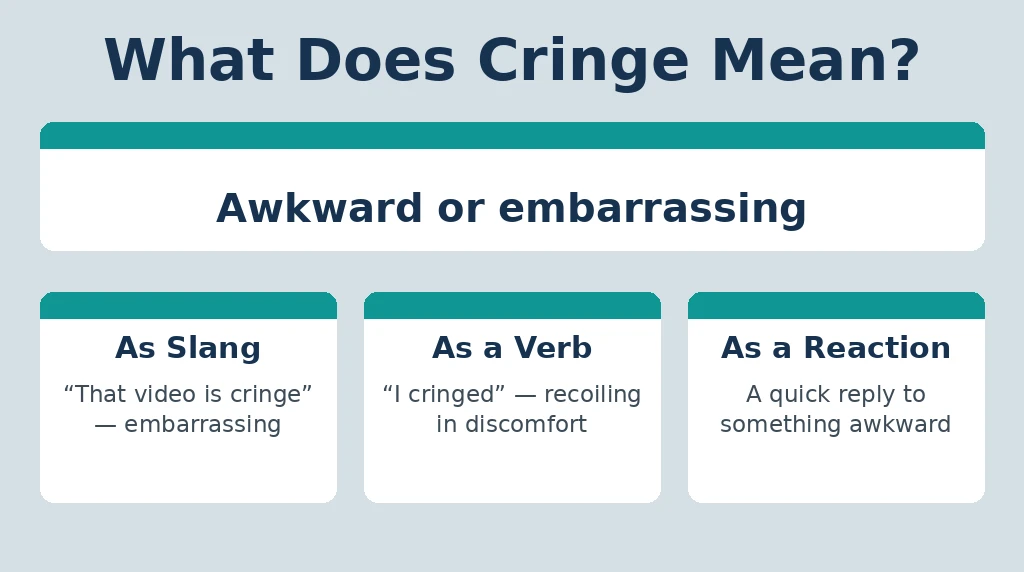
The meaning depends on how the word is used.
- As slang: “That video is cringe.” This means the video feels embarrassing or awkward to watch.
- As a verb: “I cringed when I heard the joke.” This means the speaker reacted with discomfort or embarrassment.
- As a reaction: “Cringe!” This is a quick response to something perceived as awkward or embarrassing.
In online conversations, people often use cringe to criticize behavior that seems forced, overly dramatic, socially awkward, or out of touch with the situation.
For example, a person might describe an exaggerated attempt to impress someone as cringe. Another might use the word for a joke that makes everyone in the room uncomfortable.
However, cringe is subjective. One person may find a video embarrassing, while another finds it funny or harmless.
Cringe Meaning in Simple English
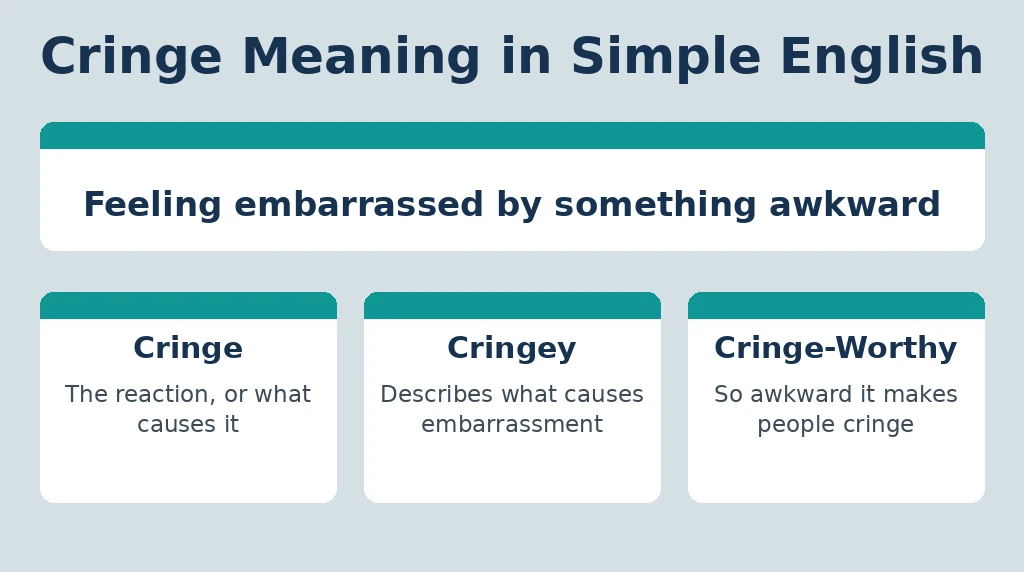
In simple English, cringe means feeling embarrassed or uncomfortable because of something awkward. In slang, it can also describe the thing causing that reaction.
Imagine a student confidently tells a joke in class, but nobody laughs. The student keeps explaining the joke, making the moment even more awkward. A classmate might later say, “That was so cringe.”
The word does not necessarily mean that something is bad, dangerous, or offensive. It often means the situation feels uncomfortable to watch.
Here is an easy way to remember it:
- Cringe: An embarrassing or uncomfortable reaction, or something that causes it.
- Cringey: Describes something that causes embarrassment or awkwardness.
- Cringe-worthy: So embarrassing or uncomfortable that it makes people cringe.
Cringe Meaning in Text Messages
The cringe meaning in text is usually informal. People use the word to react to an awkward message, an embarrassing situation, or someone’s behavior.
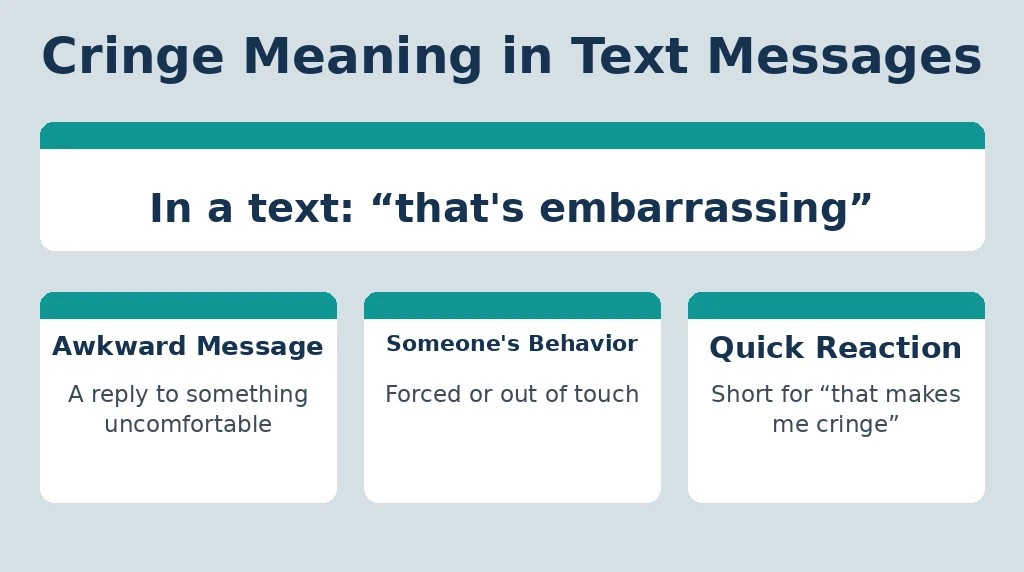
For example:
| Text message | What it means |
|---|---|
| “That message was cringe.” | The message felt awkward or embarrassing. |
| “I’m cringing so hard.” | The sender feels intense embarrassment or discomfort. |
| “Bro, that’s so cringe.” | The sender thinks something is painfully awkward. |
| “This conversation is getting cringey.” | The conversation is becoming uncomfortable or embarrassing. |
| “I can’t watch this. Too much cringe.” | The content makes the sender feel uncomfortable. |
What Does “That’s Cringe” Mean?
“That’s cringe” means “That’s embarrassing,” “That’s awkward,” or “That makes me uncomfortable.”
For example, if someone posts a dramatic declaration of love to a person they have never spoken to, a viewer might comment, “That’s cringe.”
The comment expresses the viewer’s reaction. It does not automatically prove that the person who posted the message did something wrong.
What Does “So Cringe” Mean?
“So cringe” is an informal way to emphasize how awkward or embarrassing something feels.
Example: “He tried to act like a celebrity in front of his friends. It was so cringe.”
The word so adds emphasis, much like saying “really awkward” or “extremely embarrassing.”
Cringe Meaning on TikTok
On TikTok, cringe often appears in comments, reaction videos, memes, and discussions about online trends. Users may apply it to awkward performances, forced jokes, exaggerated reactions, or content that seems designed to attract attention.
For example:
- A creator pretends to be an expert but clearly does not understand the subject.
- Someone makes an exaggerated video to appear impressive.
- A person shares an awkward interaction that viewers find uncomfortable to watch.
Comments such as “This is cringe” or “I’m getting secondhand embarrassment” express the viewer’s reaction.
However, not every unusual or unconventional video is inherently cringe. Online audiences sometimes use the label simply because a person behaves differently from what they expect. The word can therefore reveal the audience’s social expectations as much as the content itself.
Cringe Meaning on Snapchat
On Snapchat, cringe may appear in private messages, group chats, story replies, or conversations about something embarrassing.
Examples:
- “That snap was cringe.”
- “I cringed when I saw his story.”
- “Why did I send that? I’m cringing now.”
The first sentence criticizes the content. The second describes a reaction to another person’s story. The third expresses embarrassment about the sender’s own actions.
Snapchat does not give cringe a special platform-specific definition. It generally carries the same informal meaning it has in everyday online communication.
Cringe Meaning on Instagram
On Instagram, the word commonly appears under Reels, in comments, in captions, and in direct messages. People may use it to describe awkward videos, forced humor, exaggerated displays of affection, or behavior they consider embarrassing.
For example, a person might comment “Cringe” under a video of someone repeatedly trying to impress a crowd.
The same word can also be used playfully between friends. Someone might send a screenshot of an old post and write, “Why was I like this? So cringe.”
The difference lies in the tone and relationship. A friend laughing at their own old post is not necessarily attacking anyone. A stranger repeatedly using cringe to humiliate someone may be engaging in hurtful behavior.
What Does It Mean to Cringe?
Outside internet slang, cringe is a verb. It describes a reaction in which someone recoils, shrinks back, or shows discomfort.
The reaction can be physical or emotional.
Physical discomfort:
“She cringed when the dentist touched the sensitive tooth.”
This means she reacted to the discomfort.
Fear or apprehension:
“He cringed at the thought of speaking in front of a large audience.”
Here, the word communicates dread or uneasiness.
Embarrassment:
“I cringe whenever I remember my first school presentation.”
The speaker feels embarrassed when recalling the experience.
This distinction is useful because the verb meaning is broader than the slang meaning. You can cringe from pain or fear without thinking that the situation is socially embarrassing.
What Is Secondhand Embarrassment?
Secondhand embarrassment is the uncomfortable feeling you experience when someone else’s actions embarrass you on their behalf.
For example, imagine watching a person tell a long, personal story at a party while everyone else looks uncomfortable. You might feel embarrassed for them, even though you were not involved.
That feeling is often described as cringing.
The two expressions are closely related, but they are not identical:
- Cringe: A word for a reaction or something considered awkward or embarrassing.
- Secondhand embarrassment: Specifically describes feeling embarrassed because of someone else’s actions.
You can cringe at your own old photographs, a painful scene in a movie, or an awkward conversation. Secondhand embarrassment usually involves another person’s uncomfortable moment.
Cringe vs. Cringey vs. Cringe-Worthy
These expressions share a meaning, but they serve different grammatical purposes.
| Word or phrase | Part of speech or use | Example |
|---|---|---|
| Cringe | Verb, noun, or informal slang label | “I cringe when I remember it.” |
| Cringey | Adjective | “That was a cringey speech.” |
| Cringy | Alternative spelling of cringey | “The dialogue felt cringy.” |
| Cringe-worthy | Adjective | “The awkward interview was cringe-worthy.” |
| Cringeworthy moment | Noun phrase | “The speech created a cringeworthy moment.” |
Is Cringey the Same as Cringe?
They are similar, but the grammar is different.
Use cringe as a verb when describing a reaction: “I cringe at that memory.”
Use cringey when describing something that causes embarrassment: “That memory is cringey.”
In informal online speech, people also use cringe as an adjective, as in “That video is cringe.” This usage is common in casual conversation, although more formal writing may favor embarrassing or awkward.
Is Cringe an Insult?
It can be, but it is not always an insult.
Calling a video cringe may simply express a personal reaction. Calling a person cringe can sound more judgmental because it labels the individual rather than a specific action.
Compare these examples:
- “That joke was cringe.” This criticizes a particular joke.
- “You are so cringe.” This criticizes the person and may feel insulting.
- “I cringe when I remember my old posts.” This expresses self-directed embarrassment.
The distinction matters. Criticizing one awkward moment is different from using the word to make someone feel ashamed of their personality or interests.
People also use cringe humorously about themselves. Someone might say, “My old fashion choices were cringe,” without intending to insult anyone else.
Cringe Synonyms and Related Words
The best synonym depends on the type of discomfort you want to describe.
| Synonym | Meaning | Best use |
|---|---|---|
| Embarrassing | Causing shame or self-consciousness | Awkward personal situations |
| Awkward | Socially uncomfortable or clumsy | Conversations and interactions |
| Uncomfortable | Causing unease or distress | Broad situations |
| Cringeworthy | Likely to cause embarrassment | Content or behavior |
| Painful to watch | Extremely uncomfortable to observe | Difficult social moments |
| Mortifying | Extremely embarrassing | Serious or intense embarrassment |
| Cheesy | Overly sentimental, predictable, or trying too hard | Dialogue, romance, humor |
| Forced | Unnatural or lacking spontaneity | Jokes, reactions, performances |
| Inappropriate | Unsuitable for a situation | Comments or behavior that cross a boundary |
These words are not perfect replacements in every context. Mortifying is stronger than cringe, while cheesy can describe something sentimental without necessarily being embarrassing.
Choose the word that explains the reaction you actually mean.
Real-Life Examples of Cringe
Here are examples showing how the word works in everyday situations.
| Situation | Example sentence | Meaning |
|---|---|---|
| An awkward joke | “That joke made the whole room cringe.” | People felt uncomfortable. |
| An old photograph | “I cringe when I look at my old haircut.” | The speaker feels embarrassed. |
| A forced performance | “His exaggerated acting felt cringey.” | The performance seemed awkward or unnatural. |
| A social mistake | “I accidentally called my teacher Mom. I’m still cringing.” | The speaker feels embarrassed about the mistake. |
| A romantic gesture | “The dramatic public proposal felt cringe to some viewers.” | Some viewers found it awkward or uncomfortable. |
| A difficult scene | “I had to pause the show because the scene was so cringe.” | The scene was uncomfortable to watch. |
| An online post | “My old caption is embarrassing now.” | The person sees the post differently in retrospect. |
Notice that the word describes a reaction, not an objective rule. A public proposal might feel romantic to one person and awkward to another. Context, personal taste, and social expectations all influence what people call cringe.
Common Mistakes When Using Cringe
Thinking Cringe Always Means Bad
Something described as cringe is usually perceived as awkward or embarrassing, but it is not necessarily harmful, immoral, or poorly made. Sometimes people use the word for harmless behavior that does not match their taste.
Confusing Cringe With Fear
In standard English, the verb cringe can describe fear or physical discomfort. In modern slang, it often refers to embarrassment. Use the surrounding sentence to identify the intended meaning.
Using Cringe and Cringey Interchangeably in Every Sentence
Informal slang allows expressions such as “That is cringe,” but the adjective cringey may fit better in standard sentences.
For example:
- Informal: “That video is cringe.”
- More conventional: “That video is cringey.”
- Neutral: “That video is awkward.”
Assuming Everyone Shares the Same Reaction
Calling something cringe is a personal judgment. A behavior that seems embarrassing to one audience may feel confident, funny, or sincere to another. Avoid treating personal taste as a universal fact.
Frequently Asked Questions
What does cringe mean in simple words?
Cringe means to feel embarrassed, uncomfortable, or uneasy. In slang, it describes something that seems awkward or embarrassing to watch or experience.
What does cringe mean in texting?
In texting, cringe usually describes an embarrassing message, awkward behavior, or uncomfortable situation. “That’s cringe” means “That’s awkward or embarrassing.”
What does cringe mean on TikTok?
On TikTok, cringe is often used in comments or videos to describe awkward performances, forced jokes, or behavior viewers find embarrassing. Its meaning depends on the content and context.
Is cringe a bad word?
No, cringe is not generally a swear word. However, calling someone cringe can be insulting if it is used to mock their personality, interests, or behavior.
What is a cringe person?
A “cringe person” is an informal, often judgmental label for someone whose behavior another person finds awkward or embarrassing. It is a subjective description, not an objective category of people.
What is the difference between cringe and cringey?
Cringe can describe a reaction or be used informally as a label for something awkward. Cringey is an adjective describing something that causes embarrassment or discomfort.
What does “I’m cringing” mean?
It means the speaker is feeling embarrassment, discomfort, or uneasiness. They might be reacting to their own mistake or to someone else’s awkward behavior.
What is secondhand embarrassment?
Secondhand embarrassment is the feeling of embarrassment you experience on behalf of another person. It often occurs when you witness someone make an awkward social mistake.
Conclusion
The cringe meaning changes slightly depending on context. In modern slang, it describes something embarrassing, awkward, or uncomfortable to watch. As a verb, it means to recoil or react with discomfort, fear, or embarrassment.
You may see the word in text messages, TikTok comments, Snapchat conversations, and Instagram Reels. Remember that cringe is often subjective: something that feels embarrassing to one person may seem funny or perfectly normal to another. Understanding the context, tone, and grammar helps you interpret the word accurately and use it naturally.
Read More Related Articles:
- Their Meaning | Definition, Grammar, Examples & How to Use …
- FUPA Meaning in Text & Slang – SynonyMore.com
- Martyr Meaning | Definition, History, Examples & the Deeper …
