
You open a friend’s profile and the bio reads “NRS”. You send them a message anyway, and hours pass with no reply. You start to wonder whether you did something wrong, or whether those three letters were trying to tell you something all along.
Here is the quick answer. NRS means “No Response” or “No Replies”, a short heads up that the person will not answer messages for a while. It works like a do not disturb sign hung on a chat. This guide covers the nrs meaning in text, where it shows up, how it differs from DND, and the best ways to reply. By the end, you will know when to wait quietly and when a message is still worth sending.
What Does NRS Mean in Text?
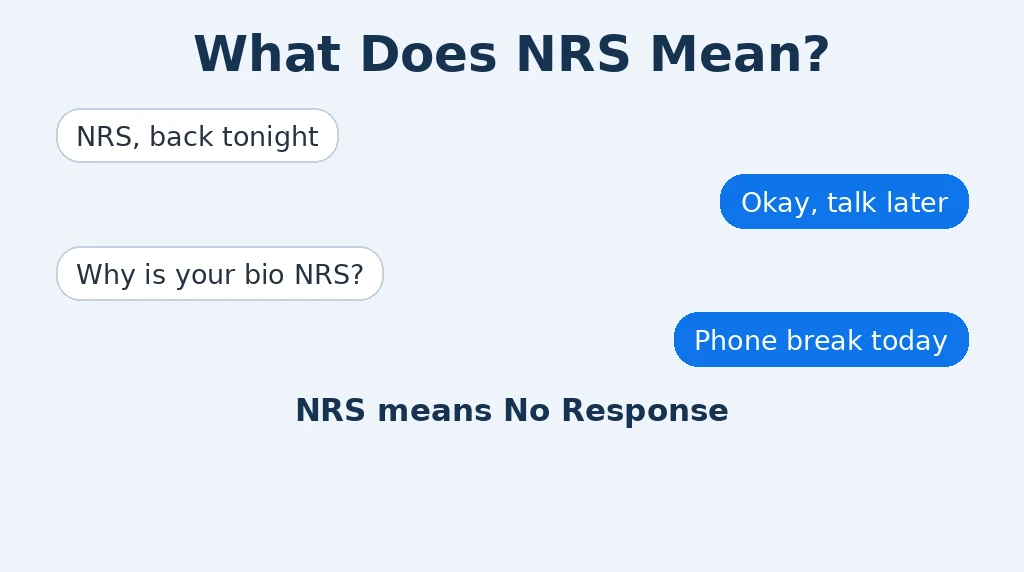
In texting, NRS means “No Response” or “No Replies”. It tells people in advance that messages will go unanswered for a while, usually because the person is busy, asleep, studying, or taking a break from their phone. A friend who sets their status to “NRS, back tonight” is not ignoring anyone, they are simply warning friends that replies will be slow.
The tone is calm and practical, not angry. NRS is a notice, not a rejection. It is the texting version of a closed shop sign: nobody is being turned away on purpose, the place is just shut for now. When it is used as a status or a general note, it reads as polite, because it saves friends from waiting and wondering.
Lowercase “nrs” reads softer and more casual than uppercase “NRS”, but the meaning stays the same either way. What changes the meaning is where it appears. As a status it speaks to everyone at once, while as a direct reply to one person it can feel colder, like a door closing on that one conversation.
Full Form of NRS
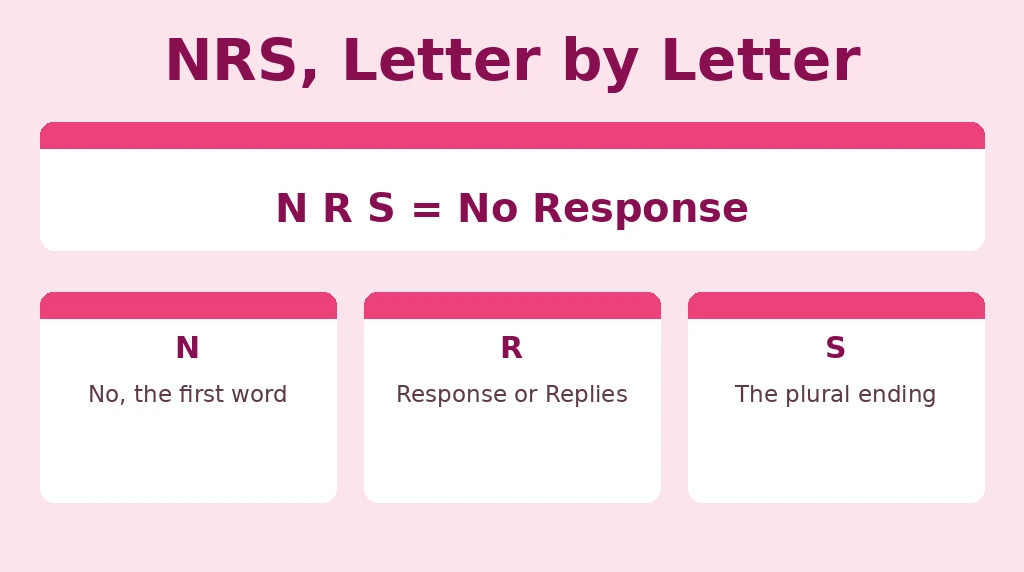
NRS stands for “No Response”, and the same letters also give you “No Replies”. The two readings mean almost the same thing, so people use them side by side.
- N: from “No”, the first word of the phrase
- R: from “Response” or “Replies”, the middle word of the phrase
- S: the plural ending, turning one “response” into “responses” or marking “replies” as plural
Say it out loud and the pattern is simple. People say the letters one at a time, en-ar-ess, because NRS is read letter by letter. Nobody pronounces it as a single word, and trying to do so is the fastest way to confuse the person you are talking to.
The “No Replies” reading is the one you will see most often in a status or a bio, while “No Response” is the one people use when they talk about a message that went unanswered. Either way, the message is the same: do not expect a quick answer.
NRS vs NR vs DND vs BRB: What Is the Difference?

NRS belongs to a small family of short “do not expect me” words, and the family members look alike at a glance. Here they are side by side.
| Abbreviation | Full Form | What It Really Says | Tone |
|---|---|---|---|
| NRS | No Response | Do not expect a reply for a while | Calm, a general notice |
| NR | No Reply | I did not answer that message | Plain, about one message |
| DND | Do Not Disturb | My phone is silenced right now | Practical, a phone setting |
| BRB | Be Right Back | I will return in a few minutes | Light, a short pause |
The classic mix up is NRS versus DND, because both tell people to hold their messages. The gap is simple, though. DND is a setting on your phone that silences calls and alerts, while NRS is a message to people, telling them not to expect a reply. One lives in your phone settings, the other lives in your status or your chat.
NR is closer to NRS, since both are about a missing reply. The difference is the scope. NR points at one single message that went unanswered, while NRS is a blanket notice that covers every message for a while. BRB is the friendliest of the four, because it promises a quick return, while NRS makes no promise at all about when the person will be back.
Where NRS Is Commonly Used
Texting and WhatsApp
In one to one chats, NRS shows up as a status or a quick note before a busy stretch. A typical line looks like this: “NRS, in class till three.” Short, plain, and friends know to wait until the person is free again.
Instagram and Snapchat
On Instagram and Snapchat, NRS lives in bios, stories, and captions. A story that says “NRS today, need a break” is a soft warning to followers, and the photo beside it usually makes the mood obvious.
TikTok Comments
On TikTok, NRS appears under clips about phones blowing up with messages. A viewer writes “me putting NRS in my bio every weekend” and the joke lands because everyone has wanted a quiet weekend at least once.
Group Chats
Group chats use NRS when one person is stepping away from the noise. Someone drops “NRS for a bit, too many notifications” and the group knows not to tag them for a while. When the exact plan is still undecided, someone drops in tbc, which means “to be continued” or “to be confirmed” and keeps the plan moving without dragging everyone back in.
Gaming Chats
Gaming chats use NRS when a player is away from keyboard or focused on a match. A line like “NRS, in a ranked game” tells teammates that messages will wait until the game ends, and most gamers respect it at once.
Discord and Forums
On Discord and forums, NRS shows up in status lines and away messages when someone is online but not answering. A user who writes “NRS, studying” in their status is asking the whole server to hold the messages for a bit.
Origin and History of NRS
NRS grew up with instant messaging and social media, when people started living inside chats that never slept. Friends expected fast replies at every hour, and some users needed a short way to say “I am here, but I am not answering right now.” Three letters did the job, and the abbreviation caught on in bios, statuses, and away messages.
As phones got smarter, the need only grew. Group chats, class groups, and work groups all buzz at once, and a single status line became the easiest way to warn everyone in one go. NRS spread because it is honest and short: it does not pretend the person is offline, it simply says replies are paused.
Dictionary sources that track internet slang now list NRS with the “No Response” sense first, which matches how most people use it today. The “No Replies” reading travelled with it, and both are still alive in different chats.
Other Meanings and Variations of NRS
In everyday talk, NRS almost always means “No Response” or “No Replies”, but the same letters carry a few other readings worth knowing.
- “No Replies” as a variant: this is the second common reading, and it means the same thing in practice. It shows up most often in a status or a bio, where it warns every reader at once that answers will be slow.
- Lowercase nrs vs uppercase NRS: the small letters feel softer and more casual in a status, while the capitals stand out like a sign on a door. The meaning stays the same either way.
- NRS as a status tag: on social media, NRS works as a label rather than a message aimed at one person, so friends read it as a general notice, not as a reply to them.
- NRS after silence: sometimes a person writes “NRS” to explain a gap, as in “sorry, NRS, I was asleep.” Here it means the silence had a reason, not that the person was ignoring anyone.
- NRS in gaming: in a game lobby, NRS can mean the player is away from keyboard and will not answer chat until the match ends, which is the same idea applied to a game instead of a conversation.
How to Use NRS Correctly
- Use it as a status, not as a weapon. NRS works best as a general notice in a bio or a status, where it warns everyone at once instead of shutting down one person.
- Add a time when you can. A bare NRS can leave friends guessing, so a quick extra word nearby, like “NRS, back tonight” or “NRS till three”, settles the wait and avoids worry.
- Use it before the messages pile up. Set the status when you go busy, not after ten unread messages, so friends see the warning before they start typing.
- Do not use it to dodge one person. If only one friend is bothering you, talk to them directly instead of hiding behind a status that confuses everyone else.
- Come back when you said you would. NRS is a promise of quiet, not a disappearing act, so reply when you are free again and the notice keeps its meaning.
Example Conversations Using NRS
A busy student
Person A: “Are you coming to the library?”
Person B: “NRS, in class till three, will text after”
A quiet weekend
Person A: “Why is your bio NRS?”
Person B: “Taking a break from my phone this weekend”
A gaming night
Person A: “Join the squad, we need one more”
Person B: “NRS, in a ranked game right now”
After a long silence
Person A: “You never replied yesterday”
Person B: “Sorry, NRS, I fell asleep with my phone on silent”
A group chat pause
Person A: “Guys, stop tagging me, I am working”
Person B: “NRS for a bit, too many notifications today”
A grateful friend
Person A: “thx for the notes, you are a lifesaver”
Person B: “Anytime, but NRS for now, I am off to sleep”
The unsure one
Person A: “NRS? Are you mad at me?”
Person B: “idk why you think that, I am just busy”
The playful one
Person A: “NRS until further notice, my phone needs a holiday”
Person B: “Enjoy the break, we will hold the memes till you return”
When Not to Use NRS
- As a direct reply to a real question: answering one person’s honest question with “NRS” feels cold, so answer them or say you will reply later.
- When someone needs urgent help: if a friend is in trouble or asking for something urgent, a status will not help them, so reply first and go quiet later.
- At work with no backup plan: putting NRS on a work chat without telling anyone who covers for you will leave people stuck, so name a backup first.
- To avoid a hard conversation: using NRS to dodge an argument ends the talk, but it does not solve anything, and it usually makes things worse.
- For weeks at a time: a status that never comes down stops meaning anything, so take it off when you are back.
- When you are actually online and chatting: if you are replying to other people while your status says NRS, friends will notice, and the notice will lose trust.
How to Respond When Someone Sends You NRS
An NRS lands in your chat and the ball is suddenly in your court. The simplest reply is usually no reply at all, since quiet is exactly what the person asked for.
Patient replies work when someone is busy or resting and just needs quiet:
- “Okay, talk later, no rush.”
- “Got it, I will wait till you are free.”
- “No worries, message me when you are back.”
Helpful replies suit an NRS that comes with a reason, like studying or a long drive:
- “Hope the studying goes well, I will send the notes later.”
- “Drive safe, we can sort the plan when you are home.”
Playful replies fit close friends and light topics, when you know the person is joking:
- “Enjoy the silence, I will keep the memes warm for you”
- “Okay, your phone gets a holiday too”
One thing to avoid: do not keep messaging after an NRS, and do not ask “why, what happened” five times in a row. If the message truly cannot wait, send it once, say it is urgent, and then step back until the person returns.
Common Mistakes People Make With NRS
- Taking it personally. Most NRS notices speak to everyone at once, not to you alone. Give it a few hours before you worry.
- Confusing NRS with DND. DND is a phone setting that silences alerts, while NRS is a message to people. One lives in settings, the other lives in a status.
- Using it as a direct answer. NRS is a general notice, and sending it as a reply to one person’s question reads as cold and dismissive.
- Leaving it up for weeks. A status that never comes down stops meaning anything, so take it off when you are back.
- Replying anyway, again and again. Sending five follow up texts after an NRS is the exact opposite of what the person asked for.
Frequently Asked Questions
What does NRS mean in text?
NRS means “No Response” or “No Replies.” It is a short heads up that the person will not answer messages for a while, often used as a status or a note at the end of a post.
Does NRS mean someone is ignoring me?
Not usually. NRS is normally a general notice, not a message aimed at one person. It means the person is busy, away, or taking a break from their phone, not that they are angry with you.
What is the difference between NRS and DND?
DND, “Do Not Disturb,” is a phone setting that silences calls and alerts. NRS is a message to people, telling them not to expect a reply. One is a setting on your phone, the other is a note to your friends.
Can I use NRS as a status?
Yes, that is its most common use. People put NRS in a bio, a status, or a story so friends know replies will be slow. Add a time when you can, like “NRS, back tonight,” so people know when to expect you.
How do I reply to NRS?
The simplest reply is no reply at all, since that is what NRS asks for. If the message matters, send it once and wait. A short “okay, talk later” works too, and then you leave the person alone until they return.
Is NRS rude?
No, NRS is polite when it is used as a general status, because it warns people in advance instead of leaving them waiting. It only feels rude when it is sent as a direct answer to one person who asked a real question.
Final Thoughts
NRS is a small set of letters with a clear job. In almost every chat it means “No Response” or “No Replies”, a short heads up that messages will go unanswered for a while. It works best as a general status, warning everyone at once, and it only feels cold when it is used as a direct answer to one person who asked a real question.
If you want a second opinion from a dictionary source, CyberDefinitions lists an entry for NRS. Either way, you now have the nrs meaning in text down, plus a calm reply ready for the next time it shows up in your messages.
