Your phone lights up with a message from a friend. It is only two letters long: “wy?” You read it twice. Are they asking why you did something, where you are, or what you are doing? Two letters should not be this hard to read, yet here you are, stuck on a reply.
Here is the short answer first. WY usually means “why” in texting, a shortened spelling of the word why, so “WY did you leave?” simply means “Why did you leave?” It is a fast way to ask for a reason in a casual chat. This guide covers the wy meaning in text, the other readings you might meet, WY vs WYA and WYM, where you will see it, and the best replies when it lands in your chat.
What Does WY Mean in Text?
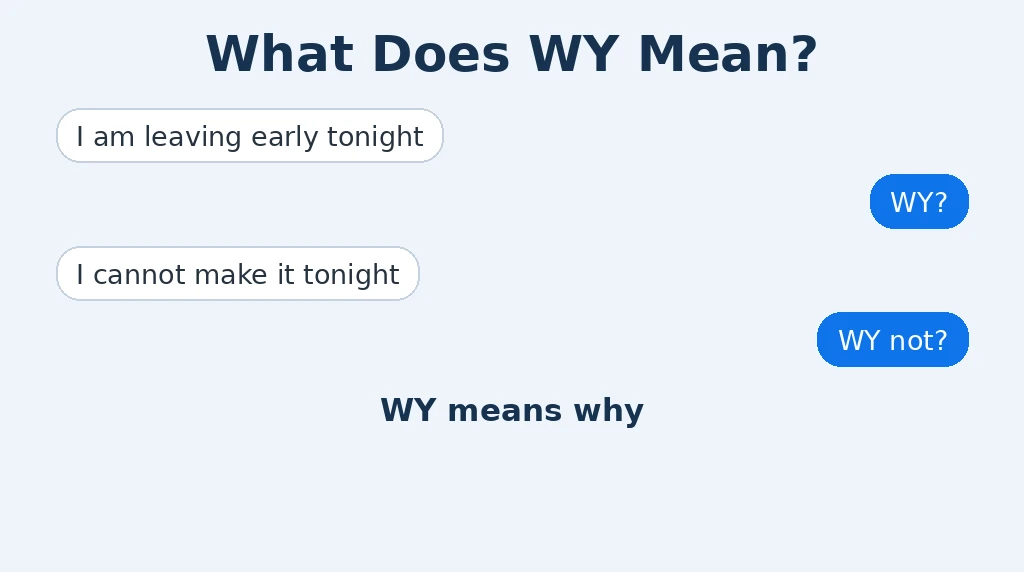
WY is a shortened spelling of “why”. People drop the h and keep the first and last sounds of the word, which is why it still reads like “why” when you say it in your head. Someone sends it when they want a reason, fast. “WY are you mad?” means “Why are you mad?” “WY not?” means “Why not?” The question is the same, only the typing is shorter.
The feeling behind it changes with the words around it. “WY did you do that?” from a close friend is usually plain curiosity. “WY.” with a full stop and nothing after it can feel blunt, almost like a challenge. Add a laughing face and the same two letters turn playful, as in “WY 😂” after a friend tells a silly story. The letters stay the same, so the mood comes from punctuation, emojis and the chat history behind the message.
It sits close to a plain huh, but the two do different jobs. A “huh” says you did not follow something. A “wy” asks for the reason behind something you did follow. Lowercase “wy” is the everyday form and feels relaxed. Uppercase “WY” looks louder, like someone leaning in, and “WY???” with three question marks reads as real surprise or disbelief. If you are ever unsure, read the message before it. That line almost always settles the meaning.
One honest warning helps here. WY is a short string of letters, so it is easy to misread. Some people use it for “would you”, “what you” or “where you”, and a few readers will not know it at all. With close friends it lands fine. With someone older, or someone who rarely uses slang, type the full word why instead.
Full Form of WY
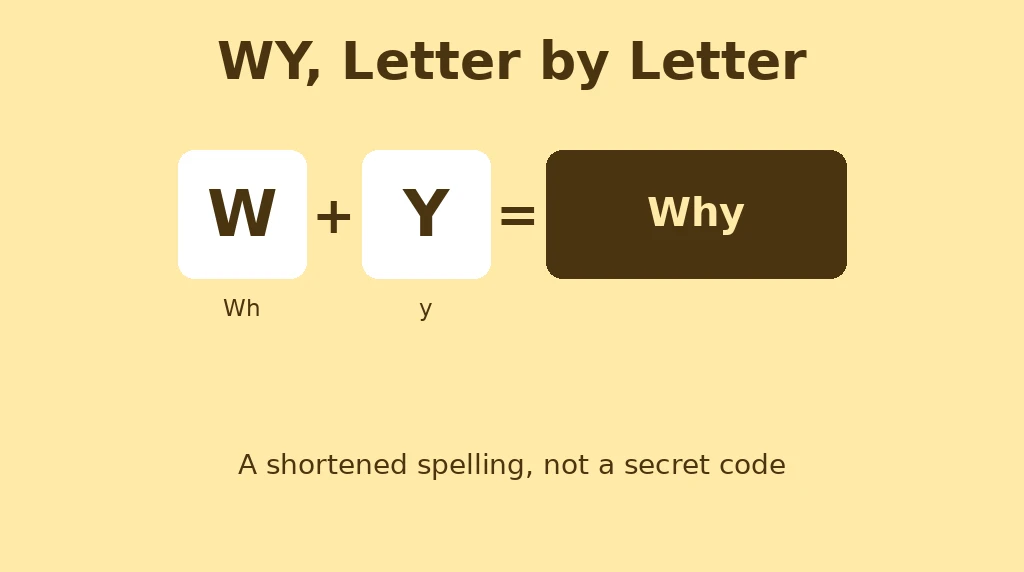
The full form is simple, because WY is a shortened spelling rather than a phrase built from initials:
- W: the opening sound of “why”
- Y: the closing sound of “why”
Put together, you get “why”. That is the reading most people mean, and it is the one meanzafy gives as the main meaning in its own guide to the term. CyberDefinitions also lists “Why?” as a definition for WY, right beside its other common reading, “Would You?”
Say it out loud and the trick becomes clear. You do not spell out W Y as separate letters in speech. You just say “why”, because the abbreviation is a typing shortcut, not a spoken word. In real conversation people say the full word, and the two letter form lives in typing only.
WY vs WYA vs WYM: What Is the Difference?
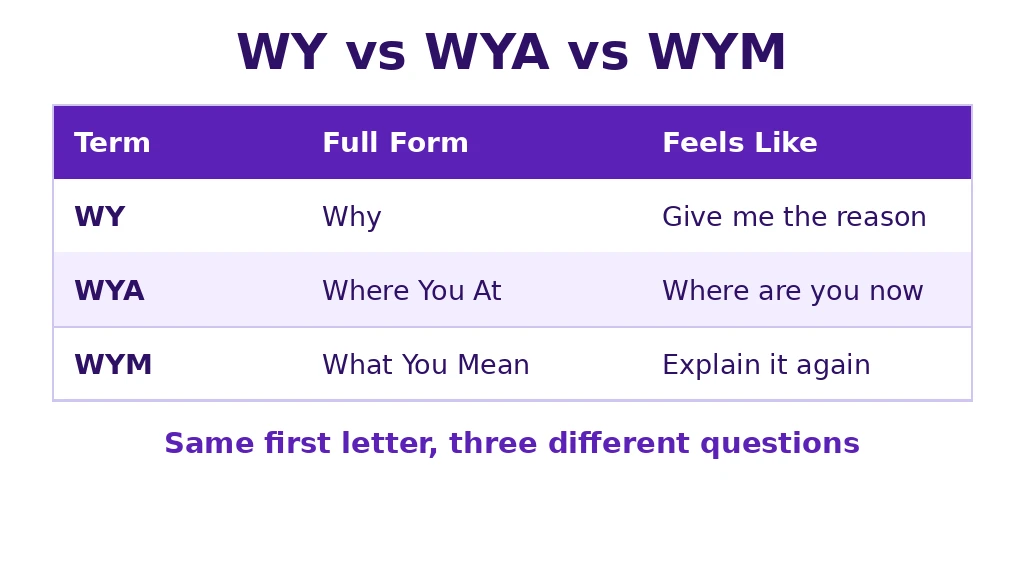
Three short forms start with the same letter, so here they are side by side.
| Abbreviation | Full Form | What It Really Asks | Tone |
|---|---|---|---|
| WY | Why | Give me the reason | Curious, sometimes blunt |
| WYA | Where You At | Where are you right now | Casual, checking in |
| WYM | What You Mean | Explain what you just said | Confused, wants clarity |
The classic mix up is WY versus WYA, because the two look almost the same and both can open a chat. “WY are you late?” asks for a reason. “WYA?” asks for a place. Answer the wrong one and the chat goes sideways fast, so check the last letter before you reply.
WYM is the odd one out in a useful way. It never asks for a reason. It asks the sender to explain their own words again, as in “WYM by that?” Think of it as three different questions wearing similar clothes. WY wants a reason, WYA wants a location, and WYM wants a clearer sentence.
Where WY Is Commonly Used
Texting and WhatsApp
One to one chats are where wy shows up most. It answers sudden news fast, without making the sender type a full sentence while they are still thinking. A typical line looks like this: “WY did you cancel?” Short, direct, and the chat keeps moving.
Instagram and Snapchat
On Instagram and Snapchat, wy appears in DMs when someone shares a surprising photo, a story twist or a decision that needs explaining. It also works as a caption or a tag. A photo captioned “wy” or tagged #wy is not asking one person a question, it is a mood, a small public shrug that says the poster is puzzled.
TikTok Comments
Scroll a busy TikTok comment section and wy pops up under videos with odd choices or surprise endings. Viewers type things like “WY would anyone do that” or “wy is this everywhere” right after the reveal.
Group Chats
Group chats run on quick reactions, so wy fits them well. One person drops a changed plan or a bold claim, and someone replies “wy?” before anyone has time to write more. The whole group then waits for the reason.
Gaming Chats
In game chat there is no time for full sentences, so wy does quick work between rounds. Players type things like “WY did you push alone” or “WY are we waiting” while the match is still moving. Everyone understands it instantly, and nobody stops playing to decode it.
Discord and Forums
Discord servers and forums use wy the same way, just in longer threads. Someone posts a surprising opinion or a strange decision, and “WY do you think that?” is a normal reply that keeps the discussion going.
Origin and History of WY
WY has no single inventor and no confirmed first use, which is normal for shorthand built out of an everyday word. “Why” has been a common question word for centuries, used whenever someone wants a reason. As typing culture shifted toward speed, people started trimming the words they typed most often.
The abbreviation travelled with texting from SMS to instant messaging, then into gaming chats and social apps, where quick questions matter more than full sentences. Short forms like this spread because they save a keystroke or two in every message, and over thousands of messages those keystrokes add up.
Other Meanings and Variations of WY
In casual texting, WY almost always means “why”, but the same letters carry other readings, and a few of them are easy to miss if you only know the main one.
- Would you?: CyberDefinitions lists this as the most common meaning for WY in its own entry, as in “WY go with me?” meaning “Would you go with me?” If the sentence reads like an invitation, this is the likely reading.
- What you?: in some chats, “WY doing tonight?” means “What are you doing tonight?” This reading works when the sentence asks about plans rather than reasons.
- Where you?: on Snapchat and in quick DMs, “WY?” can ask for a location, as in “I am here, WY?” If the chat is about meeting up, place is the safer guess.
- With you: in romantic or affectionate chats, “wish I was WY” means “wish I was with you”. The heart emoji beside it usually gives this one away.
- WY as a tag: on social media, #wy gathers reaction posts and comments under one label, so the tag works as a caption style reaction rather than a question aimed at one person.
- Wyoming: outside texting, WY is the official postal abbreviation for the state of Wyoming in the USA. An address that says WY has nothing to do with slang.
On social media, the caption and tag use behaves differently from the chat use. In a DM, wy asks one person a direct question. In a caption or a hashtag, it reacts to the post itself, a mood for everyone scrolling past, not a message aimed at one person.
How to Use WY Correctly
- Use it to ask for a reason, not to open a chat. WY works best right after someone says or does something. Starting a chat with it out of nowhere leaves the other person guessing what you mean.
- Add the rest of the question. “WY did you leave early?” is far clearer than a bare “wy” on its own, and it takes only a few extra seconds to type.
- Match the punctuation to the mood. A question mark keeps it curious. A full stop makes it sound blunt. Three question marks make it sound shocked, so save those for real surprises.
- Keep it casual. WY belongs in friendly, informal chats. If the conversation would not welcome a “lol”, it will not welcome a “wy” either.
- Watch who you send it to. With close friends it is harmless fun. With a teacher, a boss or someone you barely know, the full word why shows more respect.
Example Conversations Using WY
Leaving early
Person A: “I am leaving early tonight”
Person B: “WY?”
Person A: “I have to work tomorrow morning”
A cancelled plan
Person A: “I cannot make it tonight, sorry”
Person B: “WY not?”
Person A: “My car broke down again”
An Instagram DM about a photo
Person A: “I just deleted that photo”
Person B: “WY 😭”
Person A: “I hated how I looked in it”
A TikTok comment
Person A: “WY is this trend everywhere now”
Person B: “Because everyone keeps copying it lol”
Gaming with a teammate
Person A: “WY did you rush them alone”
Person B: “I thought we had backup”
A group chat plan change
Person A: “I am not going anymore”
Person B: “WY?”
Person A: “My plans changed last minute”
A delayed reply
Person A: “WY did you not reply earlier”
Person B: “My phone died, sorry”
The confused one
Person A: “He just texted me out of nowhere”
Person B: “idk why he would do that, honestly”
When Not to Use WY
- Work email: write “Could you explain why?” instead. Two letters look careless on the record.
- Job interviews and applications: even over chat, recruiters read wy as unprepared or too casual.
- Teachers and bosses: anyone grading or managing you deserves the full question, not a burst of shorthand.
- Customer service chats: on either side of the counter, wy sounds like nobody is taking the problem seriously.
- Serious conversations: when someone shares bad news or asks for real support, a two letter question can feel like you are brushing them off.
- With people who may not know it: WY has several readings, so some readers will guess the wrong one. Plain words avoid a confused reply.
How to Respond When Someone Sends You WY
A wy lands in your chat and the ball is suddenly in your court. The sender wants a reason, so give them one, and pick the lane that matches the mood of the question.
Patient replies work when the question is fair and calm:
- “Fair question. I left early because I had work in the morning.”
- “Good point, let me explain. The plan changed at the last minute.”
- “Honestly, I just needed some rest, nothing more than that.”
Helpful replies suit a wy that asks for detail:
- “Because the tickets sold out before I could book them.”
- “Long story, but I will send you the full update in a minute.”
Playful replies fit close friends and light topics:
- “Because I felt like it 😂”
- “WY not? Someone had to do it”
- “Ask me again after coffee and I will have a better answer”
A wy is not the same as a wdh, which reacts with shock instead of asking for a reason. Answer the question that was actually asked and move on. One thing to avoid: do not fire back a sarcastic “WY do you care?” when the wy was honest. Most of the time the person is simply curious, and a calm answer keeps the chat friendly.
Common Mistakes People Make With WY
- Assuming every WY means “why”. It usually does, but “would you”, “what you” and “where you” all share the same letters. Read the sentence first.
- Confusing WY with WYA. They look almost the same, but one asks for a reason and the other asks for a place. Answering the wrong one derails the chat.
- Sending a bare wy with no context. Two letters alone tell the other person you want a reason, but not what you want the reason for. Add one short line about the trigger.
- Using it in formal chats. WY is casual shorthand, so it fits badly in work, school and customer service, even when the question is genuine.
- Reading every WY as an attack. Most wy messages are simple curiosity, not a challenge. Tone in text is easy to misjudge, so give the sender the benefit of the doubt first.
Frequently Asked Questions
What does WY mean in text?
WY usually means “why” in texting. It is a shortened spelling of the word why, so “WY did you leave?” simply asks “Why did you leave?”
Can WY mean something other than why?
Yes. CyberDefinitions also lists “Would You?” as a common meaning, and in some chats WY can mean “what you?” or “where you?” The sentence around it tells you which reading fits.
Is WY rude?
No, the letters themselves are not rude. A bare “WY.” with a full stop can sound blunt or annoyed, while “WY?” with a question mark sounds curious, and “WY 😂” sounds playful.
What is the difference between WY and WYA?
WY usually asks for a reason, as in “WY did you do that?” WYA asks for a location and means “where you at?” Mixing them up changes the whole question.
Can I use WY in a work email?
No. WY is casual texting shorthand, so it looks unprofessional in work emails, school messages and job chats. Write the full word why instead.
How do I reply when someone sends me WY?
Give the reason they asked for. A simple “Because I had to leave early” answers it. If the question feels sharp, add a soft line first, like “Fair question, here is why.”
Final Thoughts
Two letters, one quick question, and a surprising amount of range packed inside. WY is the fastest way to ask “why” in texting, and it has earned its place in everyday chats because everyone meets moments that need a reason. Used casually, with a little extra context when the moment matters, it never really causes trouble.
If you want a second opinion from a dictionary source, Dictionary.com lists an entry for wy, which shows how far a humble texting shortcut has travelled. Either way, you now have the wy meaning in text down, plus a decent reply ready for the next time it shows up in your messages.
