You share your class notes with a friend, and the reply comes back fast: “thanks so much, you saved me”. You type “anytime”, and the next message is just three letters: “ntn”. No emoji, no extra words, nothing else.
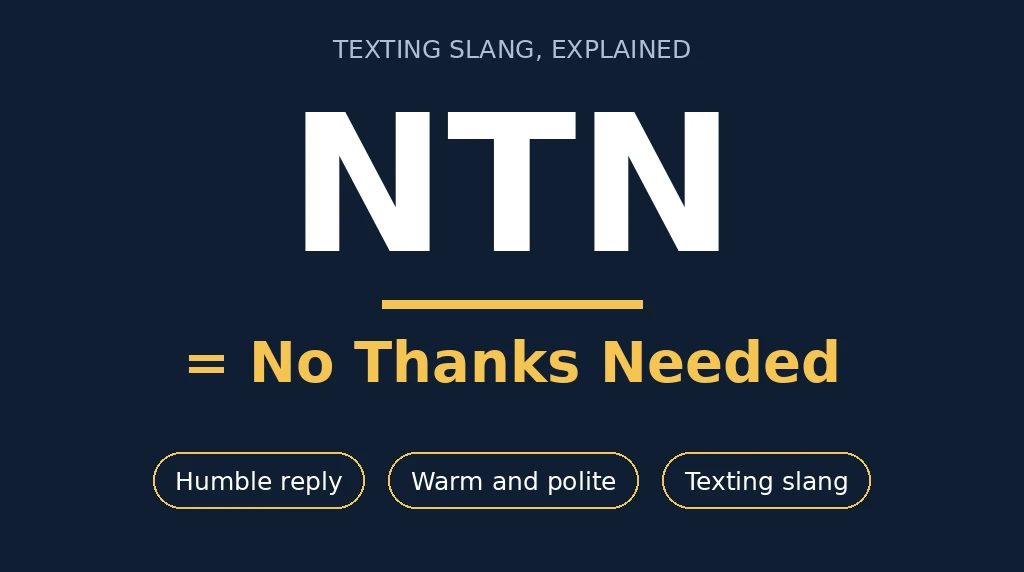
Here is the quick answer. NTN means “No Thanks Needed”, a humble reply after someone says thank you, a short way to say the favour was no trouble at all. This guide covers the ntn meaning in text, how it differs from “no thanks” and “you’re welcome”, where it shows up, and the best ways to reply. By the end, you will read NTN the way you read a warm smile, fast and without a second thought. The wrong reply can turn a warm thank you into an awkward moment, so it pays to read the message right.
What Does NTN Mean in Text?
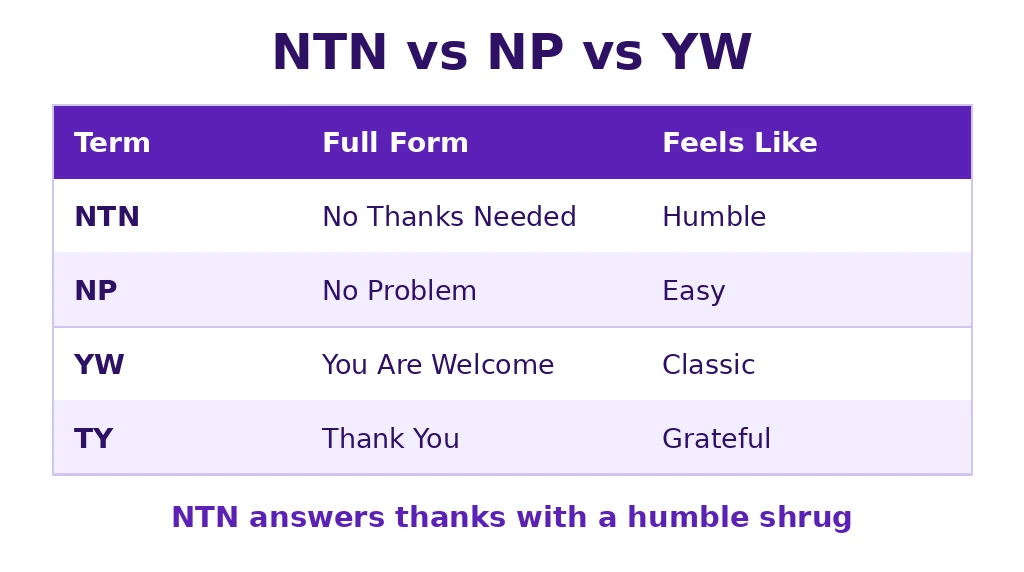
In texting, NTN means “No Thanks Needed”. It is the reply you send after someone thanks you, and it says the favour was small, easy, and gladly done. A friend who writes “ntn, anytime” after you thank them for a lift is telling you not to worry about it, the help cost them nothing.
The tone is warm, humble, and light. NTN carries no attitude at all, because it is a polite shrug in three letters. It tells the other person that the thanks were kind but unnecessary, and that the friendship matters more than keeping score. Between friends, it reads as easy and relaxed, the texting version of waving a hand and saying “forget about it”.
Lowercase “ntn” reads softer and more casual than uppercase “NTN”, but the meaning stays the same either way. What changes the meaning is the chat around it, because NTN must always follow a thank you. If no thanks came first, the letters can be misread as “no thanks”, which is a different message entirely.
Full Form of NTN
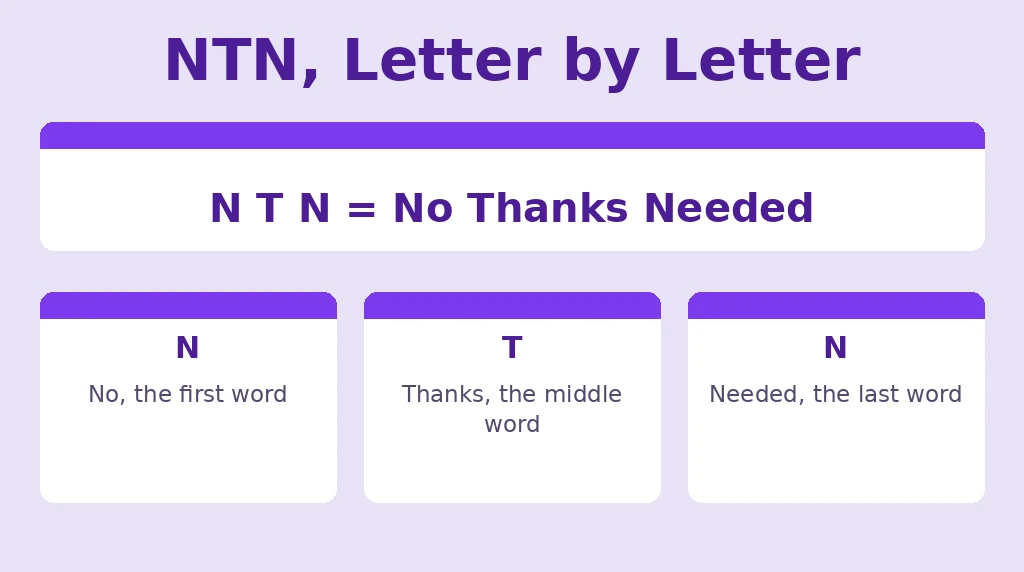
NTN stands for “No Thanks Needed”. The letters are pulled from the three words of that phrase, and each one maps cleanly.
- N: from “No”, the first word of the phrase
- T: from “Thanks”, the second word of the phrase
- N: from “Needed”, the last word of the phrase
Say it out loud and the pattern is simple. People say the letters one at a time, en-tee-en, because NTN is read letter by letter. Nobody pronounces it as a single word, and trying to do so is the fastest way to confuse the person you are talking to.
The phrase itself is a small piece of polite English. “No thanks needed” means the thanks were welcome but unnecessary, and the short form keeps that whole polite idea inside three quick letters.
NTN vs NP vs YW vs TY: What Is the Difference?
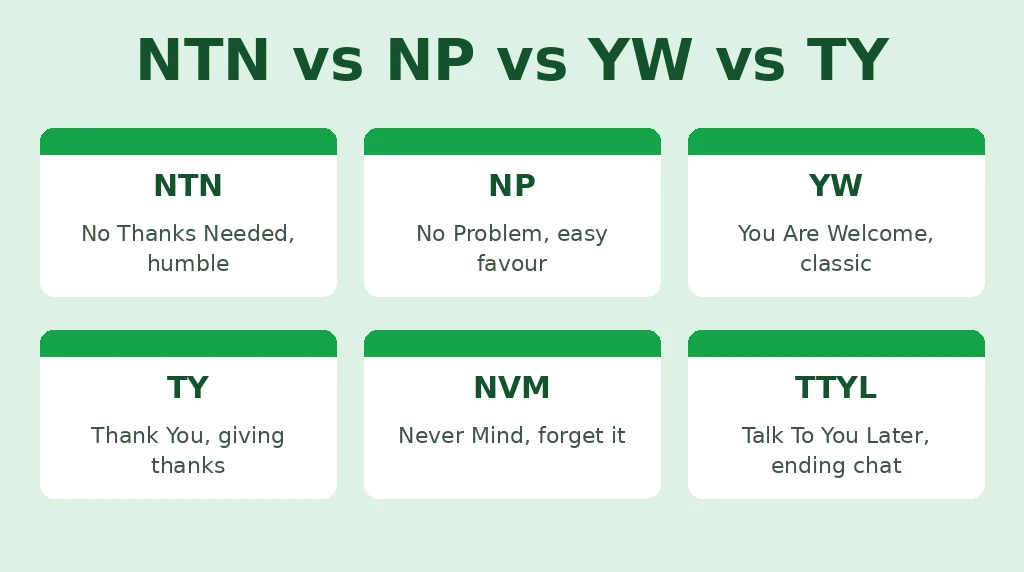
NTN belongs to a small family of short thank you words, and the family members look alike at a glance. Here they are side by side.
| Abbreviation | Full Form | What It Really Says | Tone |
|---|---|---|---|
| NTN | No Thanks Needed | Your thanks were kind but not needed | Humble, warm, modest |
| NP | No Problem | It was no trouble at all | Easy, relaxed, casual |
| YW | You Are Welcome | Glad to help, any time | Polite, plain, classic |
| TY | Thank You | I am grateful for your help | Warm, grateful, giving thanks |
The classic mix up is NTN versus “no thanks”, because the two share the first two words and look almost the same on screen. The gap is huge, though. NTN answers a thank you that already happened, while “no thanks” turns down an offer that is still open. One says “forget about it”, the other says “I do not want it”, so the chat around them will always tell you which one fits.
NP is the closest cousin, since both answer a thank you with a shrug. The difference is the shade of feeling. NP says the favour was easy, while NTN says the thanks themselves were unnecessary. YW is the plain classic reply, and TY is the odd one out in this table, because it gives thanks instead of answering them.
Where NTN Is Commonly Used
Texting and WhatsApp
In one to one chats, NTN shows up right after a thank you for a small favour. A friend drops a quick “sup” to start the chat, then later writes “ntn, anytime” after you thank them for sharing the notes. Short, plain, and the chat keeps moving.
Instagram and Snapchat
On Instagram and Snapchat, NTN shows up in replies and comments when someone thanks a creator for a link, a tip, or a repost. A comment that says “ntn, happy to share” is a warm reply, and the post beside it usually makes the favour obvious.
TikTok Comments
On TikTok, NTN appears under clips where a creator shares a trick, a recipe, or a discount code. A viewer writes “thanks for this, you are the best” and the creator answers “ntn, enjoy”, and the whole exchange takes two seconds.
Group Chats
Group chats use NTN when one person helps the whole group, like sharing a file or a venue address. Someone writes “thanks, that saved us an hour” and the helper answers “ntn, glad it helped” before the chat moves on to the plan.
Gaming Chats
Gaming chats use NTN when a teammate says thanks for a revive, a heal, or a shared item. A line like “ntn, we are a team” keeps the mood light and the squad focused on the next round.
Discord and Forums
On Discord and forums, NTN shows up in threads where one member answers a question for another. A user who writes “ntn, happy to help” after a thank you is keeping the forum friendly, and the next question can follow at once.
Origin and History of NTN
NTN grew up with early texting, when phones had small keypads and every character cost time. People shortened common polite phrases so they could type fast, and “no thanks needed” was a phrase worth shortening, because it is the kind of thing you say after every small favour. The letters caught on in SMS chats first, then spread to instant messaging and social apps.
As phones got smarter, the abbreviation stayed, because it does a job no polite sentence can do in three letters. A full sentence like “no thanks are needed, it was nothing” takes effort to type and sounds formal, while NTN is instant and warm. That speed is why it survived the move from old keypad phones to modern chat apps.
Dictionary sources that track internet slang now list NTN with the “No Thanks Needed” sense first, which matches how most people use it today. The “no thanks” confusion travelled with it, and the two readings are still mixed up by new texters who have not seen the phrase before.
Other Meanings and Variations of NTN
In everyday talk, NTN almost always means “No Thanks Needed”, but the same letters carry a few other readings worth knowing.
- “No Thanks Necessary” as a variant: this is the second common reading, and it means the same thing in practice. It shows up more in speech than in text, but the idea is identical: the thanks were kind but not needed.
- Lowercase ntn vs uppercase NTN: the small letters feel softer and more casual in a sentence, while the capitals stand out a little more. The meaning stays the same either way.
- “No thanks” as the lookalike: the plain phrase “no thanks” declines an offer, as in “no thanks, I am full.” It is not an abbreviation, and it does the opposite job to NTN, so the chat around it decides which one fits.
- NTN as a humble habit: some people use NTN every time they are thanked, the way others always say “you’re welcome.” For them it is a reflex, not a special message, and it always means the same warm thing.
- NTN as initials or a name: the letters can also be a person’s initials or a short username, so a lone “NTN” on a profile may have nothing to do with texting slang at all. The chat context decides.
How to Use NTN Correctly
- Use it only after a thank you. NTN answers thanks that already happened, so send it right after the other person thanks you, never before.
- Keep it to small favours. NTN fits notes, links, lifts, and quick help. For a big favour, a warmer reply like “happy to help, really” fits better.
- Add a warm word when you can. A bare NTN can feel short, so a quick extra word nearby, like “ntn, anytime” or “ntn, happy to help”, keeps the tone warm and friendly.
- Do not use it to decline an offer. If someone offers you food or a lift, write “no thanks” in full, because NTN will confuse them and they may think you accepted.
- Spell it out in formal writing. If you are writing to someone who might not know the short form, write “you’re welcome” in full the first time, then use NTN after that in casual chats.
Example Conversations Using NTN
Sharing class notes
Person A: “Thanks so much, you saved me”
Person B: “ntn, anytime, good luck in the exam”
A lift home
Person A: “thx for the lift, I owe you one”
Person B: “NTN, you would do the same for me”
A shared link
Person A: “That link was exactly what I needed, thank you”
Person B: “ntn, happy to share”
A gaming revive
Person A: “Thanks for the revive, that was clutch”
Person B: “ntn, we are a team”
A recipe tip
Person A: “Tried your recipe, my family loved it, thanks”
Person B: “NTN, so glad it worked out”
A group chat favour
Person A: “Thanks for booking the table for all of us”
Person B: “ntn, glad it helped, see you on Saturday”
The unsure one
Person A: “ntn? Does that mean you do not want it?”
Person B: “No, it means no thanks needed, I am happy to help”
The playful one
Person A: “Thanks, you are officially my favourite person”
Person B: “ntn, do not tell the others”
When Not to Use NTN
- To decline an offer: NTN never means “no thanks, I do not want it”, so write “no thanks” in full when you turn something down.
- Before anyone thanks you: sending NTN out of nowhere makes no sense, because there is no thank you for it to answer.
- In a work email: NTN reads as slang, so write “you’re welcome” or “happy to help” in full instead.
- After a big favour: if someone thanks you for serious help, a bare NTN can feel too light, so a warmer reply fits better.
- When someone is upset: if a friend is sharing bad news, a short NTN will feel cold, so a kinder reply is the better choice.
- When the other person does not know slang: if they have never seen NTN, they may read it as “no thanks”, so spell it out instead.
How to Respond When Someone Sends You NTN
An NTN lands in your chat and the ball is suddenly in your court. The good news is that the conversation is already complete, so your reply can be short and warm.
Patient replies work when you want to close the exchange gently:
- “Haha, thanks again anyway.”
- “You are too kind, seriously.”
- “Okay, I owe you a coffee next time.”
Helpful replies suit an NTN that follows real help, like notes or a lift:
- “Well, the notes really did save me, so thank you again.”
- “I will return the favour, just say the word.”
Playful replies fit close friends and light topics:
- “Fine, I will thank you in secret then”
- “Too late, the thank you already happened”
One thing to avoid: do not keep thanking the person again and again after an NTN, because the loop never ends. If you typed something by mistake, send a quick nvm and move on before the chat turns into a thank you contest.
Common Mistakes People Make With NTN
- Reading it as “no thanks”. NTN answers a thank you, while “no thanks” declines an offer. The two do the opposite job, so read the chat before you decide.
- Sending it before anyone thanks you. NTN needs a thank you to answer, and sending it out of nowhere will only confuse the other person.
- Using it after a big favour. A bare NTN can feel too light when someone thanks you for serious help, so a warmer reply fits better.
- Using it in formal writing. A work email or an application is not the place for a three letter short form.
- Thanking again and again after NTN. The exchange is already complete, so one more thank you is enough and then the chat can move on.
Frequently Asked Questions
What does NTN mean in text?
NTN means “No Thanks Needed.” It is a humble reply after someone thanks you, a short way to say the favour was no trouble at all.
Is NTN the same as “you’re welcome”?
Almost. Both answer a thank you, but NTN adds a humble touch: it says no thanks were needed in the first place. “You’re welcome” is the plain reply, while NTN is the modest one.
Can NTN mean “no thanks” when I decline something?
No, and this is the most common confusion. “No thanks” turns down an offer, as in “no thanks, I am full.” NTN answers a thank you that already happened. The two look alike but do the opposite job.
When should I use NTN?
Use NTN right after someone thanks you for a small favour, like sharing notes, holding a door, or sending a link. It fits casual chats with friends, classmates, and family.
Is NTN formal enough for work?
Not really. At work, write “you’re welcome” or “happy to help” in full so every reader understands it. NTN belongs in quick chats, not in formal writing.
How do I reply when someone sends me NTN?
You do not need a long answer. A smile, a thumbs up, or a short “haha, thanks again” is enough. The conversation is already complete, so a simple warm close works best.
Final Thoughts
NTN is a small set of letters with a warm job. In almost every chat it means “No Thanks Needed”, a humble reply after someone says thank you, a short way to say the favour was no trouble at all. The lookalike “no thanks” does the opposite job, turning down an offer, so the chat around the letters decides which reading fits.
If you want a second opinion from a dictionary source, CyberDefinitions lists an entry for NTN. Either way, you now have the ntn meaning in text down, plus a warm reply ready for the next time it shows up in your messages.
