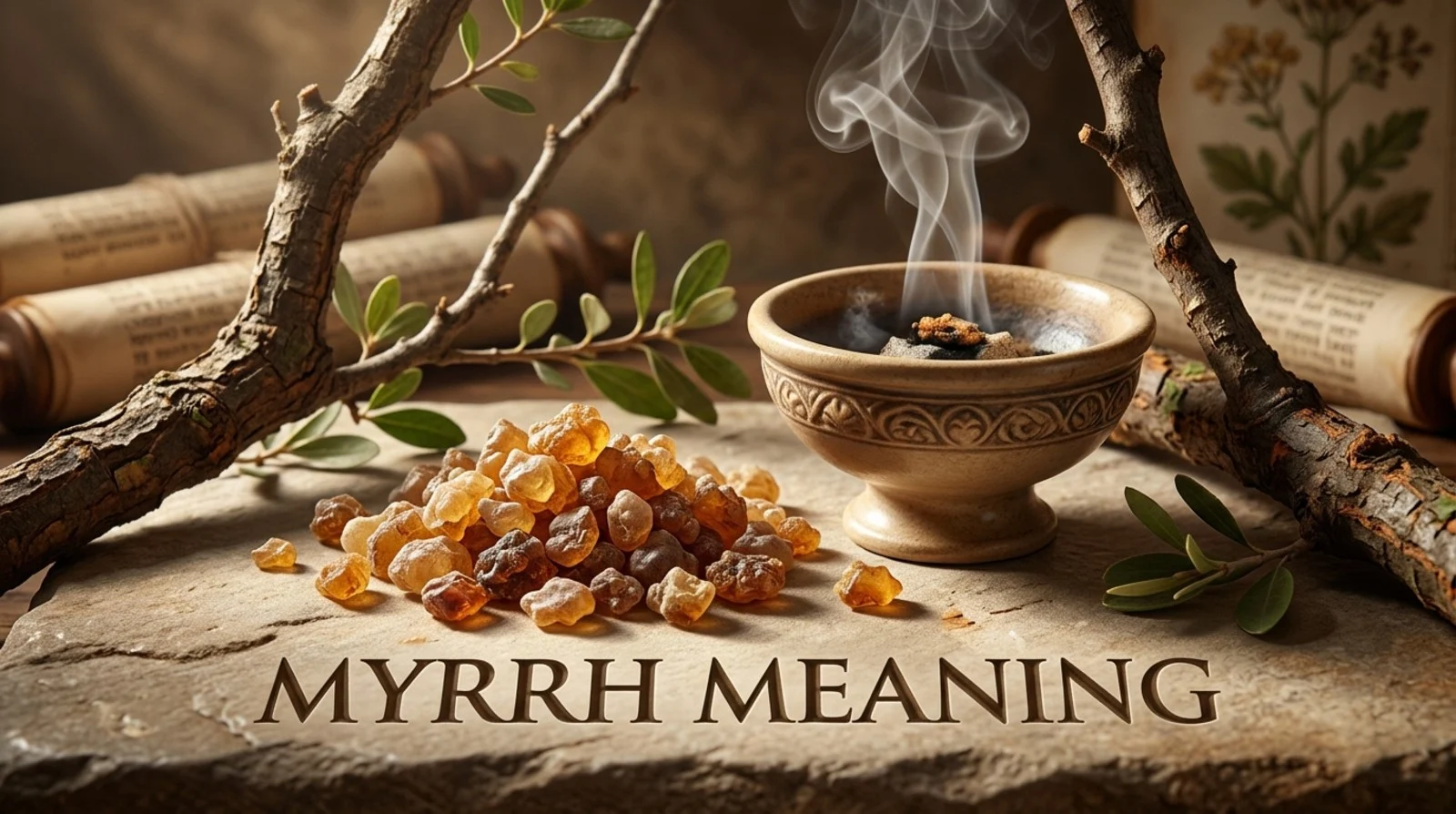
Myrrh meaning refers to the fragrant gum-resin obtained from trees and shrubs in the Commiphora genus. For thousands of years, people have valued myrrh for its distinctive aroma and used it in incense, perfumes, religious ceremonies, and traditional practices. Botanically, myrrh is associated with several Commiphora species, including Commiphora myrrha. Kew records Commiphora myrrha as a recognized species native to parts of eastern Africa and the Arabian Peninsula.
In the Bible, myrrh has an even deeper cultural importance. Matthew 2:11 names it among the gifts presented to Jesus by the Magi, while Mark 15:23 and John 19:39 connect it with the events surrounding Jesus’ death and burial.
What Does Myrrh Mean?
Myrrh is a naturally aromatic resin collected from certain Commiphora trees. The word commonly refers to the dried, fragrant material rather than the tree itself.
In biblical contexts, myrrh is associated with fragrance, worship, honor, anointing, suffering, death, and burial. Its meaning changes with the passage being discussed. Matthew 2:11 presents myrrh as one of the gifts brought to Jesus by the Magi, while John 19:39 mentions myrrh and aloes in connection with burial.
So, the simplest definition is:
Myrrh is a fragrant natural resin, historically prized for perfume, incense, ceremonial use, and traditional applications, with important references in the Bible.
What Is Myrrh?
Myrrh is an aromatic gum-resin that comes from certain trees and shrubs belonging to the genus Commiphora, a group within the Burseraceae family.
The plant grows mainly in dry regions. Kew describes Commiphora as a genus containing numerous shrubs and trees, many of which produce aromatic resinous exudates.
One important species is Commiphora myrrha, commonly called myrrh or Somali myrrh. Kew lists its native range across parts of eastern and northeastern Africa and the southern Arabian Peninsula.
How Is Myrrh Collected?
Myrrh is produced when resinous material emerges from the bark of certain trees.
Harvesters traditionally make controlled cuts or incisions in the bark. The resin seeps out and gradually hardens when exposed to air. Kew describes this process for scented myrrh and notes that the dried material can become a yellowish-red, sweet-smelling resin.
This explains why myrrh can look quite different from an ordinary plant product. It is not a leaf, flower, or fruit. It is a hardened plant exudate.
What Does Myrrh Mean in the Bible?
The myrrh biblical meaning is best understood through the passages where it appears rather than through one fixed symbolic definition.
The Bible uses myrrh in several different settings, including perfume, gifts, an offering associated with Jesus’ crucifixion, and burial preparations.
Myrrh as a Gift to Jesus
One of the most famous references appears in Matthew 2:11.
The Magi visit the young Jesus and present three gifts:
- Gold
- Frankincense
- Myrrh
The passage itself identifies these gifts but does not directly provide a detailed explanation of what each gift symbolizes.
Later Christian interpretation often connects the three gifts with different aspects of Jesus’ identity and life. Myrrh has particularly been associated with mortality and death because of its later appearance in the Gospel accounts.
That interpretation is important to distinguish from the biblical text itself. Matthew names myrrh as a gift, but it does not explicitly say, “myrrh represents death.”
Myrrh at the Crucifixion
Myrrh appears again in Mark 15:23, where Jesus is offered wine mixed with myrrh. The passage says that he did not take it.
This reference gives myrrh a very different context from the Nativity account. Here, it appears during the crucifixion narrative.
Some historical interpretations associate the mixture with an attempt to reduce suffering, although readers should avoid treating a specific medical explanation as certain when the biblical text itself simply records the mixture.
Myrrh and Burial
Myrrh appears again in John 19:39.
Nicodemus brings a mixture of myrrh and aloes in connection with Jesus’ burial. The New International Version describes the amount as about seventy-five pounds, with a footnote giving an approximate modern equivalent of about 34 kilograms.
This is one reason myrrh became strongly associated with burial and death in later Christian symbolism.
The connection is not random. Myrrh had long-standing uses involving fragrance and body preparation, and historical sources also describe its use in embalming.
Myrrh Symbolism Explained
The myrrh symbolism people discuss today usually comes from combining its historical uses with its biblical appearances.
Here are the major associations:
| Symbolic Association | Why Myrrh Is Connected to It |
|---|---|
| Honor | It was a valuable aromatic substance used in prestigious settings. |
| Worship | Myrrh was used with incense and appears in biblical religious contexts. |
| Fragrance | Its aromatic resin made it valuable in perfume and incense. |
| Suffering | It appears in the crucifixion account in Mark. |
| Death | It appears in the burial account in John. |
| Purification | Aromatic substances were used in historical ceremonial and personal practices. |
| Mortality | Christian interpretation often connects myrrh with Jesus’ future suffering and death. |
A useful distinction is that some of these are historical uses, while others are later symbolic interpretations. Keeping those categories separate makes a myrrh explanation more accurate.
Myrrh Meaning in Christianity
In Christian discussion, myrrh can carry several layers of meaning.
First, it represents a valuable gift because the Magi presented it alongside gold and frankincense.
Second, its later biblical appearance connects it with suffering and death. Mark mentions wine mixed with myrrh during the crucifixion, while John mentions myrrh and aloes during Jesus’ burial.
This creates a striking literary connection:
Myrrh appears at the beginning of the Gospel story as a gift to the child Jesus and later appears in passages concerning his death and burial.
That connection is one reason myrrh has remained such a powerful Christian symbol.
Myrrh and the Three Gifts of the Magi
The phrase gold, frankincense, and myrrh is familiar to many people.
These three gifts are mentioned in Matthew 2:11.
Their material qualities also make them interesting:
| Gift | General Nature | Common Christian Association |
|---|---|---|
| Gold | Precious metal | Royalty and value |
| Frankincense | Aromatic resin | Worship and sacred use |
| Myrrh | Aromatic gum-resin | Fragrance, suffering, death, burial |
The final column describes common Christian interpretation rather than a direct explanation provided by Matthew.
This distinction matters because many articles present traditional symbolism as if the biblical text explicitly defines it. It does not.
Myrrh vs. Frankincense
Myrrh and frankincense are often mentioned together, but they are not the same substance.
| Feature | Myrrh | Frankincense |
|---|---|---|
| Main source | Commiphora species | Boswellia species |
| Type | Aromatic gum-resin | Aromatic resin |
| Aroma | Rich, warm, bitter, earthy | Fresh, woody, balsamic |
| Historical use | Perfume, incense, ceremonies, traditional practices | Incense, perfume, ceremonies |
| Biblical association | Magi, crucifixion, burial | Worship and offerings |
| Famous pairing | Gold and frankincense | Gold and myrrh |
Kew identifies Commiphora species as sources of myrrh and Boswellia species as sources of frankincense.
Both are aromatic plant products, but they come from different botanical groups.
What Was Myrrh Used For?
Myrrh has had many uses across different periods and cultures.
1. Incense
Myrrh has traditionally been burned as incense because of its distinctive fragrance.
Kew records myrrh among materials used for incense and religious ceremonies.
2. Perfume
Its strong aroma also made myrrh valuable in perfumery.
Historical sources describe myrrh as an aromatic substance prized for perfume and related uses.
3. Religious Ceremonies
Myrrh has a long history in ceremonial settings. Its fragrance made it especially suitable for incense and sacred preparations.
4. Burial Practices
Historical evidence and biblical references connect myrrh with body preparation and burial.
John 19:39 specifically mentions a mixture of myrrh and aloes brought for Jesus’ burial.
5. Traditional Uses
Different Commiphora resins have been used in traditional practices for various purposes.
Kew records traditional uses of scented myrrh that include topical applications and other local practices.
Modern readers should not automatically treat historical or traditional use as proof that myrrh is an effective treatment for a medical condition.
What Does Myrrh Smell Like?
Myrrh is usually described as having a warm, earthy, balsamic, resinous, and slightly bitter aroma.
Its smell can seem heavier than many modern floral fragrances.
That strong character explains its long relationship with incense and perfume. When burned, myrrh produces an aromatic smoke. When used in fragrance, it can add depth and warmth.
Its taste is also characteristically bitter. The historical word history is interesting here: the Greek and Latin forms associated with myrrh have been connected with the Arabic murr, meaning “bitter.”
Myrrh Tree and the Commiphora Genus
People sometimes search for myrrh tree as if there were one single plant responsible for all historical myrrh.
The botanical reality is more complicated.
Commiphora is a large genus containing many species. Kew describes roughly 180 species in the genus, distributed across dry regions of Africa and extending into parts of Asia and beyond.
Commiphora myrrha is one recognized species associated with myrrh.
Kew also notes that the major commercial source of myrrh is related to C. myrrha, while identifying Commiphora guidottii as a species believed to be the source of the scented myrrh mentioned in the Bible.
That detail is easy to miss, but it shows why saying “myrrh comes from one specific tree” can oversimplify the subject.
Is Myrrh the Same as Myrrh Oil?
No.
Myrrh resin is the raw aromatic gum-resin obtained from the plant.
Myrrh oil is an aromatic oil prepared from myrrh material through extraction or distillation processes.
They are related but are not chemically or physically identical products.
This distinction matters when reading product labels, historical descriptions, or discussions of traditional uses.
Myrrh Meaning in Different Contexts
The word can mean slightly different things depending on what a person is reading.
| Context | Meaning of Myrrh |
|---|---|
| Everyday definition | A fragrant plant resin |
| Botanical context | Resin associated with Commiphora species |
| Biblical context | An aromatic substance appearing in several important passages |
| Christian symbolism | Often associated with honor, suffering, mortality, and burial |
| Historical context | A valuable perfume, incense, and ceremonial material |
| Fragrance context | A warm, resinous aromatic note |
| Cultural context | A traditional natural product with a long history |
This is why searching only for “myrrh definition” may not answer the real question. A reader looking up myrrh meaning in the Bible usually wants the cultural and symbolic context too.
Is Myrrh Mentioned in the Bible?
Yes.
Important references include:
- Matthew 2:11: Myrrh is one of the gifts brought to Jesus by the Magi.
- Mark 15:23: Wine mixed with myrrh is offered to Jesus during the crucifixion.
- John 19:39: Nicodemus brings myrrh and aloes in connection with Jesus’ burial.
- Exodus 30:23: Myrrh is included among ingredients associated with the sacred anointing oil.
- Psalms and Song of Songs: Myrrh appears in passages involving fragrance, perfume, or imagery.
The exact meaning depends on the passage and its historical context.
Common Misunderstandings About Myrrh
“Myrrh only means death.”
Not exactly.
Death and burial are important associations because of John 19:39, but myrrh also appears as a gift, perfume, aromatic substance, and ceremonial material.
“The Bible says exactly what the three gifts symbolize.”
Matthew names the gifts but does not give a detailed symbolic explanation for each one. Later Christian tradition developed symbolic interpretations.
“Myrrh and frankincense are the same.”
They are both aromatic plant resins, but they come from different genera and have different characteristics.
“Myrrh comes from one tree species.”
Several Commiphora species produce myrrh or related resins, so the botanical picture is broader than one species.
Why Is Myrrh Still Important Today?
Myrrh remains relevant because it sits at the intersection of botany, history, religion, fragrance, and cultural heritage.
For a modern reader, one small piece of resin can open several historical doors. It tells us about trade, ancient fragrance practices, religious rituals, plant knowledge, and biblical culture.
Its continued presence in perfumes and incense also shows that myrrh is not simply an ancient word found in Scripture. It remains a recognizable aromatic material today.
Kew documents the continued commercial and perfumery importance of scented myrrh, including its export from Somalia.
How to Understand the Myrrh Meaning in One Sentence
If you need a short explanation, use this:
Myrrh is a fragrant resin from certain Commiphora trees, historically used in perfume, incense, and ceremonial practices and famously mentioned in the Bible as one of the gifts of the Magi and in accounts of Jesus’ crucifixion and burial.
Frequently Asked Questions
What is the simple meaning of myrrh?
Myrrh is a fragrant gum-resin obtained from certain Commiphora trees and shrubs. It has been used historically for incense, perfume, ceremonies, and traditional practices.
What does myrrh symbolize in the Bible?
Myrrh has several associations in Christian interpretation, including honor, fragrance, suffering, mortality, and burial. These associations come from its historical uses and from different biblical passages.
Why did the Magi give Jesus myrrh?
Matthew 2:11 states that the Magi presented gold, frankincense, and myrrh to Jesus. The passage does not directly explain the symbolic meaning of each gift. Later Christian interpretation connected myrrh with Jesus’ suffering and death.
What does myrrh represent spiritually?
In Christian tradition, myrrh can represent devotion, sacrifice, mortality, suffering, and burial. The exact interpretation depends on the theological tradition and biblical passage being discussed.
What is myrrh made from?
Myrrh is a natural resinous material produced by certain Commiphora trees and shrubs. Commiphora myrrha is one recognized species associated with myrrh.
What is myrrh used for?
Historically, myrrh has been used for incense, perfume, religious ceremonies, body preparation, and various traditional applications. Kew also documents its continuing use in perfumery.
Is myrrh the same as frankincense?
No. Myrrh is primarily associated with Commiphora, while frankincense comes from Boswellia. Both are aromatic resins and have important historical and religious uses.
Why is myrrh associated with Jesus’ death?
Mark 15:23 mentions wine mixed with myrrh during the crucifixion, and John 19:39 mentions myrrh and aloes in connection with Jesus’ burial. These passages contributed to myrrh’s later association with suffering, death, and burial.
Final Takeaway
The myrrh meaning is much richer than simply “a fragrant resin.” Botanically, myrrh refers to aromatic resin associated with Commiphora plants. Historically, it was valued for fragrance, incense, perfume, ceremonies, and other traditional uses.
Biblically, myrrh appears in several significant settings. Matthew records it among the gifts of the Magi. Mark mentions it during the crucifixion, and John connects it with Jesus’ burial.
That combination of natural history, ancient culture, biblical context, and symbolism is what makes myrrh such a meaningful word to explore.
Read More Related Articles:
- RSVP Meaning | What This Invitation Term Really Means and …
- Demisexual Meaning | Attraction, Relationships, Examples …
- Martyr Meaning | Definition, History, Examples & the Deeper …