Your phone buzzes in the middle of a group chat. Friends are planning a movie night, messages are flying, and then one short line lands on your screen: “wtbi?” Nobody explained the plan in detail. Nobody named a time. Just four letters, sitting there, waiting for an answer.
Here is the short answer. WTBI most commonly means “Want To Be In?”, a casual way of asking if you want to join a plan, a game or a group activity. It is a quick invite, not a formal one, and it expects a simple yes or no. This guide covers the meaning, the tone, WTBI vs WYD and HMU, where you will see it, and the best replies.
What Does WTBI Mean in Text?
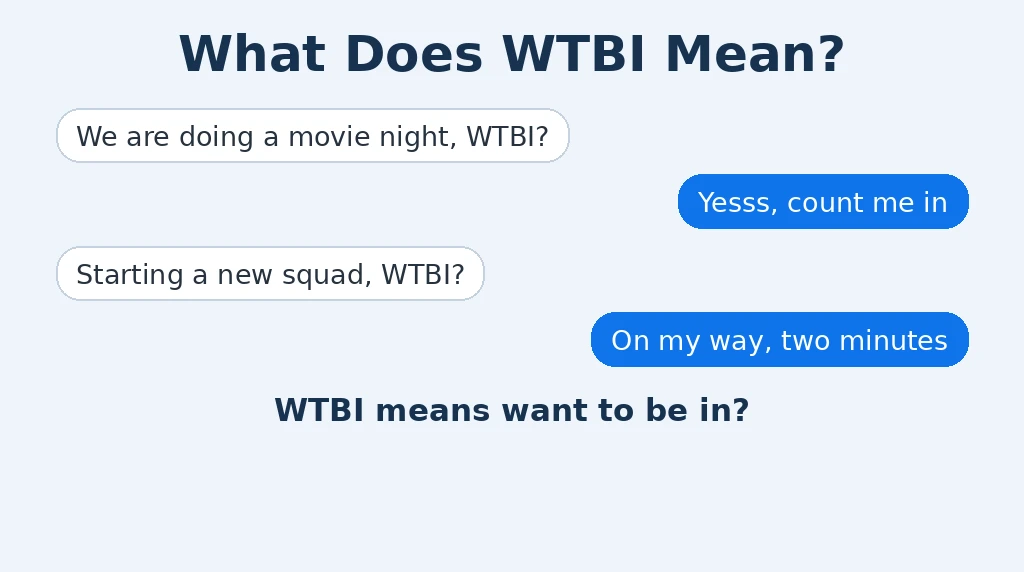
WTBI stands for “Want To Be In?”, a short way of asking someone if they want to be included in whatever is happening. Instead of typing out “Do you want to come along?” or “Do you want to be part of this?”, people shorten the question to four letters, because it is quicker to type and feels more natural in a fast-moving chat.
The trick to reading it is the context around it. “We are doing a movie night, WTBI?” is clearly an invite to the movie night. “Starting a new squad, WTBI?” is an invite to the game. On its own, with no plan attached, it is vaguer, and the honest move is to ask what the plan is before you answer. The letters stay the same, so the plan comes from the message around them.
It sits close to a plain invite like “you in?”, but wtbi feels more playful and casual, like a friend tossing out a low pressure invite that is easy to accept and easy to decline.
Say it letter by letter if you ever need to read it out loud: “double-you-tee-bee-eye”. Nobody says the full phrase “want to be in?” as an abbreviation in speech. People just ask “want in?” out loud, and the letters live in typing only.
Full Form of WTBI
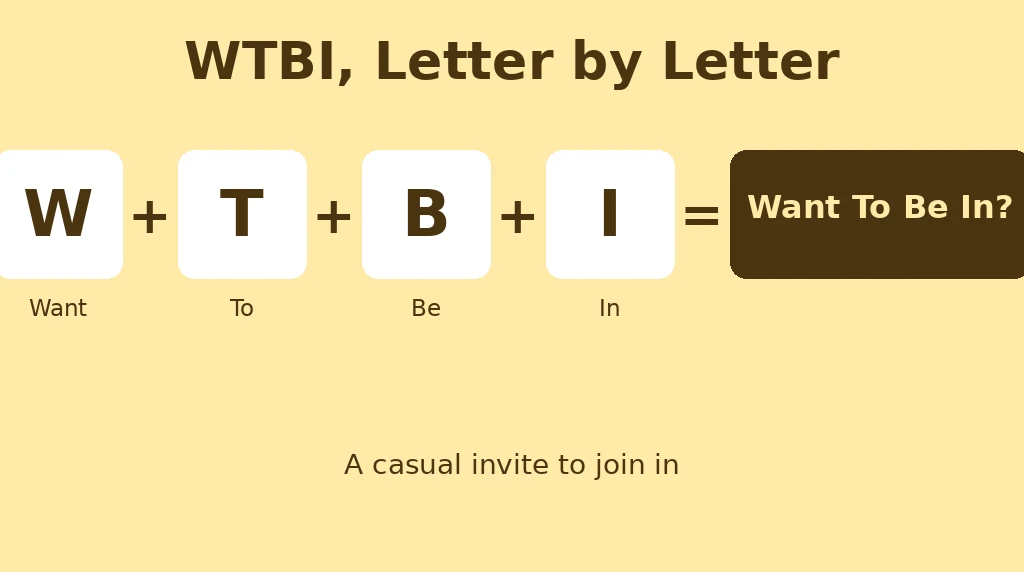
The full form is simple, with one word behind each letter:
- W: Want
- T: To
- B: Be
- I: In
Put together, you get “Want To Be In?” You will usually see it typed as a question, often with a question mark at the end, since it works as an invite rather than a statement. It can also show up attached to more context, like “We are doing game night Friday, WTBI?”, where the abbreviation wraps up the sentence instead of standing on its own.
The question mark matters more here than with most slang. “WTBI” without one can read as a statement, which makes no sense. “WTBI?” with one is clearly asking you something. When you send it yourself, keep the question mark in, so nobody has to guess whether you are inviting them or just thinking out loud.
WTBI vs WYD vs HMU: What Is the Difference?
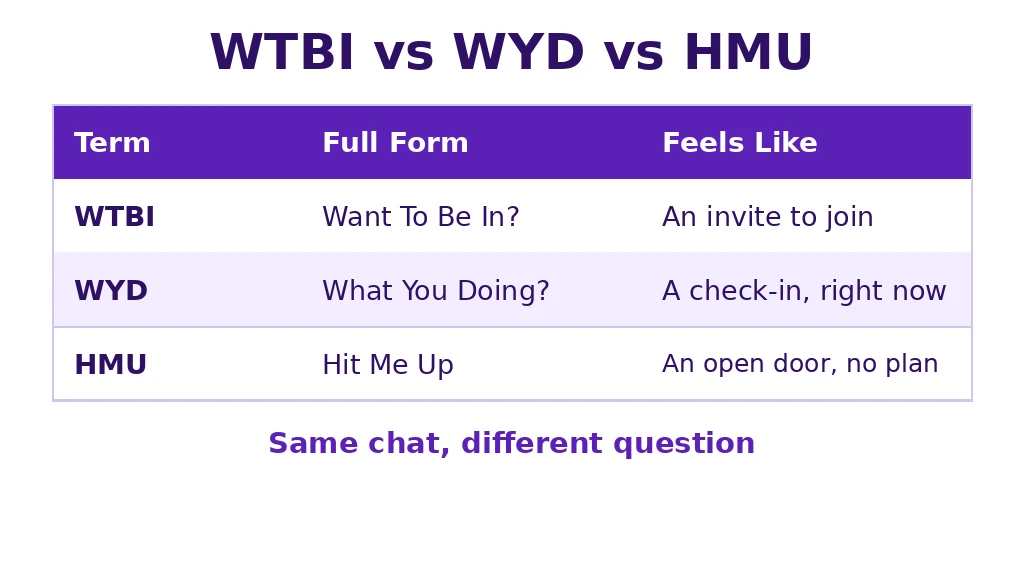
Three short messages cover the same patch of planning and checking in, so here they are side by side.
| Abbreviation | Full Form | What It Really Asks | Tone |
|---|---|---|---|
| WTBI | Want To Be In? | Do you want to join this plan? | Friendly invite |
| WYD | What You Doing? | What are you doing right now? | Direct check-in |
| HMU | Hit Me Up | Message me when you are free | Open and casual |
The classic mix-up is WTBI versus WYD, because both show up when friends are making plans. WYD asks what you are doing right now, so it looks back at your day. WTBI asks if you want to join something, so it looks forward to a plan. HMU is the loosest of the three. It does not point at a specific plan at all, it just says “message me sometime”, which makes it a worse invite and a better open door.
Think of it as a sliding scale. HMU leaves the door open, WYD checks what you are up to, and WTBI asks for a yes or no on one specific plan. Pick the one that matches what you actually want from the other person.
Where WTBI Is Commonly Used
Texting and WhatsApp
One to one chats and family groups are where wtbi shows up most. It asks a quick question about a plan without making the sender type a full sentence. A typical line looks like this: “Planning a family dinner next Sunday, WTBI?” Short, warm, and the chat keeps moving.
Instagram and Snapchat
On Instagram and Snapchat, wtbi pops up in DMs and comments under posts about events, giveaways or group activities. A poster writes “group meetup this weekend, wtbi?” and the replies sort out who is coming. In a one-on-one DM it can carry a flirtier, testing-the-waters energy, especially when it follows a playful or suggestive message.
TikTok Comments
Scroll a busy TikTok comment section and wtbi appears under videos about collabs, challenges or meetups. Viewers type things like “wtbi for a collab video like this lol” or “wtbi if we do a group meetup for this?” The comment is half question and half raised hand.
Group Chats
Group chats are where wtbi shows up the most. Whether friends are planning a weekend hangout, coworkers are organising a lunch order, or a family group is discussing a trip, wtbi is a quick way to count who is interested before locking in the plan.
Gaming Chats
In game chat there is no time for full sentences, so wtbi does quick work between rounds. A player forming a squad types “starting a new game, WTBI?” while the lobby is still loading. Everyone understands it instantly, and nobody stops playing to decode it.
Discord and Forums
Discord servers and forums use wtbi the same way, just in longer threads. Someone hosting a movie night stream or starting a collaborative project writes “hosting a movie night later, WTBI?” and the replies sort out the guest list. In niche communities it works as a fast headcount for any group activity.
Origin and History of WTBI
WTBI has no single inventor and no confirmed first use, which is normal for slang built out of an everyday question. “Want to be in?” is a natural, common question among friends, asked whenever a plan comes together. As typing culture shifted toward speed, people started shortening the phrases they typed most often, and a four-word question was an easy target.
The abbreviation travelled with texting from SMS to instant messaging, then into gaming chats and social apps, where quick headcounts matter more than full sentences. It grew out of group planning culture, where checking who wants to join something became routine. Unlike LOL or OMG, WTBI has stayed fairly niche, understood best inside friend groups, gaming communities and younger, internet fluent circles.
Other Meanings and Variations of WTBI
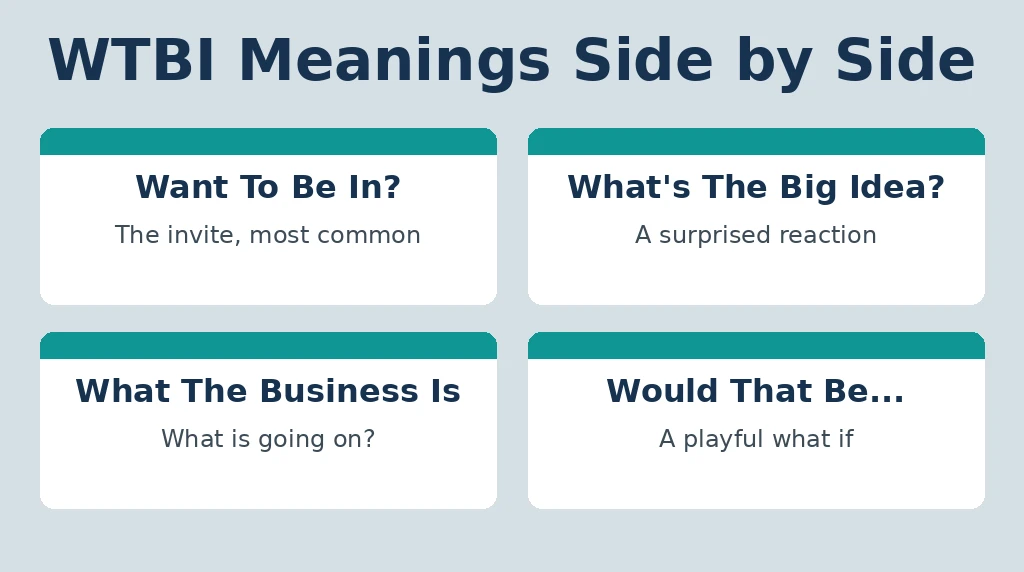
In casual texting, WTBI most commonly means “Want To Be In?”, but the same letters carry other readings, and a few of them are easy to miss if you only know the main one.
- What’s The Big Idea?: in some chats, especially ones with surprise, confusion or mild annoyance, WTBI can mean “What’s The Big Idea?”, a way of reacting to something unexpected someone just did or said.
- What The Business Is: this variation works like asking “What’s up?” or “What’s going on?”, a casual, slang forward way of checking in on someone’s situation or asking what is happening.
- Would That Be Interesting?: in some chat circles, particularly ones with a more sarcastic or playful tone, WTBI poses a “what if” style question, checking whether an idea or a plan sounds fun or worth trying.
- A personal shortcut: sometimes WTBI matches none of the readings above at all. Certain friend groups develop their own inside meanings for abbreviations, so if none of the common definitions fit, it may just be a personal shorthand.
- WTBI as a tag: on social media, #wtbi gathers invite style posts and comments under one label, so the tag works as an open call to join in rather than a question aimed at one person.
In a DM, wtbi invites one person to join a plan. In a comment or a hashtag, it invites everyone scrolling past.
How to Use WTBI Correctly
- Use it when inviting someone into a plan. The most natural use is checking interest before locking something in, like “We are doing game night Friday, WTBI?”
- Keep the tone casual. WTBI fits relaxed, informal conversations rather than serious or formal ones, since its whole purpose is to keep things quick and low pressure.
- Add context when needed. Since WTBI can carry more than one meaning, pairing it with a bit of extra information helps avoid confusion, especially with someone who might not catch which meaning you mean.
- Be mindful of flirty undertones. In a one-on-one chat with someone you like, WTBI can come across as playful or flirtatious, depending on the messages that came before it.
- Do not send it bare. A wtbi with no plan attached leaves the other person guessing. One short line about the plan, the time or the place makes the invite ten times clearer.
Example Conversations Using WTBI
Group chat planning
Person A: “Thinking about doing a beach day Saturday, WTBI?”
Person B: “Yesss, count me in”
A gaming lobby
Person A: “Starting a new squad, WTBI?”
Person B: “On my way, give me two minutes”
An Instagram comment
Comment: “wtbi if we do a group meetup for this?”
Reply: “I am so down for that”
A Snapchat message
Person A: “Thinking about hosting a little hangout this weekend”
Person B: “wtbi”
A WhatsApp family group
Person A: “Planning a family dinner next Sunday, WTBI?”
Person B: “Would not miss it”
A TikTok comment
Comment: “wtbi for a collab video like this lol”
Reply: “Let us make it happen”
A Discord server
Person A: “Hosting a movie night stream later, WTBI?”
Person B: “Definitely, send the link”
The confused reaction
Person A: “He just left without saying bye”
Person B: “wtbi, that is so random”
If the plan falls apart later, a short nvm and a new idea keep the group chat friendly.
When Not to Use WTBI
- Work email: write “Would you like to join us?” instead. Four letters of slang look careless on the record.
- Formal invitations: if you are organising something that needs clear, formal communication, spelling out the invitation fully avoids any confusion.
- Teachers and bosses: anyone grading or managing you deserves the full sentence, not a burst of slang.
- Customer service chats: on either side of the counter, wtbi sounds like nobody is taking the conversation seriously.
- Serious conversations: when someone shares bad news or asks for real support, a casual invite can feel like you are not listening.
- With people who may not know it: WTBI is not as widely known as “lol” or “omg”, so some readers will simply not know it. Plain words avoid a confused reply.
How to Respond When Someone Sends You WTBI
A wtbi lands in your chat and the ball is suddenly in your court. The sender is asking if you want in on something, so the honest move is a clear yes, a polite no, or a quick question that buys you time. Pick the lane that matches the moment.
Interested replies work when you want in:
- “Yes, count me in!”
- “Definitely, send the details.”
- “I am in, what time?”
Unsure replies suit a wtbi with no clear plan attached:
- “Wait, what is the plan?”
- “Maybe, what are we doing exactly?”
Polite decline replies fit the times you cannot make it:
- “Can’t make it this time, but have fun!”
- “Not today, thanks for thinking of me.”
A yes can be as short as a wbt when the plan is already set and all that is left is confirming you will show up. If you genuinely do not know yet, an honest idk beats a fake yes every time, since a no-show is worse than a maybe. One thing to avoid: do not leave a wtbi hanging with no reply at all. Even a short “let me check and get back to you” keeps the chat friendly.
Common Mistakes People Make With WTBI
- Assuming it always means the same thing. Since WTBI can shift between “Want To Be In?”, “What’s The Big Idea?” and other readings, assuming one fixed meaning without reading the context can lead to confusing replies.
- Missing the flirty undertone. In one-on-one chats, people sometimes miss that WTBI is being used playfully and answer in an overly literal, plan-focused way.
- Using it with the wrong audience. Sending WTBI to someone unfamiliar with internet slang, like a coworker or an older relative, can lead to unnecessary confusion.
- Not providing enough context. Since WTBI is not widely standardised, sending it on its own without any surrounding detail makes it much harder for the other person to read it right.
- Reading every wtbi as an invite. Sometimes the sender means “What’s The Big Idea?” and is reacting to something surprising, not inviting you anywhere. The message before it tells you which one it is.
Frequently Asked Questions
What does WTBI mean in text?
WTBI most commonly means “Want To Be In?”, a casual way of asking if someone wants to join a plan, a game or a group activity. It works as a quick, low pressure invite.
Is WTBI rude?
No. WTBI is friendly and casual. It only sounds off when it lands in a formal chat, where any slang feels out of place, or when it follows a serious message and reads as if the sender is not paying attention.
What is the difference between WTBI and WYD?
WYD asks what you are doing right now, so it is a check-in. WTBI asks if you want to join something, so it is an invite. One looks back at your day, the other looks forward to a plan.
Can WTBI mean something else?
Yes. It can mean “What’s The Big Idea?” as a surprised reaction, or “What The Business Is” as a way of asking what is going on. Read the sentence around it before you decide.
Can I use WTBI at work?
No. WTBI is casual slang, so it looks unprofessional in work emails, job chats and messages to teachers or bosses. Write the invitation out in full words instead.
How do I reply when someone sends me WTBI?
Say yes, no or not sure in plain words. “Yes, count me in” accepts, “can’t make it this time, have fun” declines politely, and “what is the plan?” buys you time to decide.
Final Thoughts
Four letters, one quick question, and a surprising amount of warmth packed inside. WTBI is the fastest way to ask “do you want in?” in texting, and it has earned its place in everyday chats because every plan starts with a headcount. Used casually, with a little context about the plan, it never really causes trouble.
If you want to check a dictionary source, Dictionary.com has no entry for wtbi yet, which shows how new this little invite still is to formal dictionaries. Either way, you now have the wtbi meaning in text down, plus a decent reply ready for the next time it shows up in your messages.
