You and a friend are going back and forth about a new song, or maybe debating which restaurant to pick for dinner, and suddenly they send back three letters: “wyt?” You know they want something from you, but the message is so short that it gives you almost nothing to work with. Are they asking your opinion, or telling you off?
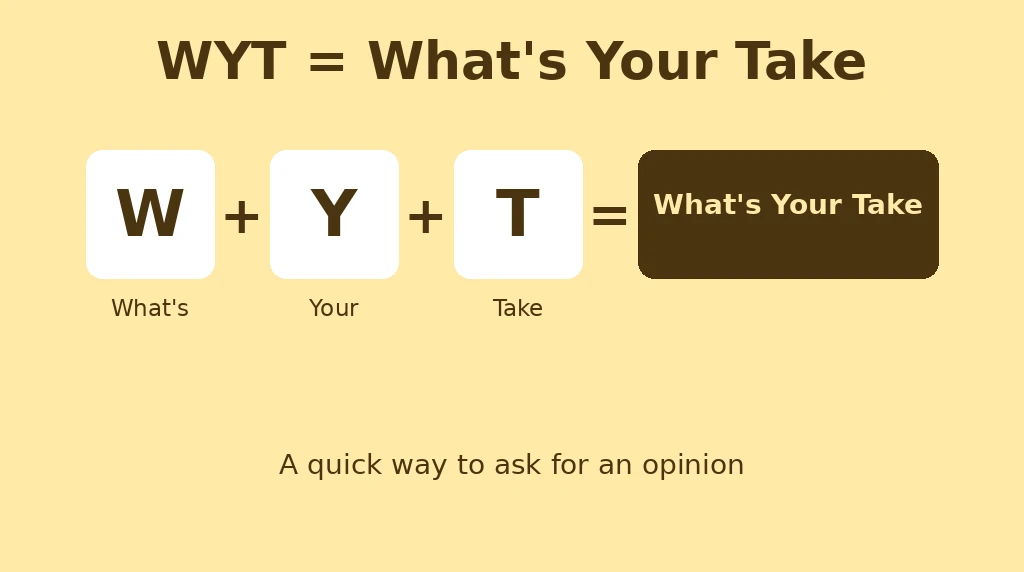
Here is the answer first. WYT means “What’s Your Take?” and people use it as a quick way of asking for your opinion on something they just shared, like a plan, a post or a piece of news. It is the texting version of “so, what do you think?” This guide covers the wyt meaning in text, the rare readings that trip people up, where it shows up, and the best replies when it lands in your messages.
What Does WYT Mean in Text?
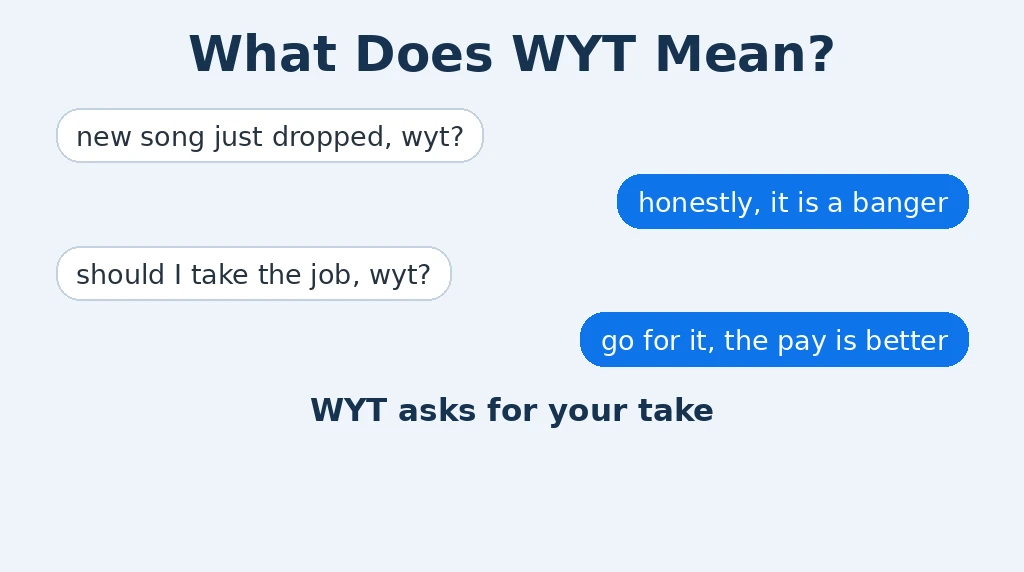
WYT stands for “What’s Your Take?” A “take” is your view on something, your opinion, your reaction, your honest read of the situation. When someone types “wyt?” after sharing news or an idea, they are handing you the floor. They want to know what you think before the chat moves on. You will see it at the end of a message most of the time, like “new phone or old one, wyt?” or “they changed the whole app design, wyt?”
The tone is almost always friendly and curious. A “wyt?” from a friend is an invitation, not a test. It says “I care what you think” in three letters. Say it out loud letter by letter, “double-u, why, tee”, and it sounds like a normal question because that is all it is.
One honest warning helps here. CyberDefinitions lists “What You Think” as a common definition for WYT, which is the same opinion question in slightly different words, so the opinion sense is solid. It also lists “Wait Your Turn” first, a reading that fits gaming and turn based chats. In everyday texting, the opinion question wins by a wide margin, but if the chat is about a game or a queue, the turn taking reading deserves a second look.
A short confused reaction like huh is close to WYT in spirit, but it works the other way round. A “huh” says you did not follow something. A “wyt” says you followed it and now someone wants your view on it.
Full Form of WYT
The full form is short, with one word behind each letter:
- W: What’s
- Y: Your
- T: Take
Put together, you get “What’s Your Take?” The phrase “what’s your take” is already casual spoken English, the kind of thing people say out loud when they want a friend’s view. Shortening it to three letters just makes it faster to type in the middle of a fast chat. You will almost never hear someone say the letters out loud. In real speech people just ask “what’s your take?” or “what do you think?” in full, and the abbreviation lives in typing only.
Pronunciation is simple, since the letters spell the question out. Say “double-u”, then “why”, then “tee”, and you have it. Some people read WYT as “what you think”, which drops the “do” and the “take” but asks the same question, so both readings land in the same place.
WYT vs WDYT vs IMO: What Is the Difference?
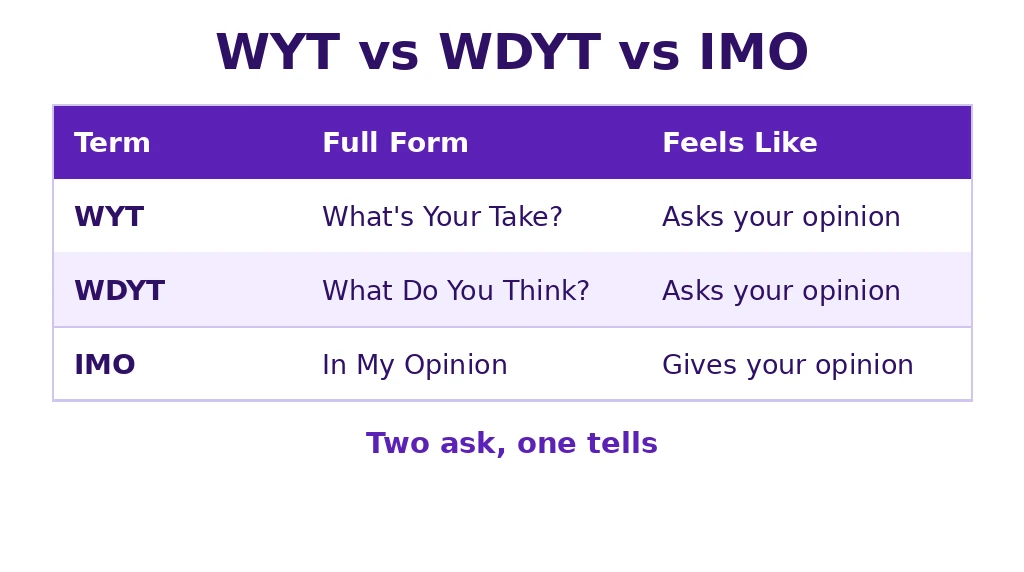
Three short opinion words cover the same patch of feelings, so here they are side by side.
| Abbreviation | Full Form | What It Really Does | Direction |
|---|---|---|---|
| WYT | What’s Your Take? | Asks for your opinion | Question to you |
| WDYT | What Do You Think? | Asks for your opinion | Question to you |
| IMO | In My Opinion | Gives my opinion | Statement from me |
The classic mix up is WYT versus WDYT, because the two ask the same question in different words. In practice, most people use them the same way, and nobody will correct you for picking one over the other. WDYT is a touch more common in longer chats, while WYT feels a little newer and shorter, which is why it shows up more on TikTok and in gaming chats.
IMO is the odd one out. It points the other way. Where WYT asks for an opinion, IMO gives one, so “imo, the new design is better” is an answer, not a question.
Where WYT Is Commonly Used
Texting and WhatsApp
One to one chats are where wyt shows up most. It answers shared news fast, without making the sender type a full sentence while they are still waiting for a reaction. A typical line looks like this: “thinking about switching jobs, wyt?” Short, honest, and the chat keeps moving.
Instagram and Snapchat
On Instagram and Snapchat, wyt appears in DMs when someone shares an opinion, a photo or a piece of gossip and wants a reaction. It also works as a caption or a tag. A photo captioned “wyt?” or tagged #wyt is not asking one person, it is asking everyone scrolling past for their view.
TikTok Comments
Scroll a busy TikTok comment section and wyt pops up under videos with bold claims or hot takes. Viewers type things like “this take is honestly wild, wyt?” or “wyt everyone, is he right?” right after the reveal.
Group Chats
Group chats run on shared decisions, so wyt fits them perfectly. One person drops a plan or a piece of news, adds “wyt?” at the end, and two or three people reply with their views before anyone has time to write more.
Gaming Chats
In game chat there is no time for full sentences, so wyt does quick work between rounds. Players type things like “should we push mid or hold back, wyt?” while the match is still moving. Everyone understands it instantly, and nobody stops playing to decode it.
Discord and Forums
Discord servers and forums use wyt the same way, just in longer threads. Someone posts an idea or a project plan, and “wyt before I commit to it?” is a normal reply.
Origin and History of WYT
WYT has no single inventor and no confirmed first use, which is normal for slang built out of an everyday question. “What’s your take” has been a common spoken phrase for a long time, used whenever people want a friend’s view on something. As typing culture shifted toward speed, people started shortening the questions they typed most often.
The abbreviation travelled with texting from SMS to instant messaging, then into gaming chats and social apps, where quick opinion swaps matter more than full sentences. Slang archives have listed entries for it for well over a decade, which shows it has stuck around even though it never became as famous as LOL or OMG.
Other Meanings and Variations of WYT
In casual texting, WYT almost always means “What’s Your Take?”, but the same letters carry other readings, and a few of them are easy to miss if you only know the main one.
- What You Think: the same opinion question in plainer words. CyberDefinitions lists it as a common definition, and most guides treat it as the same meaning as “what’s your take”.
- Whatever You Think: used when someone defers a decision, as in “pizza or tacos, wyt” meaning “whatever you think, I’m easy”. CyberDefinitions lists this one too.
- Watch Your Tone: a rare, sharp reading used as a warning in tense chats. If someone sends a blunt “wyt” after a rude comment, they may mean “watch your tone”. This reading is far less common than the opinion one.
- Wait Your Turn: CyberDefinitions lists this as its first definition, mostly in gaming and turn based chats, where it tells someone to hold on until their turn comes.
- WYT as a tag: on social media, #wyt gathers opinion posts and comments under one label, so the tag works as an open question to the whole feed rather than a message aimed at one person.
On social media, the caption and tag use behaves differently from the chat use. In a DM, wyt asks one person for their view. In a caption or a hashtag, it asks everyone scrolling past, a mood for the whole feed, not a question aimed at one reader.
How to Use WYT Correctly
- Use it when you genuinely want an opinion. WYT works best when you actually want to hear what the other person thinks about something you shared. Asking it and then ignoring the answer feels worse than not asking at all.
- Pair it with a clear topic. “new song just dropped, wyt?” is far clearer than a bare “wyt?” on its own, and it takes only a few extra seconds to type.
- Keep it casual. WYT belongs in friendly, informal chats. If the conversation would not welcome a “lol”, it will not welcome a “wyt” either.
- Do not use it as a test. If you only ask for opinions you already agree with, people will stop giving honest ones. Ask because you want the truth, not because you want applause.
- Watch the tone in tense chats. In a heated argument, a bare “wyt” can be read as “watch your tone” instead of “what’s your take”. Add a friendly line around it so nobody misreads you.
Example Conversations Using WYT
Deciding on dinner
Person A: “thinking about trying that new restaurant downtown, wyt?”
Person B: “sounds good, I have heard great things about it”
An Instagram comment
Person A: “this whole situation seems pretty unfair honestly, wyt everyone?”
Person B: “totally agree, they handled it badly”
Gaming strategy
Person A: “should we push mid or hold back this round, wyt?”
Person B: “let’s hold back, we are stronger on defense”
A big life decision
Person A: “thinking about switching jobs, not totally sure though”
Person B: “that is huge, wyt, does the new offer feel right for you?”
A TikTok comment
Person A: “this take is honestly kind of controversial, wyt?”
Person B: “I agree with every word, honestly”
Sharing news in a group chat
Person A: “just saw they are changing the whole app design again”
Person B: “ugh, wyt, I actually liked the old layout”
Asking for feedback on a project
Person A: “considering this approach for my project, wyt before I commit?”
Person B: “I like it, but test the second option too”
The unsure reply
Person A: “new haircut tomorrow, wyt?”
Person B: “idk yet, send me a photo when it is done”
When Not to Use WYT
- Work email: write “What do you think?” instead. Three letters look careless on the record.
- Job interviews and applications: even over chat, recruiters read wyt as unprepared or too casual.
- Teachers and bosses: anyone grading or managing you deserves the full question, not a burst of slang.
- Customer service chats: on either side of the counter, wyt sounds like nobody is taking the problem seriously.
- Serious conversations: when someone shares bad news or asks for real support, asking for a hot take can feel like you are turning their problem into a debate.
- Heated arguments: in a tense chat, “wyt” can be read as “watch your tone”, which pours fuel on the fire instead of cooling it down.
How to Respond When Someone Sends You WYT
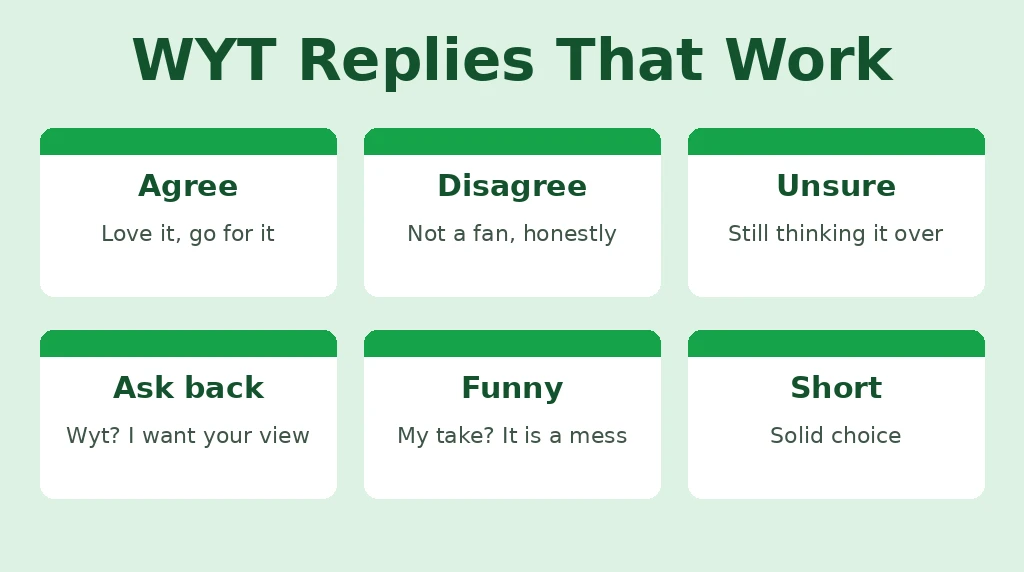
A wyt lands in your chat and the ball is suddenly in your court. The sender wants your honest view, so give it plainly, even if it is short. Pick the lane that matches the moment.
Agreeing replies work when you share the view:
- “Honestly, I love the idea, go for it.”
- “Yes, exactly what I was thinking.”
- “Same, I could not agree more.”
Disagreeing replies suit a view you do not share:
- “Not a fan personally, I’d pick the other one.”
- “I see it differently, but I get why you like it.”
Unsure replies help when you need more time:
- “Still thinking it over, give me a minute.”
- “Not sure honestly, what made you think of it?”
Playful replies fit close friends and light topics:
- “My take? It is a mess, and I love it.”
- “Bold choice, I respect it.”
If the topic has already passed and the chat has moved on, nvm and a fresh topic work better than a late opinion. One thing to avoid: do not fire back a sarcastic reply when the wyt was honest. Most of the time the person genuinely wants your view, and a straight answer keeps the chat friendly.
Common Mistakes People Make With WYT
- Confusing WYT with WYD. They look alike, but WYT asks for an opinion and WYD asks what someone is doing. Mixing them up gives the other person a confusing answer.
- Reading every wyt as a warning. The “watch your tone” reading is rare. In friendly chats, wyt means “what’s your take” almost every time, so do not jump to the tense reading first.
- Sending a bare wyt with no topic. Three letters alone tell the other person you want their view, but not on what. Add one short line about the topic.
- Asking and then ignoring the answer. If you ask for someone’s take and then brush it off, people will stop giving you honest opinions.
- Overusing it in every message. Ending every message with “wyt?” can feel like fishing for praise rather than genuinely wanting feedback. Save it for moments that matter.
Frequently Asked Questions
What does WYT mean in text?
WYT means “What’s Your Take?” People type it when they want your opinion on something they just shared, like a plan, a post or a piece of news. It is a short way of asking “what do you think?”
Is WYT the same as WDYT?
Yes, almost. WDYT means “What Do You Think?” and WYT means “What’s Your Take?” Both ask for the same thing, your opinion, so people use them the same way in most chats.
Can WYT mean “watch your tone”?
Yes, but only rarely, and only in tense chats. If someone sends a sharp “wyt” after a rude comment, they may mean “watch your tone” as a warning. In friendly chats it almost always means “what’s your take”.
Does WYT mean “wait your turn”?
CyberDefinitions lists “Wait Your Turn” as one of its definitions for WYT, mostly in gaming and turn based chats. In everyday texting, though, the opinion question is far more common.
Is WYT rude?
No, not usually. Asking for someone’s opinion is polite and friendly. It only feels pushy if someone demands an instant answer or uses it to start an argument.
How do I reply when someone sends me WYT?
Just share your honest opinion, even a short one. “Honestly, I love the idea” or “Not a fan, I’d pick the other one” both work. If you need time, say “Still thinking, give me a minute” instead of going quiet.
Final Thoughts
Three letters, one simple question, and a surprising amount of range packed inside. WYT is the fastest way to ask “what’s your take?” in texting, and it has earned its place in everyday chats because every shared plan, post and piece of news deserves a second view. Used with a clear topic and a genuine wish to hear the answer, it never really causes trouble.
If you want a second opinion from a dictionary source, Dictionary.com lists wyt with this same opinion meaning, which shows how far a humble texting shortcut has travelled. Either way, you now have the wyt meaning in text down, plus a decent reply ready for the next time it shows up in your messages.
