You tell your friend you are going to wake up at 5 AM tomorrow, run ten miles and learn a whole new language by next month. The reply comes back in four letters: “bsfr.” No emoji, no extra words. Are they laughing with you, laughing at you, or telling you to stop kidding yourself?
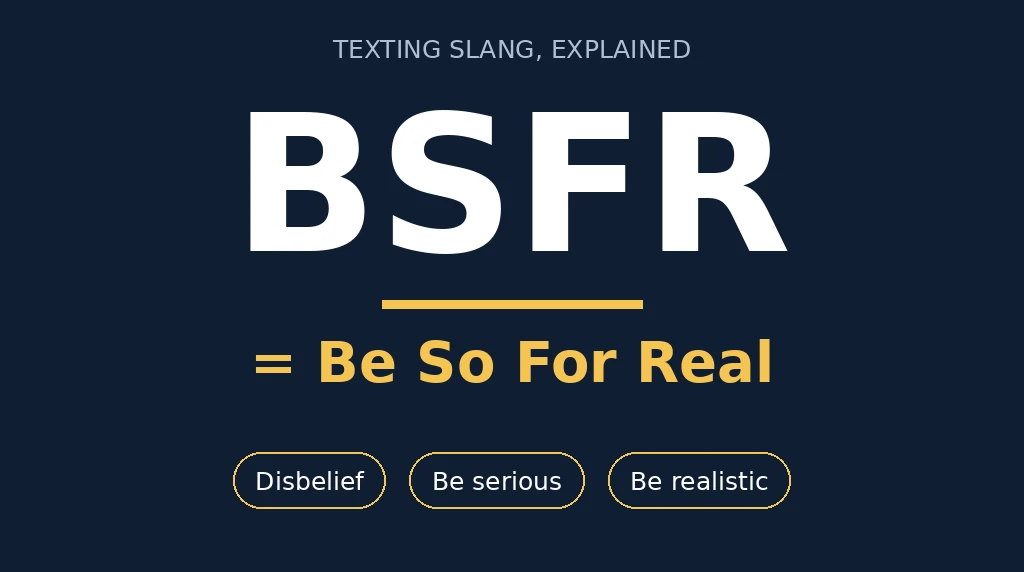
Here is the short answer first. BSFR means “Be So For Real”, a casual way to tell someone to be serious, stop exaggerating, or admit that something is obviously true. It comes from the spoken phrase “be so for real”, and Wiktionary lists it as internet slang built from exactly those words. This guide covers the bsfr meaning in text, BSFR vs BFFR and FR, where you will see it, and the best replies when it lands in your chat.
What Does BSFR Mean in Text?
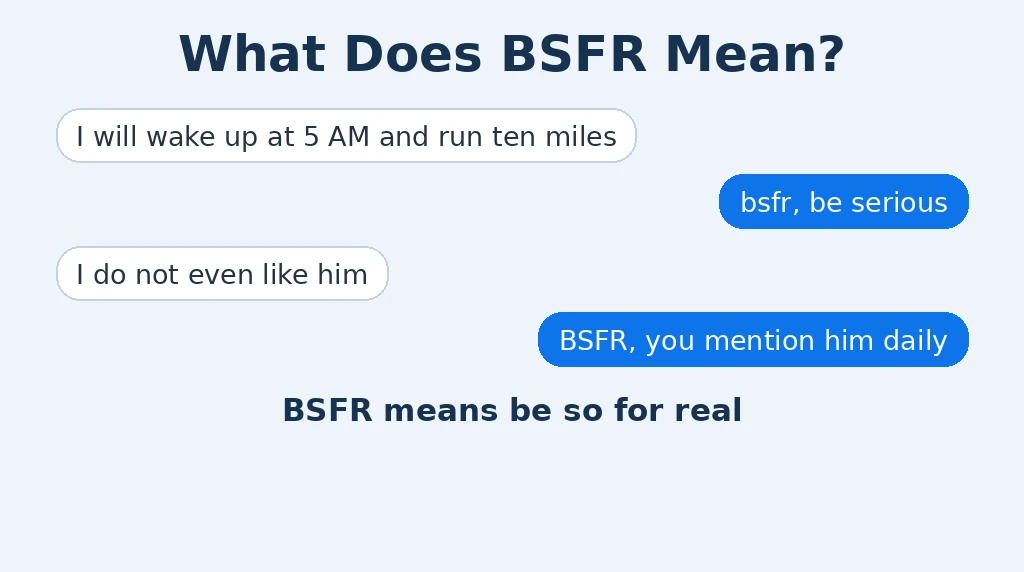
BSFR is short for “Be So For Real”. Someone sends it the second a claim sounds too big, too dramatic or too far from the truth to let pass. A friend says they will finish a whole project tonight when they have not even started. A classmate insists they do not need to study for an exam worth half the grade. A crush says they do not even like someone they talk about every single day. In each case bsfr is the same short challenge: come on, be honest, be realistic.
It sits close to a plain frl, but bsfr pushes harder. A “frl” can agree with you or ask “really?” A “bsfr” challenges you, it says the thing you just said does not hold up. Lowercase “bsfr” is the everyday form and feels relaxed. Uppercase “BSFR” looks louder, like someone raising their voice a little. Add a laughing face and the tone softens again, so “bsfr” with a crying laughing emoji is a joke between friends while a bare “BSFR.” with a full stop can feel cold or confrontational.
One honest warning helps here. BSFR is blunt by design, so it lands differently depending on who reads it. With close friends it is harmless fun. With someone you barely know, or someone already upset, it can read as dismissive, as if you are brushing their words aside instead of listening to them.
Full Form of BSFR
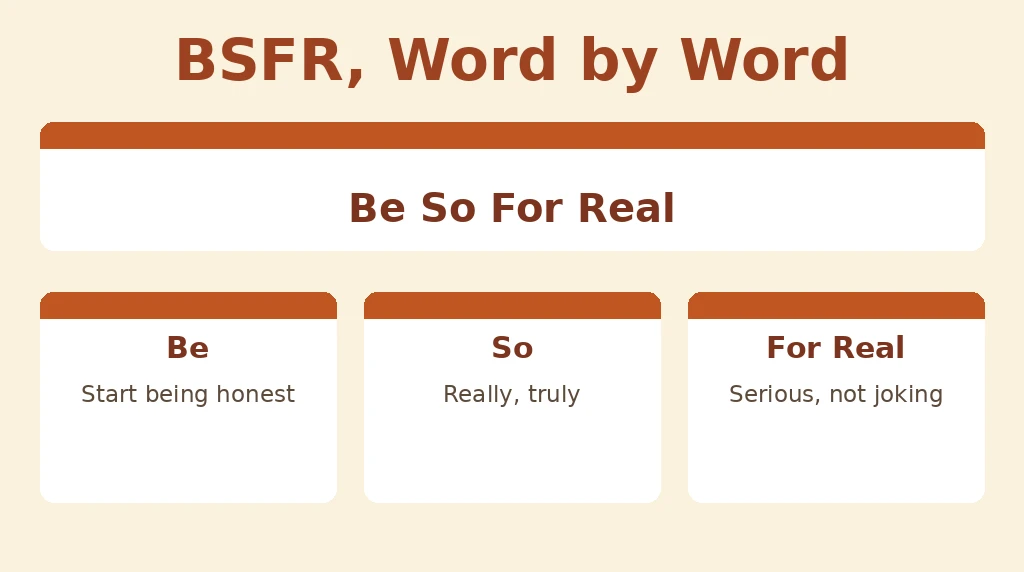
The full form is simple, with one word behind each letter:
- B: Be
- S: So
- F: For
- R: Real
Put together, you get “Be So For Real”. The phrase itself is much older than the abbreviation. “Be for real” has been everyday spoken English for a very long time, used whenever someone wants another person to stop joking around. The extra “so” turns the volume up a notch, and the shortened form appeared as texting made brevity a virtue.
Pronunciation is easy because nobody says the letters as a word. People read it letter by letter, “bee ess eff are”, or they simply say the full phrase “be so for real” out loud. In real speech the abbreviation almost never appears, it lives in typing only, which is why it can confuse anyone who mainly talks face to face.
BSFR vs BFFR vs FR: What Is the Difference?
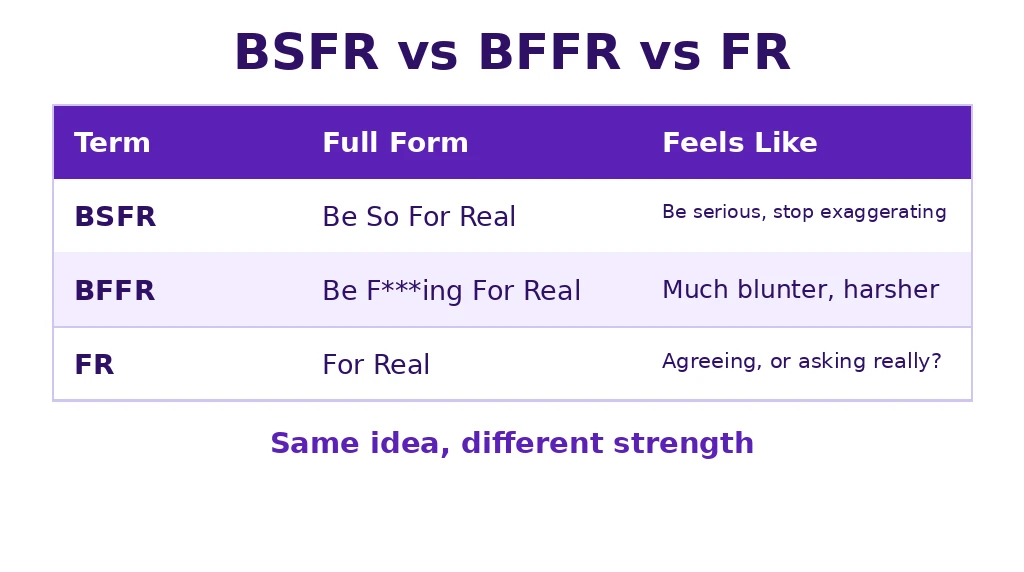
Three short reactions all orbit the same idea of being real, so here they are side by side.
| Abbreviation | Full Form | What It Really Says | Tone |
|---|---|---|---|
| BSFR | Be So For Real | Come on, be serious and realistic | Direct, playful or challenging |
| BFFR | Be F***ing For Real | Seriously, stop lying to yourself | Blunt, much stronger, sometimes harsh |
| FR | For Real | Really? I agree, or I cannot believe it | Light, flexible, often friendly |
The classic mix up is BSFR versus BFFR, because the two react to the same kind of exaggeration. BFFR adds a swear word inside it, so it hits harder and can sound angry even when the sender only meant to be funny. BSFR gives you most of that same energy without the hard edge, which is why people pick it for everyday call outs like an impossible plan or an obvious crush denial.
FR is the gentlest of the three and the most flexible. It can agree with you, question you, or simply react, depending on the chat. Think of it as a sliding scale. FR is a raised eyebrow, bsfr is a pointed finger, and BFFR is a slammed hand on the table. Pick the one that matches how big the exaggeration actually is.
Where BSFR Is Commonly Used
Texting and WhatsApp
One to one chats are where bsfr shows up most. It answers an unrealistic claim fast, without making the sender type a full sentence while they are still laughing at it. A typical line looks like this: “bsfr, you said you were done shopping and you are still looking at shoes.”
Instagram and Snapchat
On Instagram and Snapchat, bsfr appears in DMs when someone shares an exaggerated claim, a surprising photo or a story that does not add up. It also works as a caption or a tag. A photo captioned “bsfr” or tagged #bsfr is a mood, a small public shrug that says the poster is not buying what they just heard.
TikTok Comments
Scroll a busy TikTok comment section and bsfr pops up under videos with bold claims and impossible challenges. Viewers type things like “bsfr, I tried it five times and it is not that easy” right under a video that promises instant results.
Group Chats
Group chats run on big claims, so bsfr fits them perfectly. One person says they are never ordering fast food again, someone reminds them they ordered pizza last night, and two or three people reply “bsfr” before anyone writes more.
Gaming Chats
In game chat there is no time for full sentences, so bsfr does quick work between rounds. Players type things like “bsfr, you said that strategy never works and now you are using it” while the match is still moving.
Discord and Forums
Discord servers and forums use bsfr the same way, just in longer threads. Someone posts a wild take or an impossible promise, and “bsfr, that makes no sense at all” is a normal reply.
Origin and History of BSFR
BSFR has no single inventor and no confirmed first use, which is normal for slang built out of an everyday spoken phrase. “Be for real” has been a common spoken challenge for a very long time, used whenever someone wants another person to stop pretending or face reality. As typing culture shifted toward speed, people started shortening the phrases they typed most often.
The abbreviation travelled with texting from SMS to instant messaging, then into comment sections and social apps, where quick reactions matter more than full sentences. Its popularity has been especially visible on TikTok and Instagram, where users combine short abbreviations with emojis to set the tone in a single line.
Other Meanings and Variations of BSFR
In casual texting, BSFR almost always means “Be So For Real”, but the same letters carry a few other readings worth knowing.
- Be so for real, as reassurance: sometimes bsfr pushes back against a negative claim, as in “bsfr, you look amazing” when a friend says they look terrible. Here it means “seriously, stop saying that, it is clearly not true”.
- BFFR: the stronger cousin with a swear word inside it. Same challenge, much blunter, and a poor pick around people who dislike strong language.
- Lowercase bsfr: the same meaning written small. Lowercase feels softer and more casual, while capitals feel louder and more direct.
- BSFR with emojis: the crying laughing face makes it playful, the skull makes it funnier, and no emoji at all makes it sound more serious. The emoji often carries half the meaning.
- BSFR as a tag: on social media, #bsfr gathers reaction posts under one label, so the tag works as a caption style reaction rather than a reply to anyone.
- Niche meanings: in technical or professional settings the same letters could stand for something unrelated, but in a casual chat that reading almost never applies.
On social media, the caption and tag use behaves differently from the chat use. In a DM, bsfr reacts to something someone just said. In a caption or a hashtag, it reacts to the post itself, a mood for everyone scrolling past, not a message aimed at one person.
How to Use BSFR Correctly
- Use it as a reaction, not an opener. BSFR works best right after an unrealistic claim. Starting a chat with it out of nowhere leaves the other person guessing what you are challenging.
- Keep it casual. BSFR belongs in friendly, informal chats. If the conversation would not welcome a “lol”, it will not welcome a “bsfr” either.
- Add what you are challenging. “bsfr, you said you were saving money and you just bought new shoes” is far clearer than a bare “bsfr” on its own, and it takes only a few extra seconds to type.
- Soften it with an emoji when you are joking. A laughing face turns a blunt challenge into a joke between friends. Without one, the same letters can sound like a real argument.
- Watch who you send it to. With close friends it is harmless fun. With a teacher, a boss, a new contact or someone already upset, the blunt edge inside it can land badly, so use plain words instead.
Example Conversations Using BSFR
About a crush
Person A: “I do not even like him”
Person B: “You literally mention him every day”
Person A: “That is not true”
Person B: “BSFR”
About money
Person A: “I am going to save two thousand this month”
Person B: “You spent seven hundred yesterday”
Person A: “I will be more careful now”
Person B: “BSFR”
An Instagram DM about a photo
Person A: “Do you think this picture is bad?”
Person B: “BSFR. You look amazing”
A TikTok comment
Person A: “This is the easiest challenge ever”
Person B: “BSFR, I tried it five times”
Gaming with a teammate
Person A: “I can finish this entire project tonight”
Person B: “You have not even started”
Person A: “I will work fast”
Person B: “BSFR”
An exam plan
Person A: “I do not need to study for tomorrow’s exam”
Person B: “It is worth half our grade”
Person A: “I will just wing it”
Person B: “BSFR”
A fast food promise
Person A: “I am never ordering fast food again”
Person B: “BSFR, you ordered pizza last night”
The confused one
Person A: “He just texted me out of nowhere after six months”
Person B: “idk what he wants, but BSFR, that is so random”
When Not to Use BSFR
- Work email: write “I do not think that approach would be realistic” instead. Four letters that challenge someone look careless on the record.
- Job interviews and applications: even over chat, recruiters read bsfr as unprepared or too casual.
- Teachers and bosses: anyone grading or managing you deserves the full sentence, not a blunt burst of slang.
- Customer service chats: on either side of the counter, bsfr sounds like nobody is taking the problem seriously.
- Serious conversations: when someone shares bad news or asks for real support, a challenge can feel like you are dismissing their feelings instead of hearing them.
- With people who may not know it: BSFR is still new slang, so some readers will simply not know it. Plain words avoid a confused reply.
How to Respond When Someone Sends You BSFR
A bsfr lands in your chat and the ball is suddenly in your court. The sender thinks something you said does not hold up, so first work out whether they are joking or serious, then answer the point itself. Pick the lane that matches the moment.
Patient replies work when the bsfr was fair and you can admit it:
- “Okay fine, you caught me, I was exaggerating.”
- “You are right, that was a bit much. Let me be honest.”
- “Fair enough, I will stop pretending.”
Helpful replies suit a bsfr that asks for more detail:
- “Hear me out, I actually have a plan this time.”
- “I know how it sounds, but let me explain what I meant.”
Playful replies fit close friends and light topics:
- “lol, I am being so for real though”
- “BSFR right back at you”
If the bsfr was aimed at a claim you no longer stand behind, nvm and a fresh topic work better than digging in. One thing to avoid: do not fire back a sharper challenge when the bsfr was playful. Most of the time the person is teasing you, not attacking you.
Common Mistakes People Make With BSFR
- Confusing BSFR with BFFR. They challenge the same claims, but BFFR is much stronger because of the swear word inside it. Using it for a small exaggeration makes you sound angrier than you are.
- Sending a bare bsfr with no context. Four letters alone tell the other person you doubt them, but not what you doubt. Add one short line about the claim you are challenging.
- Using it in formal chats. The blunt edge inside bsfr makes it a poor fit for work, school and customer service, even when the challenge is fair.
- Forgetting the emoji. Without a laughing face, a playful bsfr can read as a real argument. The emoji often turns a challenge into a joke.
- Reading every bsfr as an attack. Most bsfr messages are teasing or honest, not hostile. Tone in text is easy to misjudge, so give the sender the benefit of the doubt first.
Frequently Asked Questions
What does BSFR mean in text?
BSFR means “Be So For Real”. People use it in texting and on social media to tell someone to be serious, stop exaggerating, or admit something is obviously true.
Is BSFR rude?
It can be. With close friends and a laughing emoji it is usually playful, but a bare “BSFR.” in an argument can sound dismissive. The tone comes from the chat around it.
What is the difference between BSFR and BFFR?
Both say “be serious”, but BFFR adds a swear word, so it hits harder and sounds blunter. BSFR gives you most of that same energy without the hard edge.
What does BSFR mean from a girl?
It means the same thing whoever sends it: “be so for real”. She is calling out something unrealistic or untrue, and whether it is playful or annoyed depends on the rest of the message and emoji.
Can I use BSFR in a work email?
No. BSFR is casual slang that tells someone to be realistic, so it looks unprofessional in work emails, job chats and messages to teachers or bosses. Write “I do not think that is realistic” instead.
How do I reply when someone sends me BSFR?
First work out if they are joking or serious. Laugh along if it is playful, admit the point if they caught you exaggerating, or explain yourself if you meant what you said.
Final Thoughts
Four letters, one blunt challenge, and a surprising amount of range packed inside. BSFR is the fastest way to say “come on, be serious” in texting, and it has earned its place in everyday chats because everyone meets claims that do not quite hold up.
If you want a second opinion from a dictionary source, Dictionary.com has a lookup page for bsfr, though slang this new does not always get a full dictionary entry yet. Either way, you now have the bsfr meaning in text down, plus a decent reply ready for the next time it shows up in your messages.
