
You text a friend asking what time the plans start, and all you get back is: “DK.” No follow up, no extra words, just two letters sitting there on the screen. Are they confused, annoyed, or just typing fast?
Here is the short answer first. DK means “Don’t Know,” a very short way to say you do not have the answer, so “DK what time it starts” means “I don’t know what time it starts.” This guide covers the dk meaning in text, DK vs IDK vs dunno, where it shows up, when it sounds rude, and the best replies when it lands in your chat. Read on for the tone traps, the gaming senses, the mistakes to avoid, and the replies that keep the chat moving.
What Does DK Mean in Text?
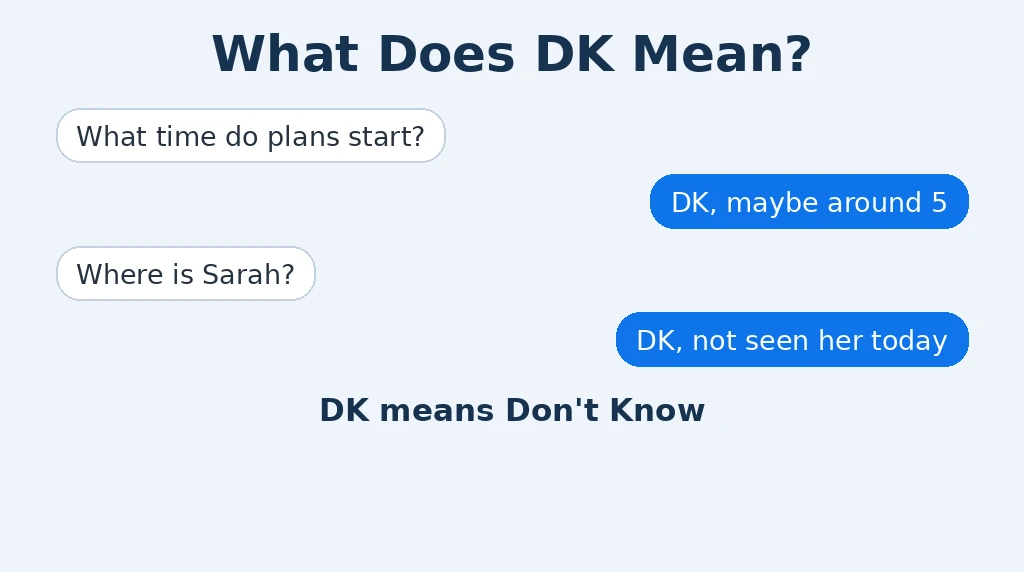
DK is the short form of “Don’t Know.” It is used for genuine uncertainty, not having an answer, or not having decided yet. Someone asks a question, you do not know the answer, and instead of typing a full sentence, you tap out DK and move on. “DK where he went” means “I don’t know where he went.”
The feeling behind it is casual and low effort. A bare dk is neutral by itself, but it can read as dismissive in a serious conversation, even when the sender means it honestly. Adding a few words fixes the tone fast, as in “dk yet, still checking.” The extra words show you care, while the bare form just reports the gap.
It sits close to a plain huh in one way: both can leave you guessing when they arrive with no context. The difference is that a huh says “I did not follow that,” while a bare dk says “I have no answer for that.” Lowercase “dk” reads softer and more casual than uppercase “DK.” If you are ever unsure, read the message before it. That line almost always settles the meaning.
One honest warning helps here. DK is much less common than IDK, so some people will not know it at first glance. If the person you are texting is older or new to slang, “I don’t know” in full is safer than a dk they have to decode.
Full Form of DK
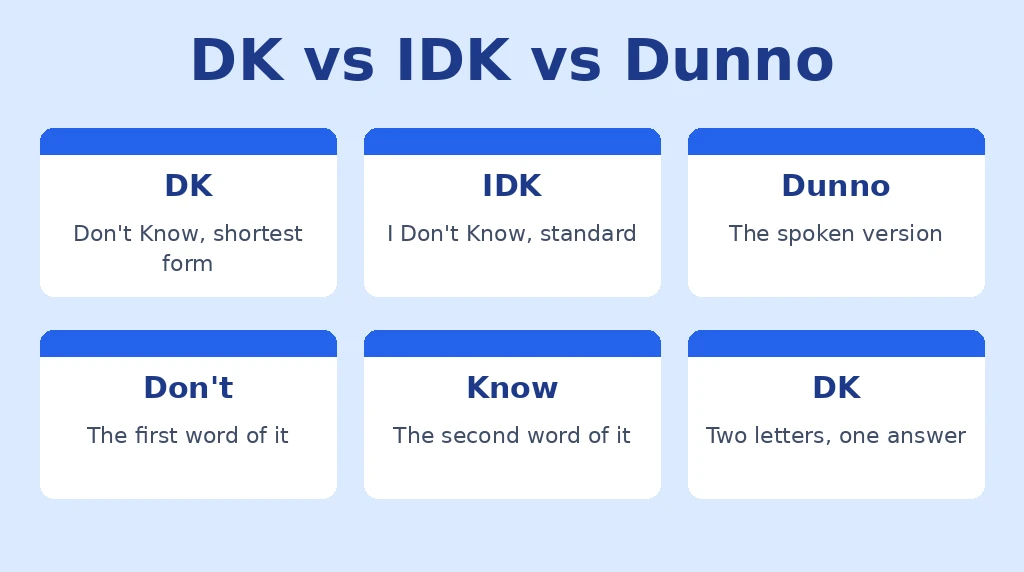
The full form is simple, because DK is built from the first letters of a plain English phrase:
- D: Don’t
- K: Know
Put together, you get “Don’t Know.” That is the reading most people mean in texting, and it is the one CyberDefinitions lists as the only definition, while Wiktionary lists it as an internet slang abbreviation of “don’t know.” Meanzafy calls it the most common meaning in text too.
Say the letters out loud and the pattern is clear. People say D K one letter at a time, dee kay, because the abbreviation is an initialism, not a spoken word. In real conversation people say “I don’t know” in full, and the short form works in typing and in quick notes.
DK vs IDK vs Dunno: What Is the Difference?
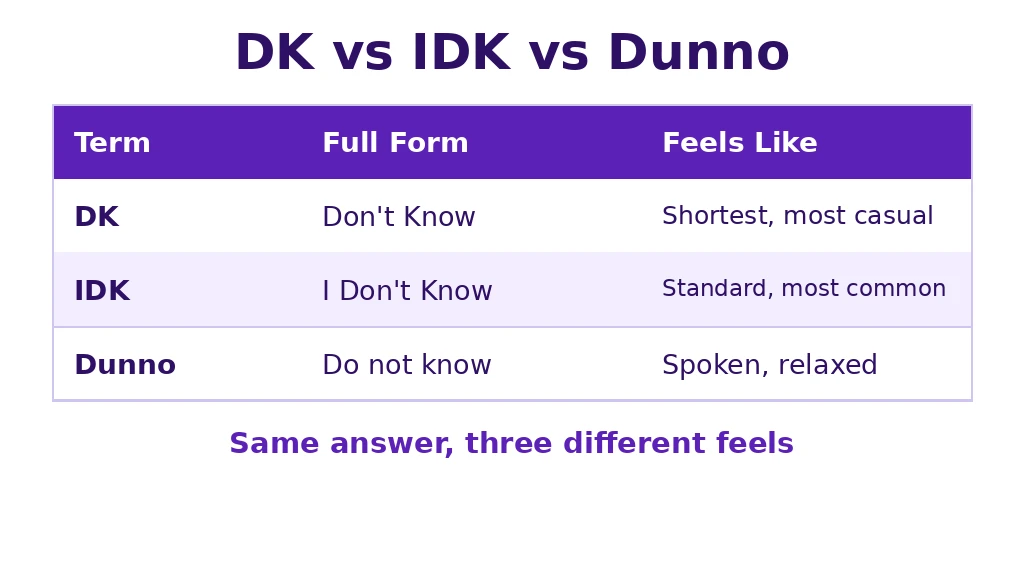
Three ways to say the same thing, so here they are side by side.
| Abbreviation | Full Form | What It Really Says | Tone |
|---|---|---|---|
| DK | Don’t Know | I have no answer right now | Casual, very short |
| IDK | I Don’t Know | I have no answer right now | Casual, standard |
| Dunno | Do not know | I have no answer, said aloud | Spoken, relaxed |
The classic mix up is DK versus IDK, because they mean the same thing. The gap is small but real. IDK keeps the “I,” so it reads as a full sentence, while DK drops it, so it reads as a fragment. IDK is also far more common, which means more people will read it without thinking twice.
Dunno is the odd one out in a useful way. It is the spoken style version, the way people actually say “I don’t know” out loud in fast speech. Think of it this way: DK is the shortest typed form, IDK is the standard typed form, and dunno is the spoken form written down.
Where DK Is Commonly Used
Texting and WhatsApp
One to one chats are where dk shows up most, usually as a quick answer to a direct question. It answers “do you know?” fast, without making the sender type a full sentence. A typical line looks like this: “DK, I have not seen her today.” Short, plain, and the chat keeps moving.
Instagram and Snapchat
On Instagram and Snapchat, dk appears in DMs and quick replies to stories. Someone asks about a plan or a post, and “dk tbh” is a common reply, meaning “I don’t know, to be honest.” The rest of the message tells you which reading fits.
TikTok Comments
Scroll a busy TikTok comment section and dk pops up under clips where people ask what happened or who someone is. Viewers type things like “dk what happened” right after the clip, a quick way to say they have no answer.
Group Chats
Group chats run on quick reactions, so dk fits them well. One person asks a question, someone replies dk, and another person jumps in with the answer. The short form keeps the chat moving while the group sorts it out.
Gaming Chats
In game chat there is no time for full sentences, so dk does quick work between rounds. Players type things like “dk where he went” while the match is still moving, and nobody stops playing to decode it. In some games, though, DK can also mean Death Knight or Donkey Kong.
Discord and Forums
Discord servers and forums use dk the same way, just in longer threads. Someone asks a question in a channel, and “dk, sorry” is a normal reply that keeps the discussion going. In gaming servers, the game sense can appear too, so the channel tells you which one you are reading.
Origin and History of DK
DK grew out of early texting and chat culture, when slow keypads and short message limits pushed people to shorten common phrases. “I don’t know” was one of the most typed sentences in any chat, so dropping the “I” and keeping the D and K was a natural shortcut.
IDK came first and stayed the standard, while DK grew beside it as the even shorter form. Both spread from SMS to instant messaging and then to social apps, where fast replies matter more than full sentences. Major dictionaries now list IDK, and Wiktionary lists DK as an internet slang abbreviation, which shows how far the short form has travelled.
The gaming senses have separate histories. Donkey Kong is a Nintendo character who first appeared in the early 1980s, and Death Knight is a character class in World of Warcraft. Players shortened both to DK in game chats, and the short form stuck. One set of letters, two histories, and the setting tells you which one you are reading.
Other Meanings and Variations of DK
In everyday talk, DK almost always means Don’t Know, but the same letters carry other readings, and a few of them are easy to miss if you only know the main one.
- Donkey Kong: in gaming, DK can mean Donkey Kong, the Nintendo ape who stars in his own games and appears in Mario games. This use only fits when the chat is about Nintendo.
- Denmark: in sports and international chats, DK is the country code for Denmark, used when people talk about Danish teams, players or streams.
- Death Knight: in World of Warcraft, DK means Death Knight, a character class players can pick. This use only fits in a game chat about that game.
- Dunno: the spoken style version of “don’t know,” written the way it sounds in fast speech. It is warmer than a bare dk, and it fits the same moments.
- DKA, not DK: in medical notes, diabetic ketoacidosis is shortened to DKA, not DK. DK on its own has no single medical meaning, so do not read a medical DK as “don’t know” without the surrounding notes.
- Initials or usernames: sometimes DK is simply someone’s initials or a username, with no wider meaning at all. If none of the usual senses fit, ask the sender what they mean.
On social media, the tag use behaves differently from the chat use. In a DM, dk tells one person you have no answer. In a hashtag, #dk groups posts about Donkey Kong, Denmark and gaming clips for everyone scrolling past, so the tag works as a topic label rather than a message aimed at one person.
How to Use DK Correctly
- Use it for real uncertainty, not for dodging. DK works best when you truly do not know. Using it to avoid a question you could answer will frustrate the other person.
- Add a few words when the chat matters. “DK yet, still checking” is far warmer than a bare “dk” on its own, and it takes only a few extra seconds to type.
- Keep it in casual chats. DK fits friends, family and light group chats. It fits badly in work, school and customer service, even when the answer is genuine.
- Pick IDK when the reader may not know DK. IDK is far more common, so it is the safer pick with older readers or people new to slang.
- Follow it with a next step. “DK, let me ask her” is better than a lone dk, because it shows you are helping even though you have no answer yet.
Example Conversations Using DK
Asking about plans
Person A: “What time do the plans start?”
Person B: “DK, maybe around 5?”
Looking for someone
Person A: “Do you know where Sarah is?”
Person B: “DK, I have not seen her today”
A group chat question
Person A: “Who is bringing the snacks?”
Person B: “DK, ask in the group”
Checking a detail
Person A: “Did the meeting move?”
Person B: “idk, I will check the mail”
A gaming lobby
Person A: “DK main here, need a healer”
Person B: “I can heal, join up”
A TikTok comment
Person A: “DK what happened in the video”
Person B: “Same, I watched it twice”
The confused one
Person A: “He just texted me ‘DK’ with no context”
Person B: “nvm, he meant he does not know”
A quick check
Person A: “DK if I can come tomorrow”
Person B: “No worries, let me know later”
When Not to Use DK
- As a bare reply in a serious chat: two letters with no extra words can read as cold or dismissive when someone needs a real answer.
- In a work email: write “I don’t know” in full, and add what you will do next, like checking with someone.
- Job interviews and applications: even over chat, a bare abbreviation can look careless when the full phrase costs nothing to type.
- Teachers and bosses: anyone grading or managing you deserves the full phrase, not a burst of shorthand.
- Customer service: a customer who asked a real question deserves a full sentence, not a two letter shrug.
- When you do know the answer: DK means you do not know, so using it to dodge a question will frustrate the other person fast.
How to Respond When Someone Sends You DK
A dk lands in your chat and the ball is suddenly in your court. The sender has no answer, so your job is to move the chat forward, not to argue about two letters.
Patient replies work when the question can wait:
- “No worries, let me check and get back to you.”
- “Fair enough, I will ask someone else.”
- “Okay, no stress, we can figure it out later.”
Helpful replies suit a dk that needs a next step:
- “I will check the time and text you back.”
- “Let me look it up, one minute.”
Playful replies fit close friends and light topics:
- “Classic dk energy, love it”
- “Okay detective, keep me posted”
- “DK gang, we never know anything”
One thing to avoid: do not push the person to guess when they already said they do not know. A dk is an honest answer, and the kind reply is to find the answer another way.
Common Mistakes People Make With DK
- Reading every DK as rude. DK is neutral by itself, and most of the time the sender is simply unsure. The rest of the message tells you how they feel.
- Using it to dodge a question. If you know the answer, say it. A dk that hides a real answer will frustrate the other person fast.
- Sending a bare dk in a serious chat. Two letters alone can feel cold when someone needs support or a real answer. Add one short line about what you will do next.
- Using it at work. DK is casual shorthand, so it fits badly in work emails, school and customer service, even when the answer is genuine.
- Assuming everyone knows it. DK is far less common than IDK, so some readers will not know it at first glance. When in doubt, use IDK or the full phrase.
Frequently Asked Questions
What does DK mean in text?
DK means “Don’t Know.” It is a short way to say you do not have the answer, you are unsure, or you have not decided yet.
What is the difference between DK and IDK?
IDK means “I Don’t Know” and DK means “Don’t Know.” DK just drops the I, so it is shorter and slightly more casual. IDK is far more common in everyday texting.
Is DK rude?
Not on its own, but a bare dk can read as dismissive in a serious chat, even when the sender means it honestly. Adding a few words, like “dk yet, still checking,” fixes the tone.
What does DK mean in gaming?
In gaming, DK can mean “Death Knight,” a character class in World of Warcraft, or “Donkey Kong,” the Nintendo character. In a normal chat, though, it still means “Don’t Know.”
Can I use DK in a work email?
No. Write “I don’t know” in full in work emails, and add what you will do next, like “I don’t know yet, but I will check.” A bare dk in a work mail looks careless.
How do I reply when someone sends me DK?
If they truly do not know, move on and ask someone else or check it yourself. If the question matters, try “No worries, let me check” and come back with the answer.
Final Thoughts
Two letters, one honest answer, and a small risk of sounding cold. DK is a fast way to say “Don’t Know” in everyday chats, and it has earned its place because everyone meets questions they cannot answer. Used plainly, with a few extra words when the moment matters, it never really causes trouble.
If you want a second opinion from a dictionary source, Dictionary.com lists an entry for DK, giving Don’t Know and the other senses. Either way, you now have the dk meaning in text down, plus a decent reply ready for the next time it shows up in your messages.
