
You send a message you are proud of, maybe a photo of a cake you baked or a score you just earned. The reply comes back in three letters: “psh.” No emoji, no extra words, just that. You stare at it and wonder whether your friend is joking, jealous, or brushing you off.
Here is the quick answer. PSH is a written down scoff, a short sound that means “yeah, right”, “whatever” or “as if.” It is not an acronym, and it has no full form at all. This guide covers the psh meaning in text, when it sounds rude and when it sounds playful, PSH vs PSHAW and MEH, where it shows up, and the best ways to reply. By the end, you will read that little scoff the way you hear one in real life, fast and without a second thought.
What Does PSH Mean in Text?
In texting, PSH is the sound of a scoff typed out in letters. It is what people write when they roll their eyes in real life, a quick puff of air that says “I do not believe you”, “that is nothing special” or “as if.” If a friend writes “psh, I could do that in my sleep” after you share a win, they are playing down your win, half joking and half showing off.
The sound is the whole meaning. Say it out loud and you will hear it: a short “psh”, air pushed through nearly closed lips, over in half a second. The letters simply spell the noise a person makes when they doubt something or shrug it off.
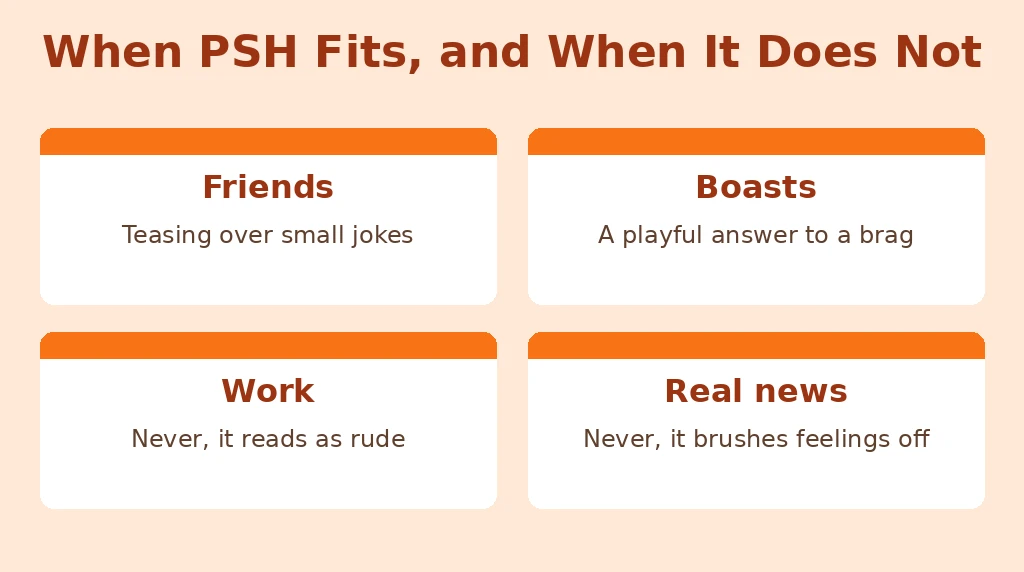
The tone is where PSH gets tricky, because the same three letters can be playful or cutting. Between close friends over a small joke, “psh” lands as teasing, the kind of scoff that comes with a grin. Aimed at a real effort, a real question or a real feeling, the same “psh” lands as a brush off, and it can sting. The chat around it decides which one you are hearing.
Lowercase “psh” reads softer and blends into a sentence, while uppercase “PSH” stands out and can look louder and sharper. The sound stays the same either way. What changes the sting is the topic, the person sending it, and whether you two joke like this all the time.
Full Form of PSH
PSH has no full form. That is the honest answer, and it matters, because many texting shortcuts do stand for words. PSH does not. It is not an acronym, it does not hide three words behind three letters, and there is nothing to expand. It is a sound written down, the same way “hmm” is a sound written down and “ugh” is a sound written down.
That is why you will never find a tidy letter breakdown for PSH. There is no P word, no S word and no H word hiding inside it. The letters only spell the noise: the P starts the puff of air, the SH carries it out. If someone offers you a full form for PSH, they are guessing, and the guess is wrong.
The nearest real word is “pshaw”, an older spelling of the same scoff, found in books and old plays. Wiktionary lists “psh” as a synonym of “pshaw”, a dismissive interjection, with cited usage to back it. So PSH is best thought of as the short modern spelling of pshaw, not as an acronym with a full form to learn.
PSH vs Pshaw vs Meh: What Is the Difference?
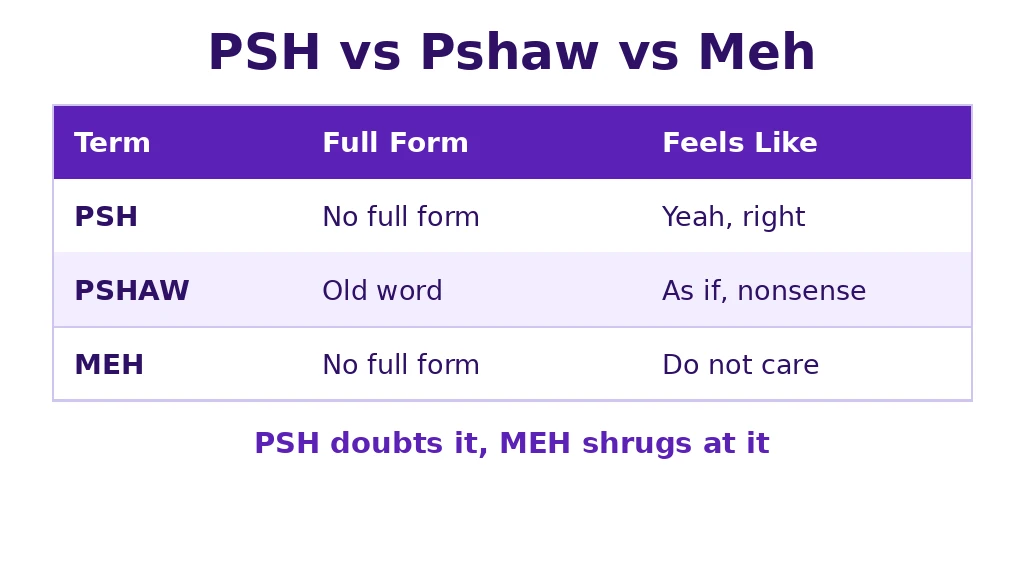
PSH belongs to a small family of short dismissive sounds, and the family members look alike at a glance. Here they are side by side.
| Word | Full Form | What It Really Says | Tone |
|---|---|---|---|
| PSH | None, it is a sound | Yeah, right, as if | Dismissive, sharp |
| PSHAW | None, it is a word | As if, nonsense | Old fashioned, scornful |
| MEH | None, it is a sound | I do not care much | Bored, flat |
The classic mix up is PSH versus MEH, because both are short sounds that shrug something off. The gap is simple, though. PSH doubts the thing, it says “I do not believe you” or “that is nothing.” MEH only shrugs at it, it says “I do not care much either way.” A “psh” argues back, while a “meh” walks away from the argument.
PSHAW sits close to PSH too, because the two are the same sound in two spellings. The difference is age and flavour. Pshaw belongs in books and old dialogue, and it sounds grand and theatrical. PSH belongs in chats, and it sounds quick and modern. In a text, PSH is the one people actually type.
Where PSH Is Commonly Used
Texting and WhatsApp
In one to one chats, PSH shows up as a quick reaction to a boast, a joke or a claim. A typical line looks like this: “Psh, I could do that with one hand tied behind my back.” Short, sharp, and the chat keeps moving.
Instagram and Snapchat
On Instagram and Snapchat, PSH shows up in comments under posts that invite a reaction. A photo captioned “best cake ever” might earn a “psh, mine was better” from a friend, and the joke beside it usually makes the tone obvious.
TikTok Comments
On TikTok, PSH appears under videos where someone shows off a skill or a win. A viewer writes “psh, I did that when I was ten” and the clip itself, a trick or a talent, does the explaining.
Group Chats
Group chats use PSH when friends tease each other over small things. One person brags about a game score, another answers “psh”, and the teasing rolls on before anyone has time to write more. When the exact plan is still undecided, someone drops in tbd, which means “to be determined” and keeps the plan moving.
Gaming Chats
Gaming chats use PSH to shrug off a loss or mock a rival play. A line like “psh, that was pure luck” means the player refuses to give credit, and everyone in the game reads it without a second thought.
Discord and Forums
On Discord and in forums, PSH shows up in fast threads where people argue about small things. A member writes “psh, everyone knows that” and the regulars know at once that the writer thinks the point is obvious and not worth debating.
Origin and History of PSH
The scoff behind PSH is old, far older than texting. People have made that puff of air for centuries when they doubted something or thought it was beneath them. Writers spelled it as “pshaw” in books and plays, where a character could dismiss a grand claim with a single scornful word.
Texting gave the old sound a shorter spelling. As people typed fast on small keypads, “pshaw” lost its vowels and its tail and became “psh”, three letters that still carry the same puff of air. The habit spread through SMS and chat apps, where a quick reaction mattered more than a proper word.
That is why PSH feels both old and new at once. The sound has been around for a very long time, but the spelling is a child of the phone age.
Other Meanings and Variations of PSH
In everyday talk, PSH almost always means the dismissive scoff, but the same letters carry a few other readings worth knowing.
- “Pshh” with extra letters: stretching the sound to “pshh” or “psshh” makes the scoff longer and heavier, as if the person is really dragging out their disbelief. More letters mean a bigger eye roll.
- “Psh, please” as a pair: adding “please” after the scoff turns it into a fuller brush off, as in “psh, please, you wish.” The pair reads sharper than a bare “psh” on its own.
- Lowercase psh vs uppercase PSH: the small letters feel softer and more casual in a sentence, while the capitals stand out and can look louder and sharper. The sound stays the same either way.
- PSH as a joke marker: between close friends, a lone “psh” can mark a whole message as teasing, the way a laugh marks a joke. The friendship around it decides whether it lands as fun or as a slap.
- PSH in usernames: some handles use PSH as part of a name, usually as a joke about being unimpressed. In that spot it is a label, not a sound in a sentence.
How to Use PSH Correctly
- Save it for friends who tease back. PSH works best with people who know your humour and trade the same kind of jokes. With strangers, it reads as plain rude.
- Keep it on small things. Use it for boasts, jokes and light claims, never for real news, real feelings or a real question that needs an answer.
- Add words when the tone could blur. A bare “psh” can sting, so a quick extra word nearby, like “psh, nice try” or “psh, you wish”, shows the joke and softens the edge.
- Match the case to the chat. Lowercase “psh” fits a relaxed chat, while uppercase “PSH” fits a loud burst or a joke. Either way, keep the rest of the message light so it does not read as anger.
- Do not force it outside its natural home. PSH works best when the conversation already makes the joke obvious. Dropping it into a serious sentence just creates hurt.
Example Conversations Using PSH
A playful boast
Person A: “I scored the highest in the whole class”
Person B: “Psh, I could do that in my sleep”
A cooking claim
Person A: “My cake turned out perfect”
Person B: “Psh, mine was better last week”
A gaming tease
Person A: “I beat the final boss on my first try”
Person B: “Psh, that was pure luck and you know it”
A joke between friends
Person A: “I am basically a genius now”
Person B: “Psh, please, you wish”
A small dare
Person A: “Bet you cannot finish that in one go”
Person B: “Psh, watch me”
A photo comment
Person A: “Best sunset photo ever, no contest”
Person B: “Psh, mine from last summer wins easy”
A shrugged off worry
Person A: “What if it rains on the trip?”
Person B: “Psh, a little rain never hurt anyone”
The unsure one
Person A: “Psh”
Person B: “Wait, are you joking or are you actually annoyed?”
When Not to Use PSH
- In a work email: using PSH instead of a plain sentence reads as openly rude to a boss or a client.
- In formal writing: reports, applications and official documents should never carry a written scoff.
- When someone shares real news: answering a win, a loss or a worry with “psh” tells them their news means nothing to you.
- With strangers: a stranger has no way to know you are joking, so the scoff lands as a straight insult.
- In serious conversations: when someone shares bad news or asks for real support, a scoff can feel like you are laughing at them.
- When you are actually angry: if you mean the scorn for real, typing “psh” starts a fight without saying what is wrong, so say the real thing instead.
How to Respond When Someone Sends You PSH
A PSH lands in your chat and the ball is suddenly in your court. Check the tone first, then pick the lane that matches.
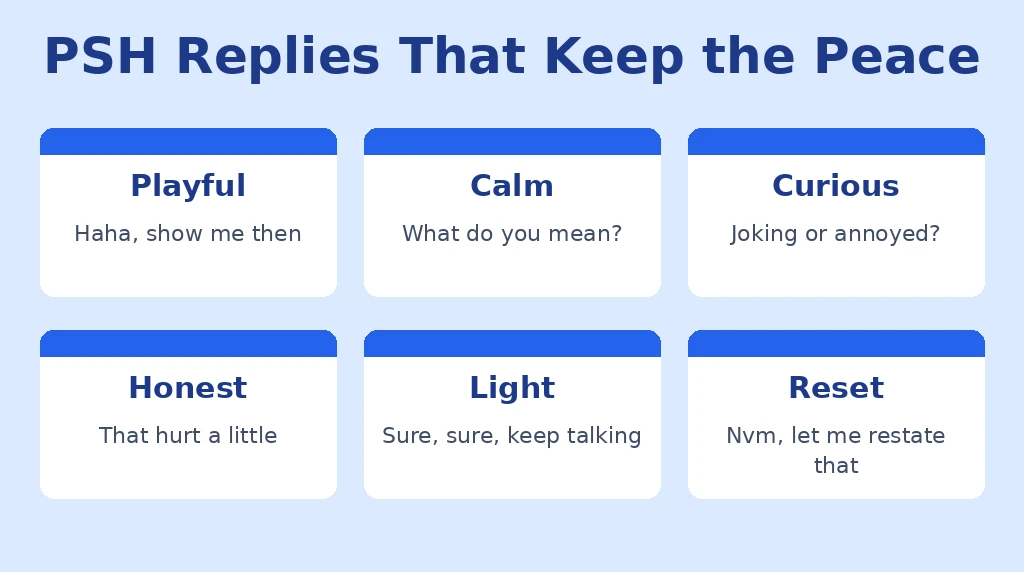
Playful replies suit close friends and light topics:
- “Haha, okay, show me then”
- “Keep talking, I love this confidence”
- “Sure, sure, and I am the queen of England”
Calm replies work when the scoff brushes off something that matters:
- “What do you mean by that?”
- “That actually mattered to me, just so you know.”
Curious replies fit a PSH that leaves you guessing:
- “Are you joking or are you annoyed?”
- “Wait, do you not believe me or are you teasing?”
One thing to avoid: do not answer a scoff with a bigger scoff and then let the chat turn into a fight. If you typed the wrong meaning, send a quick nvm and restate what you meant before anyone gets hurt. And if a friend answers your good news with a bare “psh” and it stings, a light smh before you change the subject says plenty on its own.
Common Mistakes People Make With PSH
- Treating it as an acronym. PSH has no full form. Hunting for three words behind it only leads to made up answers.
- Using it on serious news. A scoff aimed at real feelings reads as cold, even when the sender meant it as a joke.
- Using it with strangers. Strangers cannot hear your grin through the screen, so the joke lands as an insult.
- Answering a scoff with a fight. Trading scorn for scorn turns a small tease into a real argument in seconds.
- Reading it as rude every time. Between close friends, PSH is often just teasing. Check the friendship and the topic before you take offence.
Frequently Asked Questions
What does PSH mean in text?
PSH is not a word with a meaning you can look up in a list. It is a written down scoff, a short puff of air that says “yeah, right” or “whatever.” It shows disbelief, doubt or mild scorn, the same way a spoken scoff does.
Is PSH rude?
It can be. A bare “psh” brushes the other person off, so it reads as rude when the topic is serious or when it answers a real question. Between close friends over a small joke, the same “psh” reads as playful teasing.
What is the difference between PSH and PSHAW?
They are the same sound in two spellings. Pshaw is the older, fuller spelling found in books, while PSH is the short chat spelling. Both mean the same dismissive “as if,” but pshaw sounds old fashioned and PSH sounds like a text.
Does PSH have a full form?
No. PSH has no full form, because it is not an acronym and it does not stand for any words. It is a sound written out in letters, the way “hmm” or “ugh” are sounds written out in letters.
Can I use PSH in a work email?
No, never. A written scoff in a work email reads as openly rude, even if you meant it as a joke. In work messages, write a plain sentence instead, for example “I am not sure that will work, here is why.”
How do I reply when someone sends me PSH?
Stay calm and check the tone. If it is a joke between friends, laugh it off or tease back. If it brushes off something that matters to you, ask plainly, “what do you mean by that?” A short question beats a heated reply.
Final Thoughts
PSH is a small sound with a sharp edge. It is not an acronym, it has no full form, and it is simply the scoff people make when they doubt something, written out in three letters. Between close friends over a small joke it lands as teasing, but aimed at real news or real feelings it lands as a brush off. The letters never change, but the chat around them changes everything about how they feel.
If you want a second opinion from a dictionary source, Wiktionary lists PSH as a synonym of pshaw, a dismissive interjection. Either way, you now have the psh meaning in text down, plus a decent reply ready for the next time it shows up in your messages.
