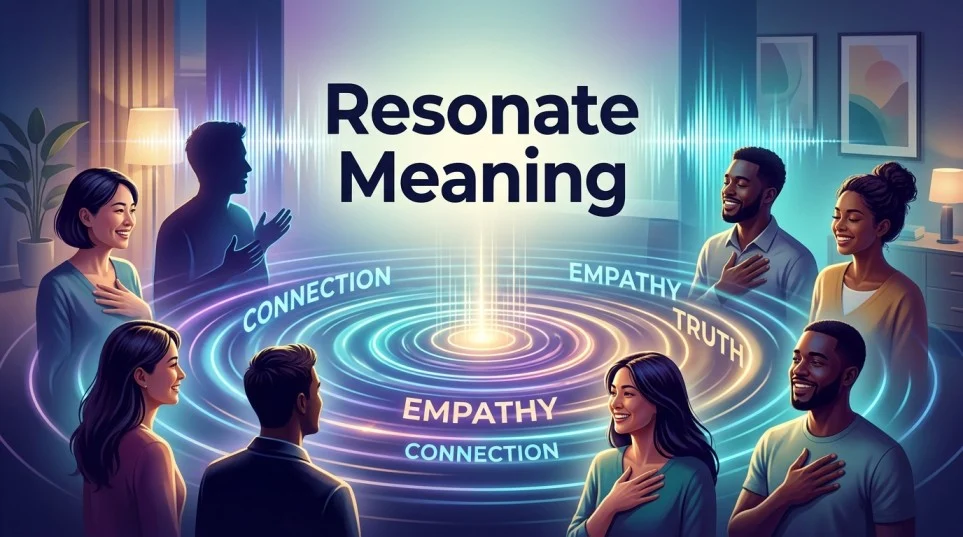
The resonate meaning is to create a strong feeling, connection, or response in someone. When an idea, story, message, song, or experience resonates with you, it feels personally meaningful or familiar. For example, if someone says, “Her story really resonated with me,” they mean the story connected deeply with their own feelings or experiences.
The word can also have a literal meaning related to sound. Something can resonate when it produces or continues to produce a deep, clear sound or vibration. In modern everyday English, however, resonate is often used in a figurative sense to describe an emotional or intellectual connection.
Resonate Meaning in Simple English
Resonate means to connect strongly with someone or create a powerful response in them.
Here are a few simple examples:
- “His advice resonated with me.”
This means his advice felt personally meaningful. - “The film resonated with young adults.”
This means many young adults connected with its message or themes. - “That song really resonates with me.”
This means the song brings out feelings, memories, or thoughts that feel personally relevant. - “Her message resonated with the audience.”
This means the audience understood, appreciated, or strongly connected with her message.
The key idea is connection. Something resonates when it reaches beyond simple understanding and feels relevant, familiar, powerful, or emotionally significant.
What Does Resonate Mean?
Resonate is a verb. It can describe both sound and a strong personal response.
1. Resonate as a Sound
In its original and literal sense, resonate relates to sound that is deep, strong, or prolonged.
For example:
“The singer’s voice resonated throughout the hall.”
Here, the voice carried strongly through the space.
Another example:
“The drums resonated through the building.”
The sound produced a noticeable vibration or echo.
2. Resonate as an Emotional Connection
The figurative meaning is now extremely common.
When something resonates with someone, it connects with their emotions, beliefs, memories, experiences, or way of thinking.
For example:
“The book resonated with me because I had experienced something similar.”
The book did more than seem interesting. Its ideas felt personally relevant.
This is why resonate is often stronger than simply saying like or understand.
Resonate With Meaning
The phrase “resonate with” means to create a strong emotional, personal, or intellectual connection with someone.
The usual structure is:
something + resonates with + person/group
Examples:
- “The message resonated with me.”
- “The campaign resonated with younger voters.”
- “Her story resonated with thousands of readers.”
- “The idea resonated with the team.”
- “That character resonated with audiences.”
The phrase does not always describe an emotional reaction. It can also describe an idea that matches someone’s beliefs, experiences, interests, or way of thinking.
Resonate With Me Meaning
“Resonate with me” means something feels especially meaningful, familiar, or relevant to you.
For example:
“The author’s comments about failure really resonated with me.”
This suggests the comments connected with something in the speaker’s own experience or perspective.
A simpler version would be:
“I really connected with what the author said.”
Resonate With Someone Meaning
“Resonate with someone” means to affect that person strongly because the subject feels relevant or meaningful to them.
For example:
“The teacher’s advice resonated with her.”
The advice probably matched something she was experiencing or thinking about.
Why Does Something Resonate With You?
Something may resonate with you because it reflects an experience, emotion, belief, memory, or problem that already matters to you.
For example, imagine someone who recently changed careers reading this sentence:
“Starting over can feel frightening, but it can also open a better path.”
That statement may resonate with them because it reflects their current situation.
People often describe these moments by saying:
- “That really resonated with me.”
- “I could relate to that.”
- “That struck a chord with me.”
- “That message hit home.”
- “I felt connected to that idea.”
This explains an important difference between understanding something and resonating with it.
You can understand an idea without feeling personally connected to it.
Resonate vs. Relate
Resonate and relate are closely connected, but they are not identical.
| Word | Main Idea | Example |
|---|---|---|
| Resonate | Create a strong personal or emotional response | “Her story resonated with me.” |
| Relate | See a connection between yourself and something | “I can relate to her story.” |
| Connect | Establish a meaningful link | “I connected with the message.” |
| Appeal | Be attractive or interesting to someone | “The idea appealed to me.” |
| Affect | Produce an emotional or mental effect | “The speech affected me.” |
If you relate to something, you can see yourself or your experience in it.
If something resonates with you, it often creates a deeper sense of personal significance.
For example:
“I can relate to his experience.”
This simply tells us that the experience is familiar.
“His experience really resonated with me.”
This suggests a stronger emotional or personal impact.
Resonate vs. Connect
The words resonate and connect are also similar.
Connect is broader. You can connect with a person, idea, audience, story, or piece of content.
Resonate usually emphasizes the response something creates inside a person or group.
Compare these:
“The speaker connected with the audience.”
This means the speaker successfully engaged the audience.
“The speaker’s message resonated with the audience.”
This suggests the message felt meaningful or relevant to them.
In professional writing, resonate can be useful when you want to describe meaningful impact rather than simple interaction.
Resonate in a Sentence
Here are practical examples from different situations.
Everyday Conversation
- “That advice really resonated with me.”
- “Her story resonated with everyone in the room.”
- “The idea didn’t resonate with me at first.”
- “His words still resonate with me today.”
Work and Business
- “The new campaign resonated with customers.”
- “The company’s message resonates with its target audience.”
- “That approach may resonate better with younger employees.”
- “The presentation resonated because it addressed a real workplace problem.”
Writing and Communication
- “The article resonated with readers.”
- “The writer used a personal story that resonated with the audience.”
- “Simple language can make an important message resonate more strongly.”
Music and Entertainment
- “The song resonated with listeners around the world.”
- “The film’s central theme resonated with audiences.”
- “The character resonated with viewers because the struggle felt realistic.”
Personal Experiences
- “Her story resonated with me because I went through something similar.”
- “That quote has always resonated with me.”
- “The book’s message resonated deeply with him.”
Resonate Meaning in Communication
In communication, resonate describes a message that feels relevant and meaningful to the people receiving it.
A message may resonate because it:
- addresses a real problem
- reflects a shared experience
- uses familiar language
- expresses an emotion people recognize
- supports an existing belief
- tells a relatable story
- gives people a new way to understand something
For example, a company could say:
“We understand how difficult it can be to start a small business.”
That statement may resonate with entrepreneurs because it speaks directly to a challenge they know.
The strength of the connection depends on the audience. A message that resonates strongly with one group may have little effect on another.
Resonate Meaning in Relationships
In relationships, resonate can describe an emotional connection between people.
For example:
“His way of thinking really resonates with me.”
This can mean that his values, perspective, or personality feels compatible with the speaker.
Another example:
“Their experiences resonated with each other.”
This suggests that shared experiences created a meaningful connection.
The word can sound more thoughtful than simply saying two people “get along,” because it focuses on shared feelings, ideas, or experiences.
Resonate Deeply Meaning
“Resonate deeply” means something creates a particularly strong emotional or personal response.
Example:
“Her words resonated deeply with me.”
This tells the reader that the words had a lasting or powerful effect.
Another example:
“The film’s message resonated deeply with people who had experienced loss.”
Here, the film’s subject connects strongly with a specific emotional experience.
The phrase is common in personal writing, reviews, speeches, interviews, and discussions about art or culture.
Can Resonate Be Negative?
Yes. Resonate does not automatically mean that someone likes something.
It can describe a strong response that is uncomfortable, painful, challenging, or difficult.
For example:
“The character’s loneliness resonated with me.”
The speaker may not enjoy loneliness. The character’s experience simply feels familiar or personally significant.
Likewise:
“The criticism resonated with him because he knew there was some truth in it.”
The reaction can be uncomfortable while still being meaningful.
So, resonate is better understood as creating a meaningful response, not simply creating a positive response.
Common Synonyms for Resonate
The best synonym depends on the context.
| Synonym | Best Used When |
|---|---|
| Connect | Something creates a personal link |
| Relate | Something feels familiar |
| Appeal | Something attracts or interests someone |
| Strike a chord | Something creates a strong emotional reaction |
| Touch | Something affects someone’s emotions |
| Move | Something creates a powerful emotional response |
| Echo | An idea or feeling continues or appears again |
| Reverberate | An effect continues or spreads |
| Affect | Something produces an emotional or mental effect |
For example, “The story resonated with me” could become “The story touched me”, but the meaning changes slightly. Touch emphasizes emotion, while resonate can include emotion, personal experience, values, and ideas.
Words Similar to Resonate
Several words are related to resonate, but they are not perfect replacements in every sentence.
Connect: focuses on forming a relationship or link.
Relate: focuses on recognizing similarities or shared experiences.
Appeal: focuses on attraction or interest.
Echo: suggests that an idea, feeling, or quality continues or repeats.
Reverberate: often describes an effect that spreads or continues over time.
Strike a chord: an idiomatic expression for creating a strong emotional response.
Choosing the right word depends on what you want the reader to notice.
How to Use Resonate Correctly
A simple pattern makes the word easy to use:
Subject + resonate/resonates + with + person or group
Examples:
- “The story resonates with readers.”
- “The message resonates with me.”
- “Her ideas resonated with the team.”
- “The campaign resonated with customers.”
For plural subjects, use resonate:
“The ideas resonate with students.”
For a singular subject, use resonates:
“The idea resonates with students.”
For past tense, use resonated:
“The idea resonated with students.”
For ongoing action, use resonating:
“The message is resonating with audiences.”
Common Mistakes With Resonate
Mistake 1: Treating Resonate as Exactly the Same as Like
Saying something resonates with you usually suggests more than simple enjoyment.
“I like this quote.”
means you enjoy or approve of it.
“This quote resonates with me.”
suggests that it feels personally meaningful.
Mistake 2: Forgetting “With”
When talking about personal or audience response, resonate commonly appears with with.
Less natural:
“The message resonated me.”
Natural:
“The message resonated with me.”
Mistake 3: Using It for Every Type of Agreement
Someone can agree with an idea without saying it resonates with them.
Agree focuses on accepting an idea as true or reasonable.
Resonate focuses on the personal significance or response created by the idea.
Mistake 4: Assuming Resonate Always Means Emotional
The response can be intellectual or practical too.
“The proposal resonated with the board because it offered a practical solution.”
The board may not have experienced a strong emotional reaction. The proposal simply connected with their priorities.
Resonate in Professional Writing
The word is common in marketing, presentations, leadership, journalism, education, and creative writing.
For example:
“The message needs to resonate with customers.”
This means the message should feel relevant and meaningful to the intended audience.
However, using resonate repeatedly can make professional writing vague. If you know the specific response, say it directly.
Instead of:
“The report resonated with employees.”
You could write:
“Employees responded positively because the report addressed concerns about workload.”
The second sentence gives the reader actual information.
That is an important writing principle: use resonate when the meaningful connection matters, but explain the reason when the detail matters more.
What Does Resonate Mean?
Resonate means to create a strong personal, emotional, intellectual, or meaningful response. When something resonates with you, it feels relevant to your experiences, feelings, beliefs, or interests. For example, “Her story resonated with me” means her story connected with me in a meaningful way.
Frequently Asked Questions
What does resonate mean in simple words?
Resonate means to connect strongly with someone or create a meaningful response. If something resonates with you, it feels personally relevant or familiar.
What does “resonate with me” mean?
“Resonate with me” means something feels especially meaningful or relevant to you. It may connect with your experiences, emotions, beliefs, or interests.
Is resonate a positive word?
Usually, resonate is neutral to positive, but it does not necessarily mean that someone likes something. A sad, painful, or uncomfortable experience can also resonate with someone.
What is another word for resonate?
Depending on the context, alternatives include connect, relate, appeal, touch, move, echo, affect, and strike a chord.
What does “resonate with someone” mean?
It means that an idea, message, story, experience, or other thing creates a meaningful connection with that person.
What is the difference between resonate and relate?
Relate often means recognizing a similarity with something or someone. Resonate suggests a stronger sense of personal significance or impact.
Can a person resonate with another person?
Yes. In informal and modern English, people can say that someone’s personality, ideas, experiences, or values resonate with them.
For example:
“I really resonate with the way she thinks.”
What does resonate mean in communication?
In communication, resonate means that a message feels relevant and meaningful to its audience. A message may resonate because it reflects their experiences, needs, values, or concerns.
What is the past tense of resonate?
The past tense is resonated.
Example:
“Her message resonated with the audience.”
What is the difference between resonate and appeal?
Appeal usually means something is attractive or interesting to someone. Resonate suggests a deeper connection with the person’s thoughts, feelings, experiences, or values.
Final Takeaway
The simplest way to understand resonate meaning is to think of meaningful connection.
When something resonates with you, it does not merely catch your attention. It reaches something that already matters to you. That could be an emotion, memory, belief, experience, interest, or personal value.
In everyday English, the most useful structure is “resonate with.” You can use it for people, ideas, stories, messages, music, films, campaigns, experiences, and much more.
Read More Related Articles:
- Fidelity Meaning | Definition, Examples, Context & The Deeper …
- Inshallah Meaning | Definition, Origin, Usage & the Deeper …
- ENO Meaning in Text | Definition, Uses, Context & What It …