You are scrolling through Instagram when a post about someone’s tough week starts with two bold letters: TW. Or a close friend drops a quiet “tw” in the group chat before sharing something heavy, and the whole chat slows down for a second while everyone waits to see what comes next.
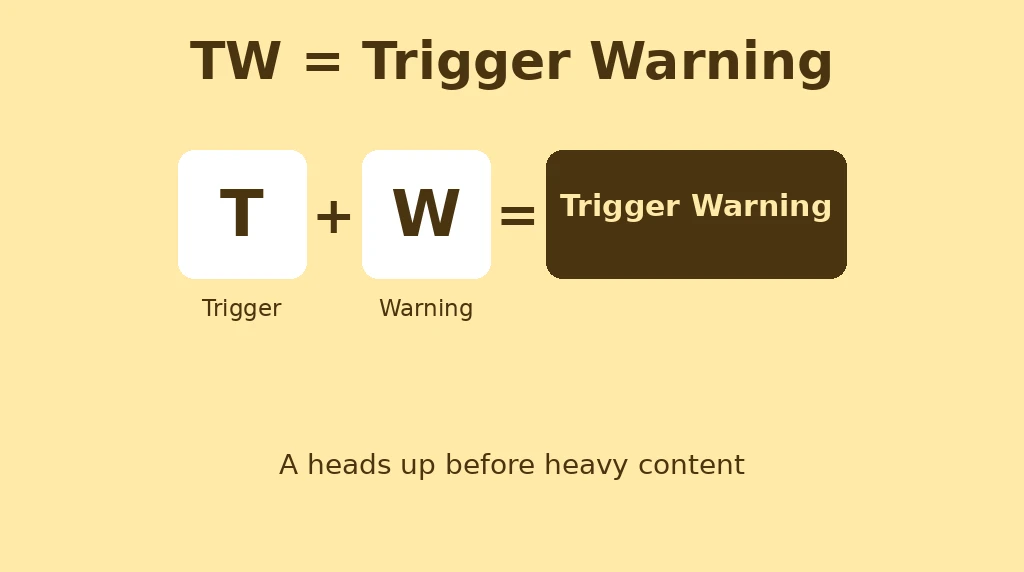
Here is the quick answer. TW means “trigger warning” in texting and on social media, a short heads up before content that might upset some readers, so the tw meaning in text is really about care and choice. This guide covers what a trigger warning does, TW vs CW and NSFW, where it shows up, the rare “tomorrow” sense, and how to reply when one lands in your chat.
What Does TW Mean in Text?
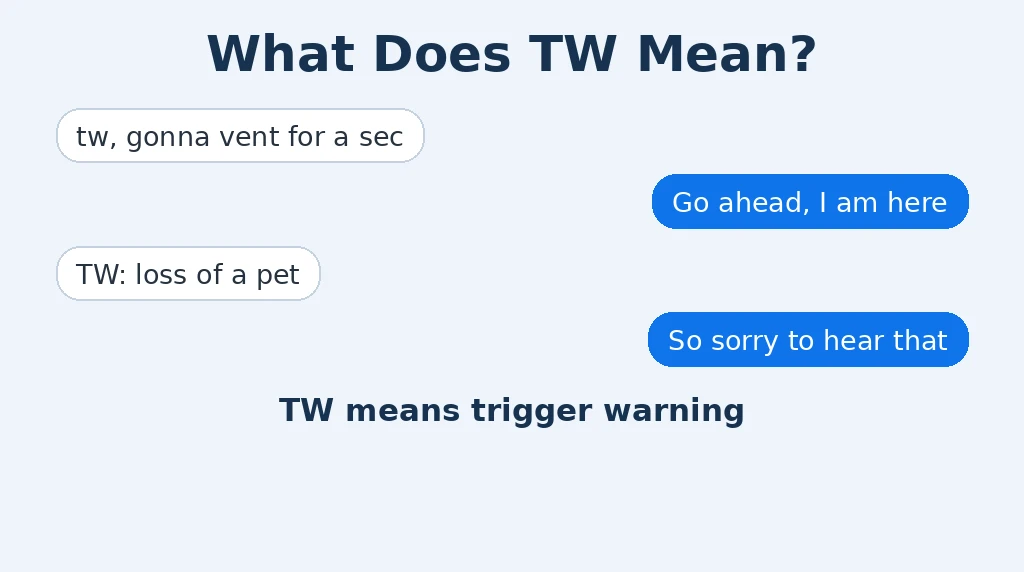
TW stands for “trigger warning,” a short notice placed before content that could stir up a painful memory or a strong emotional reaction. Think of it as a small flag at the start of a post, a video or a message that says, “what follows might be heavy, so read on only if you are up for it.” The warning itself is the point, not the content after it.
The tone is caring and respectful, never dramatic. A TW says the sender thought about the reader before posting, and that thoughtfulness is why the abbreviation is so widely trusted. Lowercase “tw” feels softer and more casual in a private chat, while uppercase “TW” stands out in a caption or a video overlay, where it needs to catch the eye before anyone reads further.
What counts as a trigger is personal, so the warning often names the topic in a few words, like “TW: loss of a pet” or “TW: talks about anxiety.” That short label lets each reader decide for themselves.
Full Form of TW
TW is a true acronym, built from two words that each do a clear job:
- T: “Trigger,” something that can bring back a painful memory or set off a strong emotional reaction, often tied to a past experience
- W: “Warning,” a notice given ahead of time, so the reader can prepare or step away
Put together, a trigger warning is a notice placed before content that might trigger an emotional response. Say it out loud and the pattern is simple. People say the letters one at a time, tee double you.
The phrase itself comes from psychology and trauma care, where a “trigger” is a sight, a sound or a topic that can pull a difficult memory back to the surface. The warning is the kind part, the bit that hands the choice back to the reader.
TW vs CW vs NSFW: What Is the Difference?

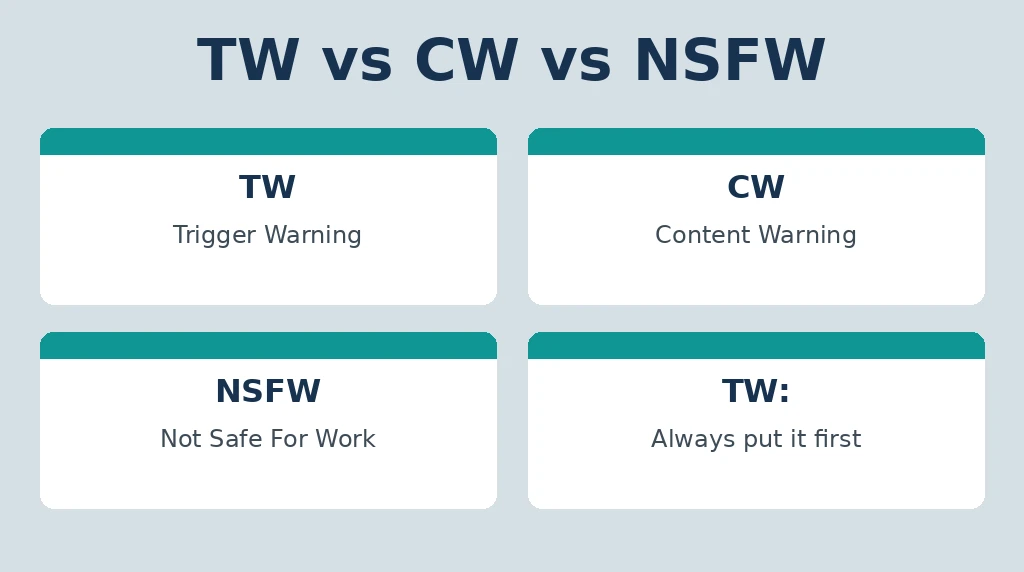
TW belongs to a small family of warning labels, and the family members look alike at a glance. Here they are side by side.
| Abbreviation | Full Form | What It Really Says | Tone |
|---|---|---|---|
| TW | Trigger Warning | This may stir up a painful memory | Caring, careful |
| CW | Content Warning | This covers sensitive material in general | Neutral, broad |
| NSFW | Not Safe For Work | This is not fit for a public screen | Blunt, practical |
The classic mix up is TW versus CW, because both flag sensitive content and many people use them as if they were the same. The gap is real, though. TW points at a specific kind of harm, a trigger tied to trauma or a painful memory, while CW is a wider net that covers anything sensitive, from spoilers to graphic scenes.
NSFW is different again, because it is about the setting, not the feeling. It warns that the content is explicit or graphic and should not be opened at work or in public. A post can carry both labels at once.
Where TW Is Commonly Used
Texting and WhatsApp
In one to one chats, a friend types “tw” before sharing something heavy, giving the other person a small warning before the story gets tough. A typical line looks like this: “tw, kinda heavy, but my dad is in the hospital again and I just needed to tell someone.”
Instagram and Snapchat
On Instagram and Snapchat, TW sits at the start of captions, stories and reels about grief, illness, body image or personal struggles. A story captioned “TW: mentions of illness” is talking about a health update, and the warning lets viewers decide whether to keep watching.
TikTok Comments
On TikTok, creators put a TW text overlay at the start of a video when the topic turns heavy, and viewers use it in comments too. A comment like “tw: emotional scene” under a clip about loss tells the next viewer what to expect before they press play.
Group Chats
Group chats are where a quiet “tw” does some of its best work. One person types “tw, gonna vent for a sec about my breakup” and the whole group knows to slow down and listen with care.
Gaming Chats
In game chat and Discord servers, TW shows up when a player or a streamer pauses the game talk to share something personal. A streamer might flash a quick TW on screen before telling a serious story, so viewers can choose to stay or step away.
Discord and Forums
Discord servers and forums, especially support spaces, treat TW as basic etiquette. A post in a mental health or grief community almost always opens with one, because the whole point of the space is that people can engage on their own terms.
Origin and History of TW
The idea of a trigger warning did not start on social media. It has roots in academic, therapeutic and activist spaces, where the term was used to help people dealing with trauma avoid unexpected exposure to distressing material. In a classroom or a therapy setting, a warning before a tough topic was a practical kindness, not a trend.
As online forums and blogging communities grew in the early 2000s and 2010s, especially spaces focused on mental health and feminism, the practice of adding trigger warnings before sensitive posts became more common. Communities wanted safer spaces where people could engage with content on their own terms, and a short label at the top of a post was the simplest way to do it.
Social media then carried the habit into everyday internet culture. Tumblr, with its strong culture of content warnings, helped the abbreviation “TW” catch on fast, and it later spread to Instagram, Twitter, TikTok and beyond.
Other Meanings and Variations of TW
In everyday talk, TW almost always means “trigger warning,” but the same letters carry a few more readings worth knowing.
- Tomorrow: in very fast texting, some people shorten “tomorrow” to “tw,” though this is far less common than “trigger warning.” It only fits when the chat is clearly about plans, like “see you tw.”
- Team Wipe: in some team based games, TW can mean “team wipe,” the moment a whole team is eliminated at once. It only fits inside a match, never in a caption about a heavy topic.
- TrackWrestling: in wrestling communities, TW can mean TrackWrestling, a platform for match tracking and statistics.
- Twitter, the old shorthand: in older internet slang, “tw” was sometimes used loosely to mean Twitter, though that use has faded as the platform changed its name to X.
- TW with a topic label: the most useful variation is not a new meaning at all, just a clearer warning, like “TW: grief” or “TW: medical stuff.” The label after the colon tells the reader exactly what to expect.
- Lowercase tw vs uppercase TW: the small letters feel softer and more casual in a private chat, while the capitals stand out in a caption or a video overlay. The meaning stays the same either way.
How to Use TW Correctly
- Put it first, never last. A warning only works before the content it warns about. “TW: loss of a pet” at the top of a post gives the reader a choice, while the same label buried at the end gives them nothing.
- Name the topic in a few words. A bare “TW” tells the reader to be careful, but “TW: grief” or “TW: medical stuff” tells them what to be careful about. That small detail is what makes the warning useful.
- Keep the tone sincere. TW is meant as a genuine kindness, not a dramatic hook. Using it sincerely keeps its meaning intact, while using it as a joke wears it out for the people who really need it.
- Do not overuse it for mild topics. If every small complaint carries a TW, the label starts to feel like background noise. Save it for topics that could genuinely upset someone.
- Respect the skip. If someone steps away after your TW, that is the warning working as intended. Never press them to read on.
Example Conversations Using TW
An Instagram caption
Person A: “TW: family loss. Lost my grandma last week and I am still processing everything. Sharing this because writing helps me heal.”
Person B: “So sorry to hear that, here for you”
A TikTok video overlay
Person A: “TW: discusses anxiety. Skip if you are not in the headspace for this today.”
Person B: “Thank you for the warning, watching later”
A group chat
Person A: “tw, gonna vent for a sec about my breakup”
Person B: “Go ahead, I am here for you”
A Reddit post title
Person A: “TW: eating disorder mention, looking for advice on supporting a friend”
Person B: “Thank you for flagging it, here is what helped me”
A Twitter post
Person A: “tw // medical stuff. Just had a rough hospital visit.”
Person B: “Hope you are okay, take your time”
A Discord message
Person A: “hey tw, I want to talk about something that happened growing up, feel free to skip this if you are not up for it”
Person B: “idk what to say, but I am listening”
A YouTube video description
Person A: “TW: this video briefly discusses loss. Viewer discretion advised.”
Person B: “Thanks for the heads up, appreciated”
A WhatsApp message to a friend
Person A: “tw, kinda heavy, but my dad is in the hospital again and I just needed to tell someone”
Person B: “I am so sorry, call me anytime”
When Not to Use TW
- In a work email: even about a sensitive topic like medical leave, write in a clear, professional tone instead of using internet shorthand.
- In formal writing: academic papers, reports and official documents should use the full phrase “trigger warning” if one is truly needed, not the abbreviation.
- In job interviews or workplace messages: even in a casual work chat, TW can come across as unprofessional.
- In customer service chats: businesses stick to clear, plain language, and a TW would only confuse the person on the other end.
- As a joke or a dramatic hook: using TW to tease a mild story wears the label out for people who really need it.
- For very mild topics: a small complaint does not need a trigger warning, and adding one makes the real warnings easier to ignore.
How to Respond When Someone Sends You TW
A TW lands in your chat and the first job is yours, not theirs. Read the warning, check in with yourself, and decide whether you are in the right headspace for the topic.
Supportive replies work when you read on and want the person to feel heard:
- “Thank you for the warning, I am here for you.”
- “Take your time, there is no rush at all.”
- “I am really sorry you are going through this.”
Respectful replies suit the moment you decide to step away:
- “Thanks for flagging it, I am going to sit this one out today.”
- “I appreciate the heads up, I will check in with you later.”
Gentle check ins fit a friend you care about:
- “ik this is heavy, no pressure to talk more than you want to”
- “Here if you need anything, even just a distraction”
- “Want to talk, or want me to just sit with you for a bit?”
One thing to avoid: do not ask for details the person has not offered, and do not say “just get over it” or anything close to it. If you replied too fast, a quick nvm and a softer second message can still set things right.
Common Mistakes People Make With TW
- Putting the warning after the content. A TW at the end of a post warns nobody, because the reader has already seen the heavy part. It always goes first.
- Using a bare TW with no topic. “TW” on its own tells the reader to be careful, but not about what. A few words after the colon fix it.
- Treating TW and CW as the same thing. They overlap, but TW points at trauma linked triggers while CW covers sensitive material in general. Pick the label that fits the post.
- Reading “tw” as “tomorrow” before a heavy topic. When the letters sit in front of grief, illness or loss, “trigger warning” is the right reading, and “tomorrow” makes no sense there.
- Pressing someone who skipped. If a reader steps away after a TW, that is the warning working. Never guilt them into reading on.
Frequently Asked Questions
What does TW mean in text?
TW means “trigger warning” in texting and on social media. It is a short heads up placed before content that might upset some readers, so people can choose whether to read on or skip past it.
Is TW the same as CW?
They are close but not the same. TW, short for “trigger warning,” points at content that could stir up a painful memory or a strong emotional reaction. CW, short for “content warning,” is broader and covers any sensitive material, including spoilers and graphic scenes.
What does TW mean on Instagram?
On Instagram, TW means “trigger warning” and usually appears at the start of a caption, a story or a reel about a heavy topic such as grief, illness or a tough personal story. It gives viewers a chance to decide whether to keep watching.
Does TW mean tomorrow?
It can, but only rarely. Some people shorten “tomorrow” to “tw” in very fast texting, yet that use is far less common than “trigger warning.” If the message sits before a heavy topic, “trigger warning” is the right reading.
Is it rude to skip content after a TW?
No, skipping is exactly what the warning is for. A TW gives you the choice to step away, and nobody expects you to read something heavy just to be polite.
How do I reply when someone sends me TW?
First, read the warning and decide whether you are in the right headspace for the topic. If you read on, reply with care and patience. If you skip it, you can still check in later with a simple, kind message.
Final Thoughts
TW is a small abbreviation with a big job. It takes two letters, places them at the top of a heavy post, and hands the choice back to the reader: read on, or step away, with no pressure either way. Used plainly, with the topic named in a few words, it makes the internet a kinder place to scroll.
If you want a second opinion from a dictionary source, Dictionary.com lists an entry for TW. Either way, you now have the tw meaning in text down, plus a kind reply ready for the next time it shows up in your messages.
